Social Media Addiction: 12 Signs and How to Break the Loop
Social media addiction explained: 12 signs of problematic use, why the feed is so sticky, where the habit loop breaks, and 6 steps to get your attention back.
 Andrea Marino10 min read
“Social media addiction” is the phrase people type when the feed has started to run their day. It is not a formal diagnosis, and most people who search for it are not addicted in the clinical sense. But the pattern is real and worth taking seriously early. This guide gives you 12 signs of problematic use, why it happens, where the loop breaks, and 6 steps that work.
Quick answer: Social media addiction is not an official diagnosis; researchers call it “problematic social media use”. The signs are about loss of control: checking without deciding to, failing to cut back, scrolling to escape, and letting it crowd out sleep, work or people. The fix is to break the habit loop at the cue and the reward, not willpower.
Is social media addiction a real addiction?
It depends what you mean by “real”. Social media addiction is not listed in the DSM-5, the manual clinicians use to diagnose mental disorders. Researchers use “problematic social media use” for a pattern a person has trouble controlling and that causes harm. Whether it should count as a behavioral addiction, like gambling, is still debated.
If you are worried about yourself, you are probably dealing with a strong habit, built by apps designed to be sticky, and habits can be changed. If the pattern comes with low mood, anxiety or a sense that you cannot stop whatever you try, raise it with a professional, because the scrolling may be a symptom rather than the cause.
In this guide, “addiction” is the everyday word for a loop you did not choose and cannot easily leave. That is a problem you can solve.
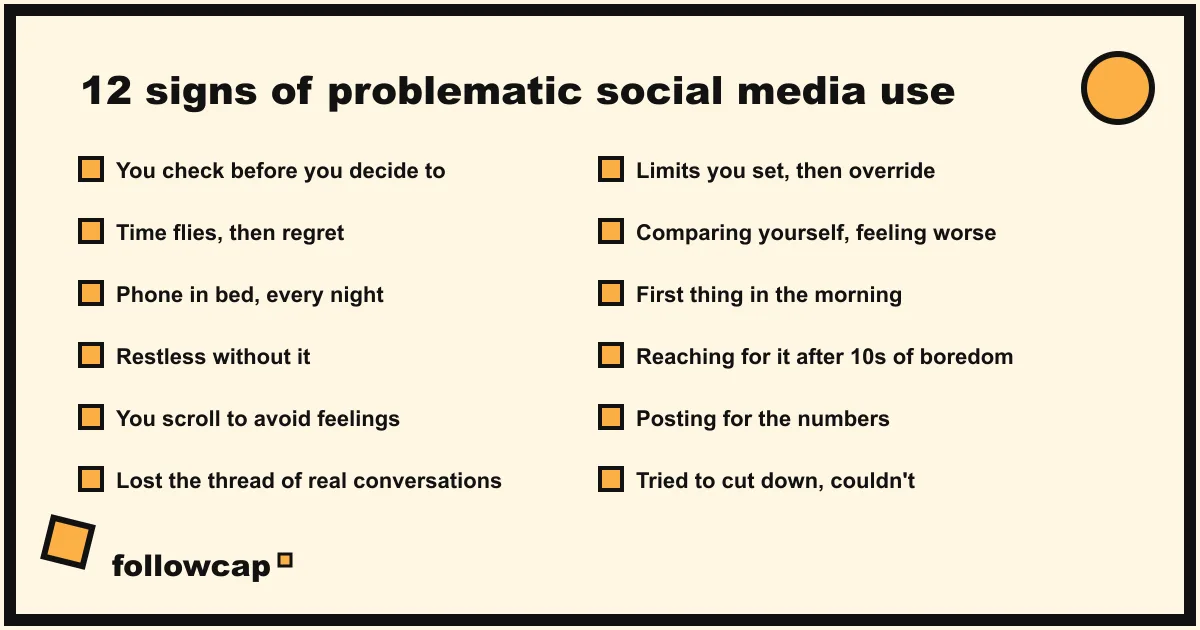
12 signs of problematic social media use
These come up most often in research questionnaires and in people’s own descriptions. You do not need all of them: if four or more have been true for months, the pattern is worth working on.
- You open the app without deciding to. Your thumb goes to it while you are thinking about something else.
- You check more than you planned. “Five minutes” becomes 40, regularly.
- You have tried to cut back and failed. More than once.
- You feel restless or irritable when you cannot check. A dead battery feels like a real problem.
- You use it to escape. Bad mood, boredom, stress, loneliness: the feed is the first move.
- It is the first thing in the morning and the last thing at night. Before getting up, after lights out.
- Sleep is shorter because of it. You stay up scrolling or wake up to check.
- You think about it when you are not on it. What to post, what you missed, what people said.
- It gets in the way of work or study. Tasks take longer because you keep switching.
- You hide or understate your use. You round down when someone asks.
- You keep using it even when it makes you feel worse. You notice the comparison and the anxiety, and keep scrolling.
- People you care about have mentioned it. More than once.
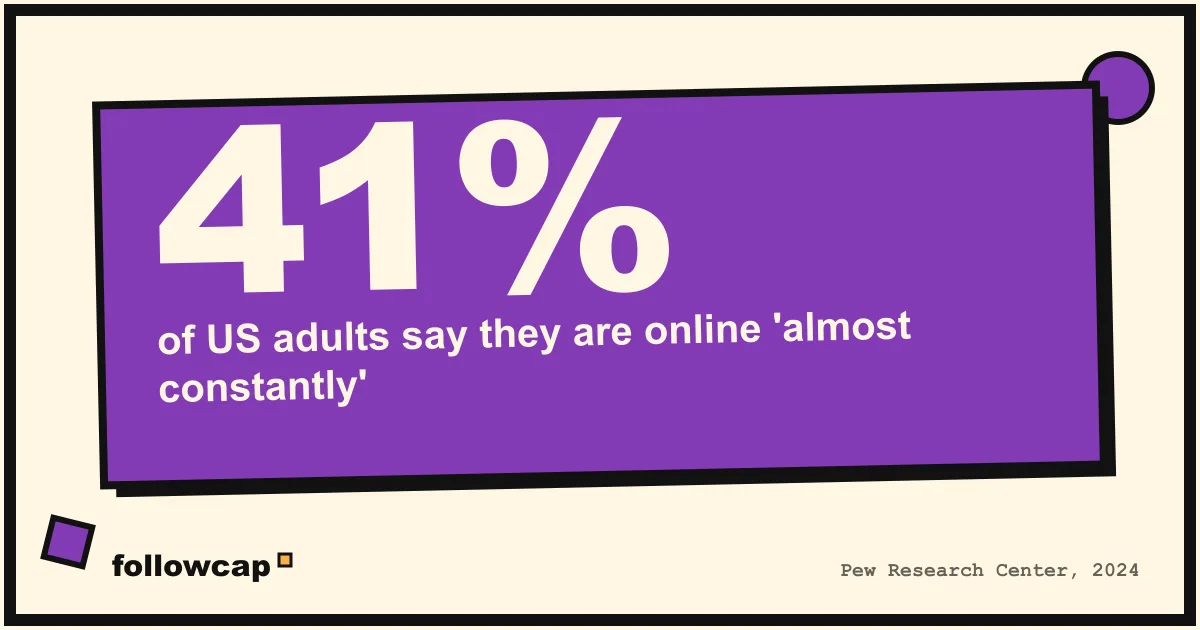
For scale: 41% of US adults say they are online “almost constantly” (Pew Research Center, 2024), and teens spend about 4.8 hours a day on social media (Gallup, 2023). Heavy use alone is not a sign; the signs above are about control and cost, not hours.
The four most common signs, explained
Opening the app without deciding to (sign 1). The clearest marker of a habit rather than a choice. The app has become the default response to small moments of friction: waiting, a hard task, a pause in conversation. People check their phone around 144 times a day (Reviews.org, 2023), and most of those checks were never a decision.
Failing to cut back (sign 3). Most people have tried: deleting the app, a weekend off, a timer they kept dismissing. Failing usually means the attempt removed the behavior without removing the cue or replacing the reward, so the loop restarted.
Using it to escape (sign 5). The feed is a fast, reliable way to not feel something, and it works in the moment, which is what makes it hard to drop. The thing you were avoiding is still there afterward, with less time to deal with it.
Sleep loss (sign 7). Less sleep means worse mood and less self-control the next day, which means more scrolling. It is also the easiest sign to fix, with one rule: the phone does not sleep in the bedroom.
Why does social media become addictive?
The apps are built by very good engineers whose success metric is your time. Four mechanisms do most of the work:
- Variable rewards. Sometimes the feed has something great, sometimes nothing. Unpredictable rewards build the strongest habits.
- Social validation. Likes, comments and follows tap into an old need: to be seen and approved of by the group, served cheaply.
- The infinite feed. There is no last page. Every natural stopping point was designed out, so stopping takes an active decision every time.
- Fear of missing out. Stories expire, trends move on, group chats continue. Being away feels costly, even when what you missed was nothing.
None of this means anything is wrong with you. The same mechanisms work on nearly everyone; the reliable defense is to change the setup, not to try harder.
The habit loop and where to break it
Every habit runs on the same loop: a cue triggers a craving, the craving drives a response, and the response delivers a reward that makes the cue stronger next time.
| Stage | With social media | Where you can intervene |
|---|---|---|
| Cue | Boredom, a buzz, the icon, a pause, bed | Remove or hide the cue |
| Craving | “Let me just check” | Delay, notice, name it |
| Response | Open, scroll | Add friction |
| Reward | Novelty, validation, distraction | Replace with a slower reward |
Most failed attempts attack only the response: delete the app, promise to stop. The cue (phone in hand) and the reward (relief from boredom) are untouched, so the loop finds a new response. The two attacks that matter most are on the cue and the reward.
The cue is easiest: phone in another room, buzz off, icon off the home screen, and the loop never starts. The reward is harder but more important: give yourself a real alternative for boredom and a real way to keep up with the people you follow, and the feed stops being the only answer.
6 steps to break social media addiction
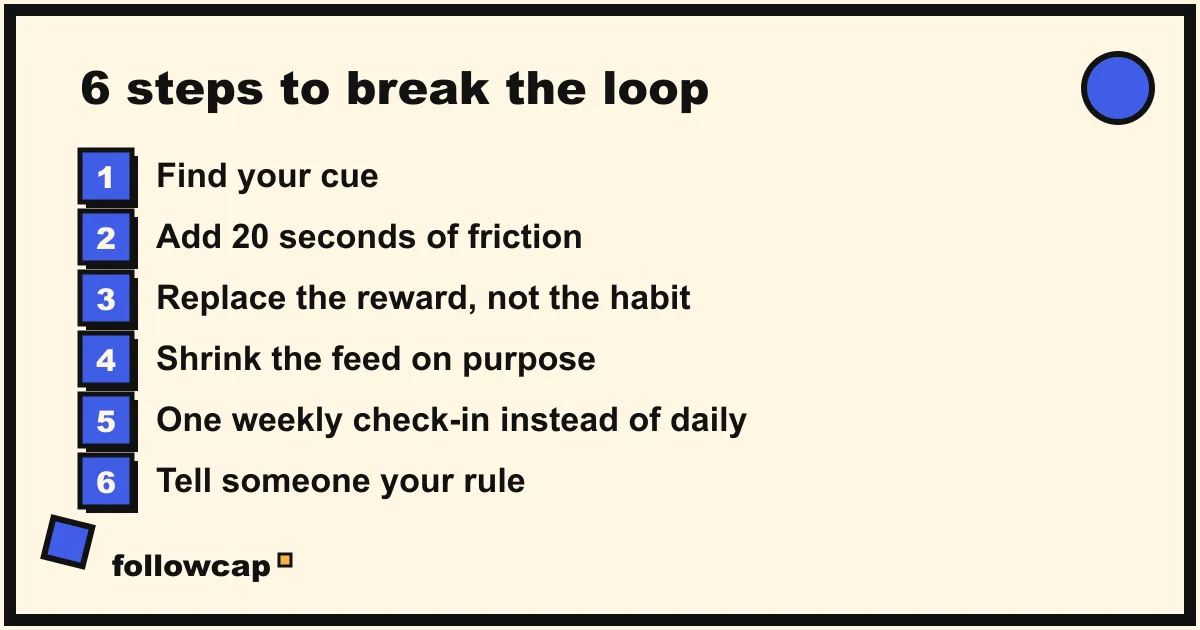
These are in order. Do the first three this week, the rest over the next month.
Step 1: measure, then set one target
Open Screen Time (iOS) or Digital Wellbeing (Android) and write down three numbers: daily time on social apps, pickups, and the hour you last used the phone at night. Average time on social media is about 2 hours 21 minutes a day (DataReportal, Digital 2025); yours is what matters. Then set one target, not three: “under an hour a day” or “phone out of the bedroom” is enough.
Step 2: kill the cues
Turn off every notification except calls and messages from real people. Move social apps off the home screen, or delete them and use the browser. Put a charger in the kitchen and leave the phone there from a fixed time at night. This step alone removes a large share of checks, because they were triggered by the phone, not by you.
Step 3: add friction and a delay
When you still reach for the app, make it slightly harder and slower: log out so you have to log in, set an app timer with a real limit, and use the 20-second rule, because an automatic check often does not survive a 20-second wait. The comparison of the best apps to limit social media covers tools that do this, free and paid.
Step 4: replace the reward
The loop needs somewhere to go. For boredom: a book on the phone instead of a feed, a podcast queue, a walk. For escape: write down the thing you are avoiding and do the first two minutes of it. For keeping up with people and creators: move from push to pull, so you no longer need the feed to know what happened. If your creators are mostly on Instagram, Followcap does this with one Sunday email: a 30-second summary of the week, the 3 posts worth seeing, a short recap of every post with the link, and what you can apply. No Instagram login or password is needed. It replaces the reason you open the app, which a blocker cannot do; it is paid, so it only makes sense if those creators matter to you.
Step 5: give the feed a box
Decide when social media is allowed: once a day for 20 minutes, or once a week for a longer check-in. A window turns the feed from a reflex into an appointment. If daily is too hard at first, the 30-day social media detox plan makes this one change at a time.
Step 6: review weekly and expect relapses
Every Sunday, look at the three numbers from step 1. If they went up, find the cue that crept back (usually notifications or the phone back in bed) and fix it. A bad week is information, not proof you cannot change. The people who succeed notice within a week and patch the rule.
For late-night scrolling specifically, see the guide to stopping doomscrolling.
When should you talk to someone?
Most problematic use responds to the steps above within a month. Consider talking to a doctor, therapist or counselor if any of these are true:
- You made a structured attempt (like the six steps) and nothing shifted after several weeks.
- The scrolling comes with persistent low mood, anxiety or trouble sleeping.
- You use it mainly to manage feelings you cannot face otherwise, and it is getting worse.
- It is hurting relationships, work or school in ways others have noticed.
- You are a parent and your teen’s use looks like signs 4, 7 and 11 together.
Talking to someone is not an admission that you are “addicted”. It is a faster route to figuring out what the scrolling does for you, and what could do it better.
FAQ
Am I addicted to social media?
If four or more of the 12 signs have been true for months, you have a pattern of problematic use worth working on. That is different from a clinical addiction, which does not exist as a formal diagnosis for social media. The useful question is not “am I addicted” but “do I decide when I open it”.
Is there a social media addiction test?
Researchers use short questionnaires, usually six to nine questions about loss of control, mood, conflict, withdrawal and relapse. No online test can diagnose anything; it can only tell you whether the pattern is familiar enough to act on.
What are the effects of social media addiction?
The most consistent reported effects are shorter sleep, difficulty concentrating, more comparison and lower mood after long sessions, and less time for what matters. Effects vary by person and by use: passive scrolling tends to feel worse than messaging friends.
How long does it take to break social media addiction?
Checks usually drop within the first week of killing cues, and the urge weakens within two to four weeks if the reward is replaced. Comfort with a once-a-day or once-a-week window takes a month or two. Relapses are normal and do not reset the clock.
Should I delete social media completely?
Not necessarily. For most people, deleting removes the signal with the noise and ends in reinstalling within weeks. A better default is to keep what gives you something (messages, a few creators) in a pull-based form and remove what only takes (the infinite feed, notifications). If the boxed version failed twice, deleting is a reasonable next step.
The bottom line
Social media addiction is not a diagnosis, but problematic use is real, common, and built by design, not by weakness. Look at the 12 signs honestly, then attack the loop at the cue and the reward, not just the response: kill notifications, add friction, replace the feed with a slower reward and a pull-based way to keep up, and give what is left a fixed window. If your creators live on Instagram, start a free Followcap trial and let one Sunday email do the job the feed was doing all week. And if the pull feels bigger than a habit, talk to someone; that is the fastest way out.