Dopamine Detox: What It Is, What Science Says, and a 7-Day Plan
Dopamine detox without the hype: where the term comes from, what dopamine really does, 5 myths, and a realistic 7-day plan so cheap scrolling loses its grip.
 Andrea Marino10 min read
A dopamine detox is a short period where you cut the cheap, instant rewards (feeds, short videos, notifications, junk snacks) so that slower rewards (reading, walking, a real conversation) feel good again. The name is wrong, the idea is partly right. This guide covers where the term comes from, what dopamine actually does, five myths, and a realistic 7-day plan.
Quick answer: A dopamine detox does not lower your dopamine, and you cannot “reset” your brain in a weekend. What a short detox can do is break cue-driven habits, show you which apps you open on autopilot, and raise your tolerance for low-stimulation activities. Treat it as a one-week experiment, then keep two or three rules.
Where does the term “dopamine detox” come from?
The term started with Cameron Sepah, a psychiatry professor at UCSF, who published a guide to “dopamine fasting” in 2019. His version was modest and based on cognitive behavioral therapy: pick a few impulsive behaviors that cause you problems (compulsive scrolling, emotional eating, gaming, online shopping) and schedule fixed periods without them. The goal was to weaken the link between a trigger and an automatic response, not to change brain chemistry.
Then the internet got hold of it. Within a year, people were doing 24-hour “fasts” with no food, no music, no eye contact and no talking, claiming they had “reset” their dopamine. Sepah himself called this a misreading: none of those rules were in the original idea, and “dopamine” was a metaphor that people took literally. This guide keeps the name and drops the mythology.
What does dopamine actually do?
Dopamine is a neurotransmitter involved in movement, motivation, learning and reward prediction. The simplest accurate summary: it is more about wanting than about liking. It rises when your brain predicts a reward, or gets one better than expected, and drives you to seek that reward again.
Three things follow from this:
- You cannot “deplete” dopamine by not scrolling. Your brain produces it continuously. Genuinely low dopamine signaling is a medical condition, such as Parkinson’s disease, not the result of a weekend on Instagram.
- You cannot “detox” from your own neurotransmitter. Detox means removing a toxin. Dopamine is not one, and nothing you do in a week “flushes” it.
- What you can change is the prediction. Every time a cue (a buzz, boredom, the app icon) is followed by a quick reward, your brain learns to expect it. Remove the reward for a while and the prediction weakens. That is learning, not chemistry.
So the realistic goal of a dopamine detox is behavioral: you are not fixing your brain, you are retraining a few habits by removing the rewards that keep them going.
What can a dopamine detox realistically do?
Here is what people reliably report after a week of cutting the cheap hits:
- Cue-driven habits get weaker. When you stop opening the app in response to boredom, the boredom stops triggering the urge as strongly. This usually takes days, not hours.
- Low-stimulation activities feel better. After a few days without short videos, a walk or a chapter of a book stops feeling flat. The walk did not change; your point of comparison did.
- You notice your triggers. Most people cannot say why they opened Instagram. After one day of writing it down, they can.
- Attention lengthens a little. The average stretch on one screen before switching is about 47 seconds (Gloria Mark, “Attention Span”, 2023). A week will not fix that, but you get to feel what staying on one thing is like.
It will not cure a real addiction, fix depression or anxiety, or produce permanent change on its own. If the pull feels like more than a habit, read the signs of problematic social media use and talk to a professional; that beats any detox.
5 dopamine detox myths vs reality
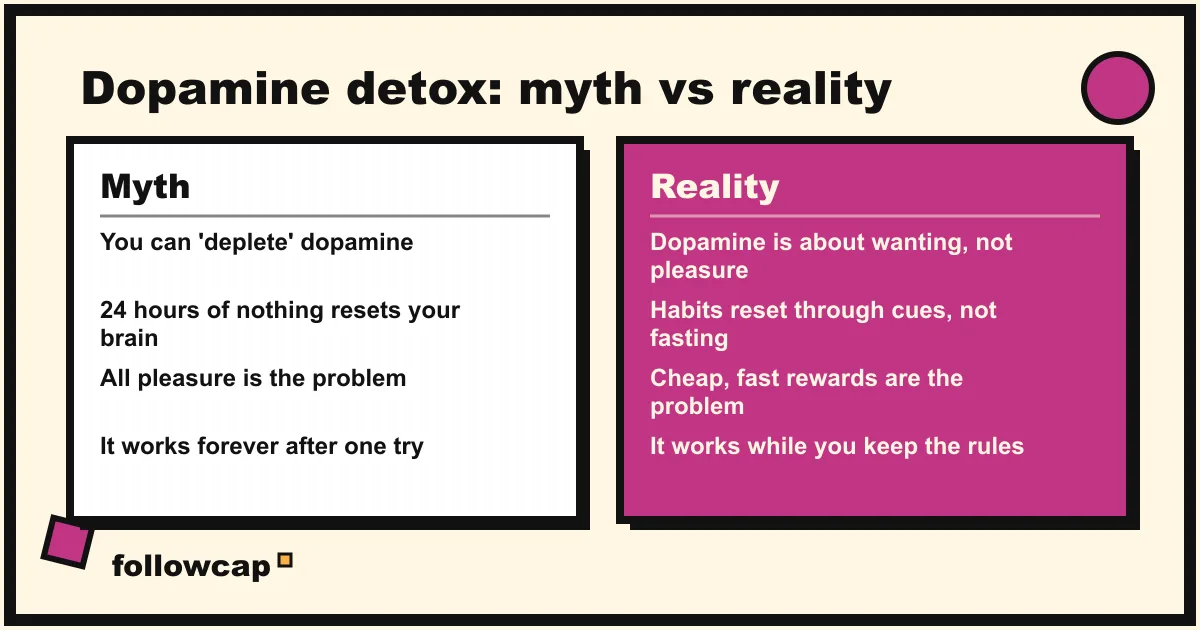
Myth 1: you lower your dopamine by avoiding pleasure
Reality: your body regulates dopamine, not your app choices. Avoiding pleasure for a day does not lower any baseline. You are removing rewards that reinforce a habit, and that works through learning.
Myth 2: a 24-hour fast “resets” your brain
Reality: nothing in the brain resets in a day. Habits weaken over weeks of repeated non-reward. A single day is an audit and a proof that you can do it, not a reset.
Myth 3: you have to give up everything, including food, music and people
Reality: the original idea targeted specific impulsive behaviors. Skipping conversation and meals is not in it and makes the week harder for no benefit. Remove the cheap hits, keep the slow, real rewards.
Myth 4: more rules mean better results
Reality: the rules you keep after the week matter more than the ones you follow during it. Three you can hold beat ten you abandon on day 3.
Myth 5: once you finish, you are done
Reality: the cues come back the first day you are tired, bored and alone with your phone. A detox gives you information and a small win. A system (where the phone sleeps, when you check feeds, what you do instead) keeps the result.
The realistic 7-day dopamine detox plan
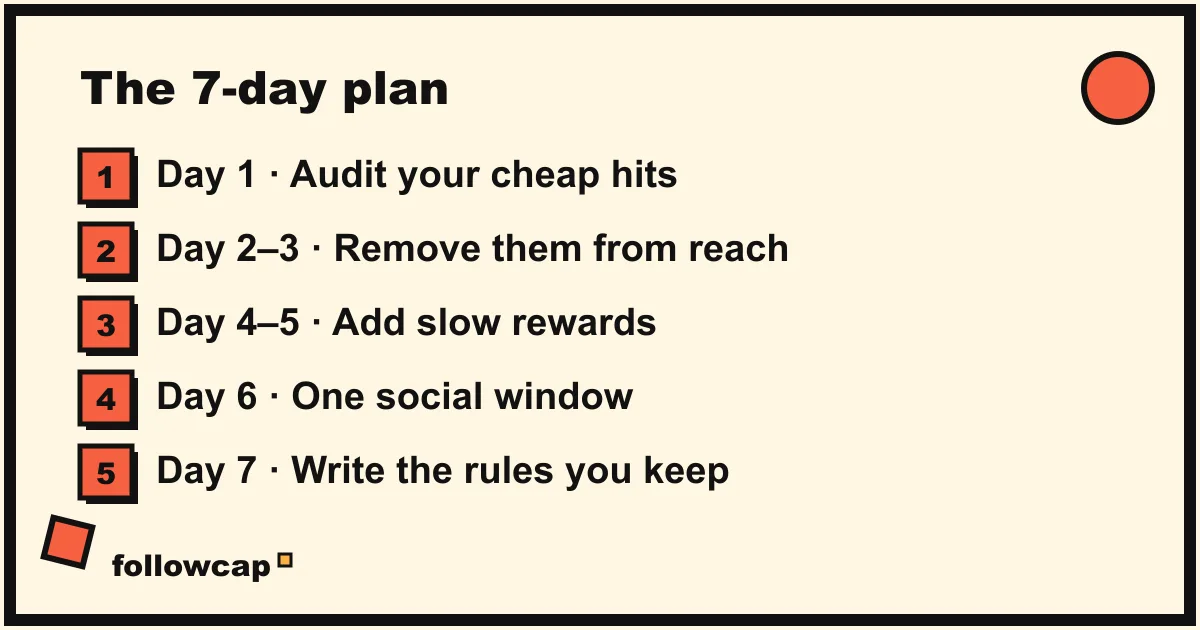
One principle: remove cheap rewards, add slow ones, finish with rules you will keep. You still eat, listen to music, talk to people and work.
Day 1: audit
Change nothing today. Just record. Every time you reach for a cheap hit, note three things: the time, what you were feeling or doing right before (bored, waiting, avoiding a task, tired), and what you opened.
Tonight, check Screen Time (iOS) or Digital Wellbeing (Android) and write down total time, pickups and your top three apps. Average daily screen time worldwide is about 6 hours 38 minutes (DataReportal, 2025), but you need your own number.
By evening you will have a short list of triggers. Most people find two or three, usually “waiting for something” and “avoiding a task”.
Days 2 and 3: remove the cheap hits
Now cut the rewards that your day 1 list points to. The usual suspects:
- Short video feeds (Reels, TikTok, Shorts): off the phone for the week, or at least off the home screen.
- Notifications: turn off everything except calls and messages from real people.
- Infinite feeds of any kind: news apps, Reddit, X. Log out, do not just promise.
- Phone in bed: it charges in another room. Buy a €10 alarm clock if that is the excuse.
- Snacking while scrolling, if that is your pairing. Keep the snack, lose the screen.
Expect these two days to be boring. That is the point: the boredom is the gap where the habit used to be, and you want to sit in it long enough to notice that it passes. Do not fill it with another feed. If you catch yourself scrolling anyway, the guide on how to stop doomscrolling has tricks for that moment.
Days 4 and 5: add slow rewards
Removing is half the plan. Now add things that reward you slowly, so the brain has somewhere to go:
- A 30-minute walk without headphones, ideally at the same time each day.
- Reading on paper or an e-reader, 20 pages.
- One real conversation, in person or on a call.
- Making something with your hands: cooking, fixing, drawing badly.
- Exercise that leaves you tired in a good way.
Pick two per day. They will feel flat on day 4 and noticeably better on day 5. That shift is the main result of the week.
Day 6: one social window
Today you reintroduce social media, on purpose, inside a box. Pick a 20-minute window, set a timer, and check what you want. Then close it.
Most people notice two things: the feed feels louder and more pointless than they remembered, and the urge to keep going is still there at minute 20. The first means your tolerance shifted. The second means the box is your system, not willpower.
If 20 minutes was enough, that is your weekly format. If you wanted hours, replace most of the feed with something pull-based: newsletters, RSS, or a weekly recap. The guide to staying up to date without social media shows how to keep the creators without the feed.
Day 7: design the rules you keep
The last day is for writing. Look at your day 1 notes and your day 6 experience, and pick two or three rules that fit your real life. Good rules are specific, with a time or a place:
- “The phone charges in the kitchen from 10 pm.”
- “No feeds before my first task of the day.”
- “Social media once a week, Sunday, 20 minutes, via recap and a timer.”
Write them somewhere you will see them. Tell one person. Then run them for a month and review.
How to keep it after the week
A week proves it is possible. The month after is where it sticks or dissolves. What helps:
- Keep the slow rewards on the calendar. The walk, the reading, the conversation. If they disappear, the cheap hits come back to fill the time.
- Make the feed pull-based. The feed is the only way to see what the people you follow posted; remove that reason and most of the urge goes with it. For the Instagram creators you learn from, Followcap sends one Sunday email with a 30-second summary, the 3 posts worth seeing, a short recap of every post with its link, and what you can apply this week. For example, 10 creators post around 58 reels, posts and stories a week, roughly 12 hours of scrolling; the recap takes about 5 minutes to read. No Instagram login or password needed, and it only makes sense if those creators matter to you.
- Protect the first and last hour. No feeds in the first 30 minutes after waking or the last hour before bed; these two windows hold most mindless use.
- Review on day 30. Compare your Screen Time numbers to day 1. If they slid back, run days 2 and 3 again.
- Expect relapses. A bad day with three hours of scrolling is data, not failure. Look at the trigger and patch the rule.
If you want structure beyond one week, the 30-day social media detox plan turns these rules into a month, one change per week.
FAQ
Does a dopamine detox actually work?
The behavioral part works: removing cheap rewards for a few days weakens habits and makes slower activities feel better. The neurochemical part (“resetting” dopamine) is a myth. Expect a habit reset, not a brain reset, and you will not be disappointed.
How long should a dopamine detox last?
One day works as an audit. A week is long enough to feel the shift in what seems rewarding. Beyond that, the rules you keep matter more than the length: a 7-day plan followed by three permanent rules beats a 30-day fast followed by nothing.
What are the dopamine detox rules?
There is no official list. The sensible version: cut short-video feeds, infinite scrolling and notifications for the week, keep food, music, people and work, add slow rewards daily, and finish by writing two or three rules you keep. Rules about eye contact or silence were never part of the original idea.
Can I still listen to music or watch a film?
Yes. The point is to remove fast, bottomless rewards, not all pleasure. A film ends, an album ends, a feed does not. If you play music only to avoid silence, try one quiet walk and see how it feels.
What are the benefits of a dopamine detox?
Most people report less autopilot phone use, more tolerance for boredom, better sleep once the phone leaves the bedroom, and a clearer view of their own triggers. Beyond that, it depends on whether you keep the rules.
The bottom line
A dopamine detox will not lower your dopamine and will not reset your brain, because neither of those is a real thing. What a 7-day plan can do is break a few cue-driven habits, make slow rewards feel good again, and show you exactly when and why you reach for the phone. Keep two or three rules, make your feeds pull-based, and protect the first and last hour of the day. If Instagram is where your creators live, start a free Followcap trial and let a Sunday email replace the daily scroll.