How to Stay Up to Date With Creators Without Social Media
Stay up to date without social media: 5 pull-based ways to follow your favorite creators, plus a 20-minute setup, so you keep the ideas and drop the scroll.
 Andrea Marino10 min read
You can stay up to date without social media. The people you learn from publish in more places than their feed, and most of those places let you decide when to look instead of pulling you in. This guide gives you five ways to keep up with your favorite creators, a 20-minute setup, and an honest look at what you lose and what you gain.
Quick answer: To stay up to date without social media, switch from push to pull. Subscribe to creators’ newsletters, put blogs and YouTube channels in an RSS or read-later app, keep podcasts in one app, get a weekly recap email for the Instagram creators who post nowhere else, and open all of it in a single 15-minute check-in each week.
The real fear: can you stay up to date without social media?
Most people who want to quit social media are not scared of missing memes. They are scared of missing the handful of people they actually learn from: the coach whose drills fixed their running form, the designer who explains typography better than any course, the nutritionist who posts recipes that work on a Tuesday night.
That fear is reasonable. If you follow 300 accounts, maybe 20 matter. But the app bundles the 20 with the 280, and with ads, and with suggested reels you never asked for. So when you delete the app you lose both the noise and the signal, and the signal is what hurts.
The fix is to find the 20 people somewhere else, in a format that waits for you. Keep the creators, lose the feed.
Push vs pull: why the feed is the worst way to follow 20 people
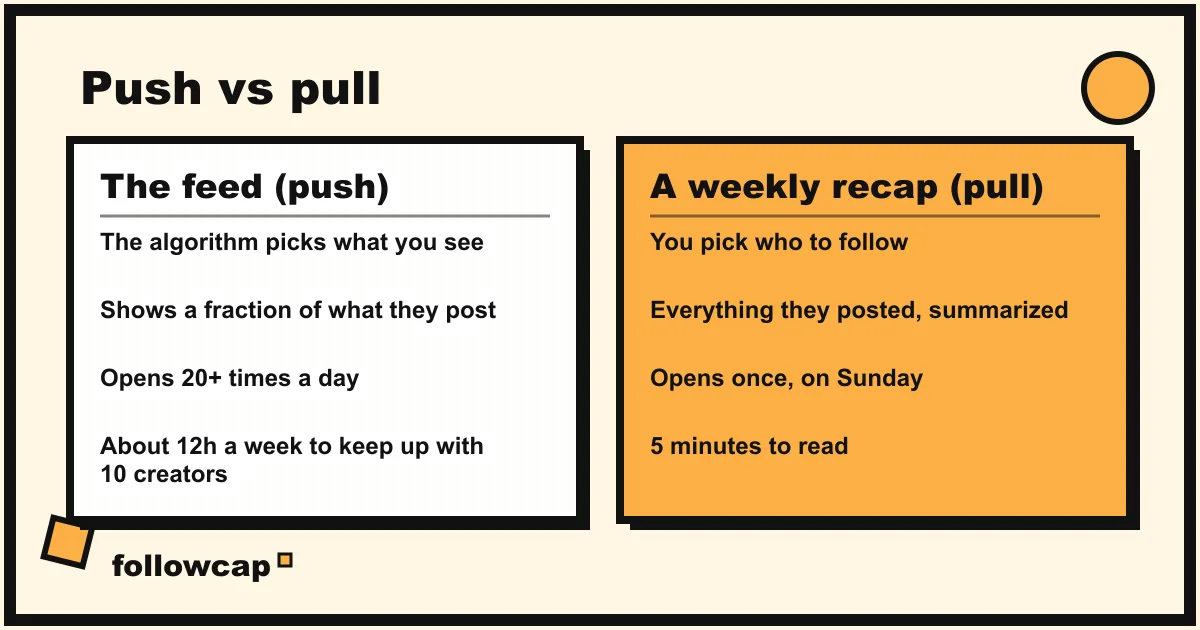
A feed is a push system. It decides what you see, when, and for how long, in an order chosen to maximize time spent, not what you wanted to learn. Infinite scroll removes the stopping point, and pull-to-refresh works like a slot machine: sometimes something new, sometimes nothing, and that uncertainty keeps you pulling.
A pull system is the opposite. You go to the content when you decide to. An inbox, a podcast queue, an RSS reader, a weekly email: they all sit there until you open them, and they end.
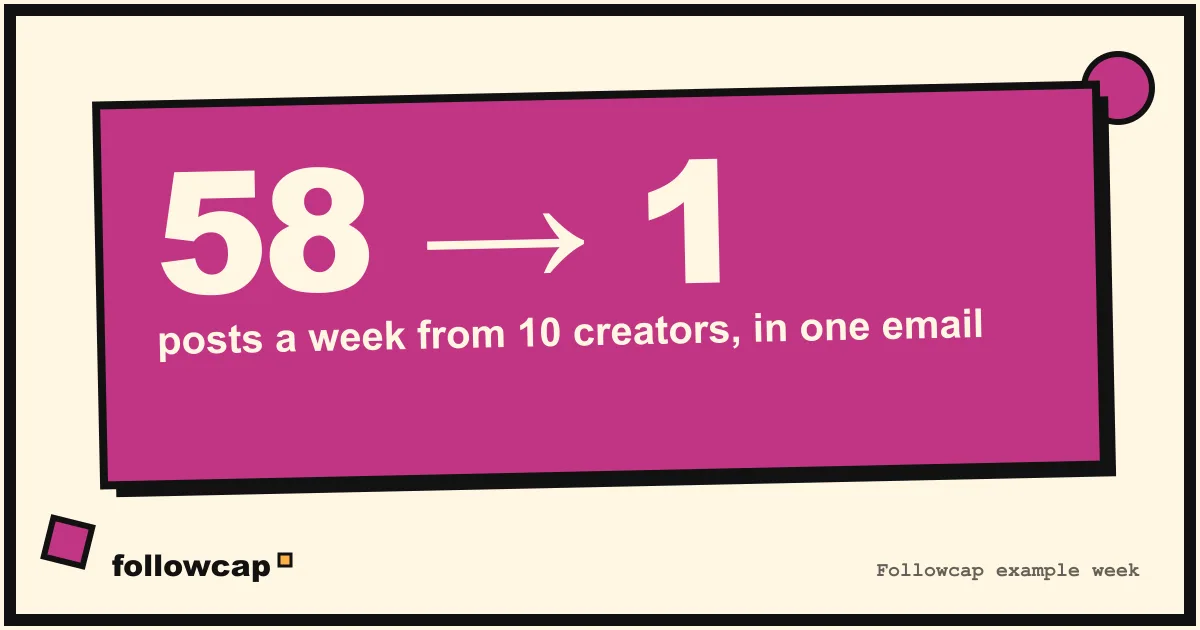
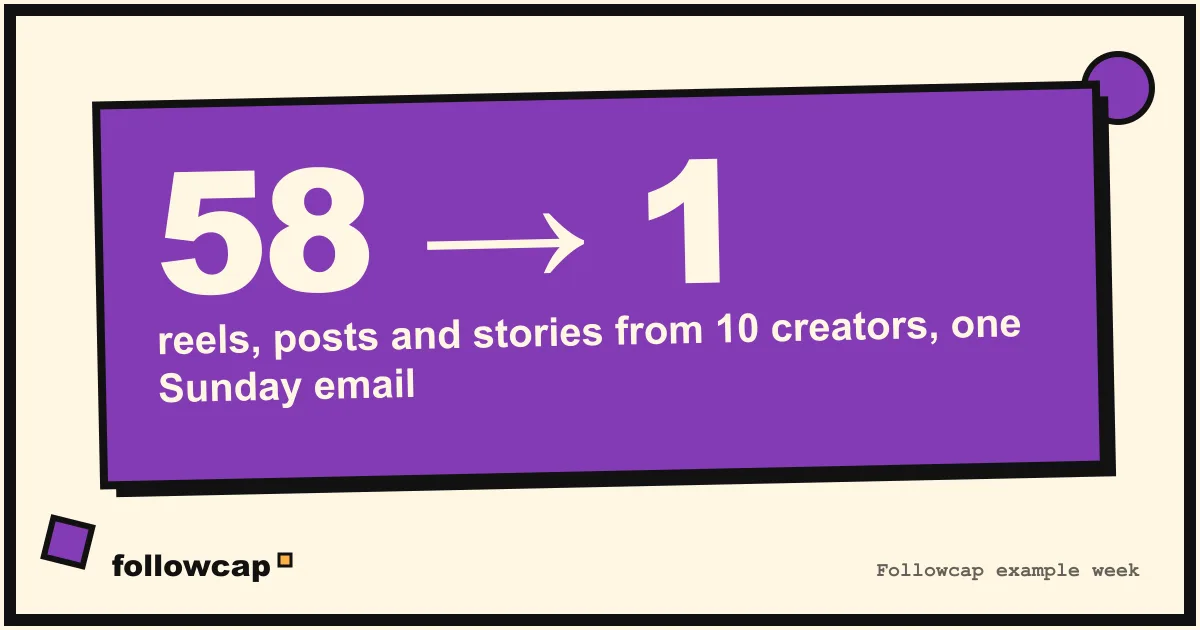
The difference shows up in numbers. People spend about 2 hours 21 minutes a day on social media on average (DataReportal, Digital 2025), and check their phone around 144 times a day (Reviews.org, 2023). Almost none of that time goes to the 20 creators you care about. For example, 10 creators post about 58 reels, posts and stories in a typical week. Keeping up with those by scrolling costs roughly 12 hours, because they are scattered among everything else. A recap of the same 58 posts takes about 5 minutes to read.
5 ways to stay up to date without social media
Each of these works on its own. Most people end up with two or three. Pick by where your creators actually publish.
1. Newsletters from the creators themselves
Many creators run a newsletter, often on Substack, Beehiiv, ConvertKit or their own site. It is usually their most thoughtful work: longer, less rushed, and written for people who chose to be there. It arrives by email, so you already have the habit and the app.
To find them, check the link in a creator’s bio or search their name plus “newsletter”. Subscribe with an address you check once a day, not once a minute.
Trade-off: newsletters pile up. Twenty weekly newsletters is twenty emails a week, and some creators write daily. Keep the ones you would pay for, and unsubscribe the moment one goes three issues unread.
2. RSS and read-later apps for blogs and YouTube
RSS is old, free, and still the best pull system ever built. Almost every blog has a feed, and so does every YouTube channel (paste the channel URL into most readers and it just works). A reader like Feedly, Inoreader or NetNewsWire shows you new posts in one list, newest first, with no recommendations and no ads.
Pair it with a read-later app such as Instapaper, Readwise Reader or Matter: anything long goes there, and you read it on your terms, usually in the evening or on the weekend.
Trade-off: RSS has a learning curve of about 15 minutes, and it only works for people who publish on the open web. Instagram and TikTok do not offer feeds.
3. Podcasts and YouTube subscriptions in one place
If your creators talk more than they write, podcasts are the easiest switch. A podcast app is pull by design: you see the episodes you subscribed to and nothing else. Set it to download new episodes and you get a queue that waits for you.
YouTube is trickier because the home page is a feed. Two fixes: bookmark the Subscriptions tab directly (youtube.com/feed/subscriptions), or route channels through your RSS reader as in way 2. Either way you get a list of what your people published, without the sidebar.
Trade-off: podcasts are slow. An hour of listening gives you less than 10 minutes of reading. That is fine for commutes and walks, not for research.
4. A weekly recap email for Instagram creators
The gap in every “quit social media” plan is Instagram. Many creators post there and only there, in reels and stories that disappear, with no RSS and no newsletter. You either open the app or you miss it.
This is the problem Followcap was built for. You choose the creators you want to follow (up to 5, 10 or 20 depending on the plan), and every Sunday you get one email with a 30-second summary of the week, the 3 posts worth your time, a 2 to 3 line recap of every post with its link, and a short “what you can apply this week”. No Instagram login or password is needed. It costs from €9 a month after a 7-day free trial, so it only makes sense if Instagram creators are a real part of how you learn. If they are not, skip it.
5. A scheduled 15-minute check-in once a week
The four sources above only help if you also stop checking all day. So add one rule: all of it gets opened in one 15-minute slot, once a week. Sunday morning with coffee works for most people. Saturday evening is the other popular pick.
During the slot you read the recap email, skim the RSS list, queue two podcasts and save two articles for later. Then you close everything. If a creator posted something important, it will still be there next week, and you will have read it in a calm state instead of between two notifications.
Why 15 minutes? Five feels like a punishment, and 60 turns into a scroll. If 15 is too short for your list, your list is too long.
How to build your pull list in 20 minutes
Do this once, with a timer, before you delete anything.
- Write down the 20 (max) accounts you would miss. Not the ones you like, the ones you would notice were gone. Most people stall at 12. That is a good sign.
- For each one, find their “home”. Newsletter, blog, YouTube, podcast or Instagram only. Two minutes per name, no more. Put it in a simple table.
- Subscribe at the source. Newsletter sign-ups, RSS feeds in your reader, podcast subscriptions in your app. For the Instagram-only names, add them to a recap service or decide you will check them in your weekly slot.
- Block the slot. Put a 15-minute weekly event in your calendar. Call it something you will respect.
- Then unfollow, mute or delete. Now the feed is not your source of anything, so removing it costs nothing.
A sample table might look like this:
| Creator | Where they really publish | Pull source |
|---|---|---|
| Running coach | Instagram reels | Weekly recap email |
| Typography designer | Blog + newsletter | RSS + inbox |
| Tax lawyer | YouTube | Subscriptions tab in RSS |
| Interviewer | Podcast | Podcast app |
If you want to do this as part of a bigger reset, the 30-day social media detox plan uses week 3 for exactly this step, and the digital detox ideas list has a section on coming back to your sources without binging the feed.
What you lose and what you gain
Be honest with yourself here, because the losses are real.
What you lose
- Serendipity. The feed sometimes shows you a creator you did not know and now love. A pull list does not. Recommendations from people you already follow replace it: slower, but better filtered.
- Speed. You will hear about things a day or a week later. For news that matters to your job, keep one pull source that updates daily. For everything else, a week late is fine.
- Small talk. You will miss the reel everyone laughed at on Tuesday. You can live with that.
- DMs and comments. If the feed is also how you talk to friends, keep the messaging part (or move the group to another chat app) and lose the feed.
What you gain
- Time. Even cutting the average 2 hours 21 minutes in half gives you back around 8 hours a week.
- Focus. It takes about 23 minutes to fully refocus after an interruption (Gloria Mark, UC Irvine). Fewer checks means fewer interruptions, which means more deep work with the same hours.
- Better content. Newsletters and blogs are a creator’s considered work. Reels are their quick work. You end up reading the better version.
- Control. You choose the order, the time and the end. The feed never ends on purpose. If you have ever lost an evening to it, the guide on how to stop doomscrolling explains why and what to do instead.
The first week is uncomfortable, because the hand still reaches for the app. By the second, most people would not go back.
FAQ
Can I follow creators without an Instagram account?
Partly. You can read many creators through their newsletter, blog, YouTube or podcast without any account. For creators who post only on Instagram, you need either the app, a browser session, or a recap service that sends you their posts by email. Followcap does the last one and does not ask for your Instagram login.
How do I keep up with news without social media?
Pick one or two sources that publish a daily or weekly summary and subscribe by email or RSS. Read it in a fixed slot. News through a feed is sorted for outrage, not for importance, so you lose less than you think.
Will I miss out if I’m not on social media?
You will miss some things, mostly the ones designed to expire within 24 hours. You will not miss the work that matters, because good creators repeat their best ideas across formats. Ask a friend who quit a year ago what they regret missing.
How long does it take to stop missing the feed?
Most people report the urge fading noticeably in one to two weeks, and the “what did I miss” feeling dropping away in about a month, once the weekly check-in becomes normal. It is faster if you fill the first days with a clear alternative rather than willpower alone.
What if a creator only posts on Instagram?
Three options. Check their account directly in your weekly slot through a browser, so you do not reinstall the app. Ask them, in a comment or DM, if they have a newsletter; many do and do not promote it. Or use a weekly recap email that covers their posts for you.
The bottom line
You can stay up to date without social media by replacing one push feed with a few pull sources: newsletters, RSS, podcasts and a weekly recap for the Instagram-only creators, all read in one 15-minute slot. You lose some serendipity and a little speed. You gain hours, focus and the better version of each creator’s work. If Instagram creators are part of how you learn, start a free Followcap trial and let the Sunday email handle that part, so the rest of the week stays yours.