Digital Detox: 20 Ideas for a Weekend (or a Week) Offline
Plan a digital detox that actually works: 20 ideas for a weekend or a week offline, a 48-hour template, and how to come back without bingeing the feed.
 Andrea Marino10 min read
A digital detox is a fixed stretch of time, usually a weekend or a week, where you step away from screens on purpose and fill the space with something better. This article gives you 20 digital detox ideas sorted by mood, a 48-hour template you can copy, and a plan for coming back so you don’t binge the feed on Monday.
Quick answer: The simplest digital detox is 48 hours, Friday evening to Sunday evening, with the phone in a drawer and three written exceptions (calls from family, maps, tickets). Prepare on Friday, plan real activities for both days, and set up pull-based sources before you return so the feed has nothing to pull you back with.
A weekend is 48 hours. At the worldwide average of about 6 hours 38 minutes of screen time a day (DataReportal, 2025), around 13 of those hours would normally go to a screen. That’s what you’re getting back. The 20 ideas below are what to do with it.
What is a digital detox (and what it isn’t)
A digital detox is a deliberate break from screens, or from the parts of screens that cost you the most: social feeds, news, notifications, the reflex check. It has a start, an end and rules you chose in advance.
What it isn’t: a moral test, a permanent lifestyle, or an all-or-nothing deal. You’re allowed to keep maps. You’re allowed to call your mother. If being unreachable for 48 hours is impossible in your job, your detox can be “phone on, apps off” and it still counts.
Three honest things to know before you start:
- The first evening is the hardest. People check their phone about 144 times a day (Reviews.org, 2023), so expect to reach for it dozens of times without thinking. That reflex is the thing you’re detoxing from. Noticing it is the point, not a failure.
- One weekend won’t rewire you. It will show you how much of your scrolling is habit rather than choice, and give you a clear memory of what a quiet day feels like.
- The benefit is mostly in the return. How you come back matters more than how strict you were. More on that at the end.
If you want something longer and more gradual, our 30-day social media detox plan is the slow version of the same idea.
How to prepare for a digital detox weekend
Thirty minutes on Friday afternoon makes the difference between a calm weekend and a weekend of small emergencies.
- Tell people. A message to the three or four people who might worry: “Offline until Sunday evening, call if it’s urgent.”
- Set an auto-reply on email and, if you use it for work, on chat. Keep it short and give a date.
- Download what you need. Offline maps for where you’ll go, the podcast or audiobook for the train, the recipe you want to cook.
- Print or write down tickets, addresses and times. On paper. Old-fashioned, and it works.
- Write your exceptions. Three at most. “Calls from family. Maps if I’m lost. The camera.” Write them on a card and put the card where the phone usually sits.
- Decide where the phone lives. A drawer, a box, your partner’s bag. Not your pocket. Not the bedside table.
- Plan the first two hours. Friday evening is when most detoxes fail: nothing to do, phone right there. Pick one idea below and start it the moment the phone goes away.
Outdoors: digital detox ideas that get you out of the door
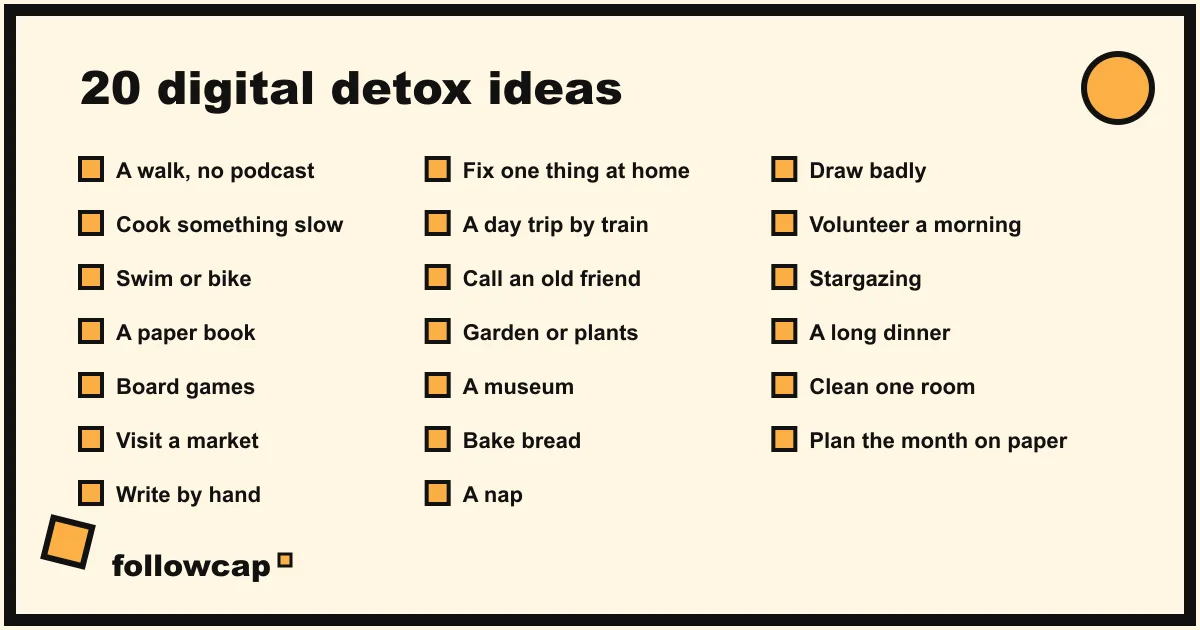
- 1. The long walk with no destination. Two or three hours, no route, no podcast. It’s boring for the first 20 minutes and then it isn’t.
- 2. A day trip by train with a paper map. Pick a town one or two hours away you’ve never visited. Buy the ticket on Friday. Getting a bit lost is part of it.
- 3. A sunrise or sunset you actually watch. Sit through the whole thing, 30 to 40 minutes, without photographing it. It’s surprisingly hard and surprisingly good.
- 4. Something with your hands, outside. Garden, chop wood, help at an allotment, clean the bike. Work that tires the body quiets the head.
- 5. A swim, a run or a hike that’s slightly too long. Long enough that you stop thinking about anything else. Tell someone where you’re going, since your phone isn’t coming.
At home: ideas for an offline day
- 6. Cook one thing slowly. Bread, a stew, a recipe with 15 steps. The time it takes is the feature, not the bug.
- 7. Read a whole book. On paper. Pick a short one if you’re out of practice: 200 pages across a weekend is doable when no feed is competing.
- 8. Fix, clean or sort one thing you’ve been avoiding. The drawer, the wardrobe, the box of cables. Two hours of this gives a strange, specific satisfaction.
- 9. Do something analogue and slightly pointless. A jigsaw, a model kit, sketching, a crossword. Low stakes, slow reward, the opposite of a feed.
- 10. Music, the whole album, with nothing else. Sit, listen, don’t tidy while it plays. Forty minutes.
With people: ideas that don’t need a screen
- 11. A long meal with no phones on the table. Cook together or go out. Put every phone in one bag by the door. Dinner lasts twice as long and it’s better.
- 12. Board games or cards. Two hours disappear, and nobody checks anything.
- 13. Visit someone you’ve been meaning to visit. A grandparent, an old friend, the neighbour who moved. Bring something you baked (idea 6).
- 14. Volunteer for one morning. A food bank, a park clean-up, a shelter. You’ll meet people and you’ll be too busy to miss the phone.
- 15. Teach or learn something in person. Ask a friend to show you how they do the thing they’re good at, or show them yours. An hour, a kitchen table, no tutorials.
For your head: ideas that reset your attention
- 16. Write by hand for 20 minutes. What you’re worried about, what you want, what you noticed today. Don’t reread it. Writing slowly does the work.
- 17. Sit and do nothing for 15 minutes. No app, no technique. A chair, a window, a kitchen timer. Boredom is the feeling of your attention recovering.
- 18. Plan the next month on paper. One sheet, four weeks, the few things that matter. You’ll see them more clearly without 20 tabs of “inspiration”.
- 19. A nap. Twenty to 40 minutes, in the afternoon, which almost nobody does when a phone is within reach.
- 20. Make a list of what you actually want from your phone. Which people, which creators, which tools. This is the most useful thing you’ll bring back from the weekend, and the basis of the return plan below.
A 48-hour digital detox template
Here’s a weekend you can copy. Swap any idea for another from the same group.
Friday evening
- 18:00. Last check: messages answered, auto-reply on, exceptions card written. Phone goes in the drawer.
- 18:15. Start something immediately: cook one thing slowly (6) with the whole album playing (10).
- 21:00. Read (7) until you’re sleepy. Alarm clock instead of phone.
Saturday
- Morning. No phone, no news. Breakfast, then the long walk with no destination (1), two hours.
- Afternoon. Fix, clean or sort one thing (8), then a nap (19).
- Evening. Long meal with people, phones in a bag by the door (11). Board games after (12).
Sunday
- Morning. Sunrise if you’re up, otherwise a late breakfast and 20 minutes of writing by hand (16).
- Midday. Visit someone (13) or volunteer (14).
- Afternoon. Sit and do nothing for 15 minutes (17). Then plan the month on paper (18), and write the list of what you actually want from your phone (20).
- 18:00. The return, step by step (next section). Not before.
If you crack on Saturday afternoon and check one thing, put the phone back and continue. The weekend isn’t ruined. The only way to really fail is to give up on the rest of it.
How to come back from a digital detox without the rebound
This is the part most digital detox guides skip, and it decides whether the weekend changed anything. Pick up the phone on Sunday night, open every app you missed, and you’ll spend an hour catching up, feel worse than on Friday, and conclude that detoxes “don’t work”. They do. The rebound is what breaks them. The fix is to come back in a specific order, over about 30 minutes.
- Messages from humans first. Family, friends, work chat. Answer what needs answering. Ten minutes.
- Then, before you open any feed, change what the feed can do. Use the list from idea 20. Unfollow or mute everything that isn’t on it. Turn off every notification that isn’t from a person. Move the social apps off your home screen. Our list of ways to spend less time on your phone has the full setup.
- Replace the pull. The reason you’ll open Instagram on Monday is the handful of creators you actually like. Give yourself a way to follow them that doesn’t involve the feed. For example, 10 creators post about 58 reels, posts and stories a week, which is roughly 12 hours of scrolling to keep up with. Followcap collapses that into one Sunday email: a 30-second summary, the 3 posts you shouldn’t miss, a short recap of every post with its link, and what you can apply this week, about 5 minutes to read. You choose the creators (up to 5, 10 or 20 depending on the plan) and no Instagram login or password is needed. It won’t stop you opening the app, but it takes away the main reason to. The 7-day trial is free, so you can test it the week after your detox.
- Then, and only then, the feed. With a timer. Fifteen minutes. You’ll notice how little you missed.
More ways to keep up without the feed, newsletters and RSS included, are in how to stay up to date without social media.
The goal of the return isn’t zero screen time. It’s that Monday looks different from the Monday before: fewer sources, fewer notifications, and the posts you care about arriving on your terms instead of pulling you in 144 times a day.
FAQ
How long should a digital detox last?
Forty-eight hours is the sweet spot for a first one: long enough to get past the first-evening reflex, short enough to fit a normal life. A full week shows you more clearly what you actually miss, but needs more preparation. Don’t start with a month.
What are the benefits of a digital detox?
People most often report sleeping better, feeling less rushed, and noticing how much of their scrolling was habit rather than choice. Some report more focus in the following week. None of this is guaranteed, and it fades fast if you go straight back to the old setup on Monday.
Can I do a digital detox if I need my phone for work?
Yes. Define the detox as “no feeds, no news, no notifications” rather than “no phone”. Keep calls and work chat if you must, and put the social apps in a folder or delete them for the weekend.
Is a digital detox the same as a dopamine detox?
They overlap, but they’re not the same. A digital detox is about screens and time. A dopamine detox is about cheap rewards in general, including snacks, shopping and games, and the term is often misunderstood. We explain what the science actually supports in our dopamine detox guide.
The bottom line
A digital detox is a weekend with rules, not a test of character. Prepare on Friday, fill the 48 hours with things from the list above, and come back in the right order: people first, then fix the feed, then replace the pull, and only then the apps. Done that way, the detox doesn’t end on Sunday night. The week after is quieter too, and a weekly recap like Followcap gives you the creators you care about in 5 minutes instead of 12 hours of scrolling.