How to Be More Productive: 15 Habits for a Focused Day
Learn how to be more productive with 15 simple habits for your morning, workday and inputs: fewer interruptions, fewer feeds and more hours of real focus.
 Andrea Marino10 min read
If you want to know how to be more productive, the honest answer is not “work more hours”. It is “protect your attention”. This guide gives you 15 habits, grouped into morning, workday and inputs, that you can start this week without a new app, a 5 a.m. alarm or a hustle mindset.
Quick answer: To be more productive, plan the night before, do one must-do task in a 90-minute block before you open any feed, batch messages into two fixed slots, and cut the number of sources you follow. Productivity is mostly about fewer interruptions and fewer inputs, not about more hours or more effort.
Why being more productive is about attention, not hours
Most productivity tips treat the day like a container: fit more in, waste less. But the hours were never the problem; the holes in them are. The average person spends about 6 hours 38 minutes a day looking at screens, and about 2 hours 21 minutes of that on social media (DataReportal, 2025). People check their phone around 144 times a day (Reviews.org, 2023). On a screen, the average stretch of attention before switching to something else is about 47 seconds (Gloria Mark, 2023).
You can’t do deep work in 47-second slices. You can only do shallow work, which feels busy without moving anything forward.
So the question “how to be more productive” really splits into three smaller questions:
- How do I start the day with focus instead of noise? The morning habits.
- How do I protect focus once the day gets loud? The workday habits.
- How do I stop feeding myself more input than I can use? The input habits.
The 15 habits below answer those three questions. You don’t need all 15. Pick one from each block, run it for two weeks, then add another.
Morning habits: how to be more productive before lunch
Your morning is the only part of the day you control almost completely. These five habits make sure it’s spent on your work, not on other people’s.
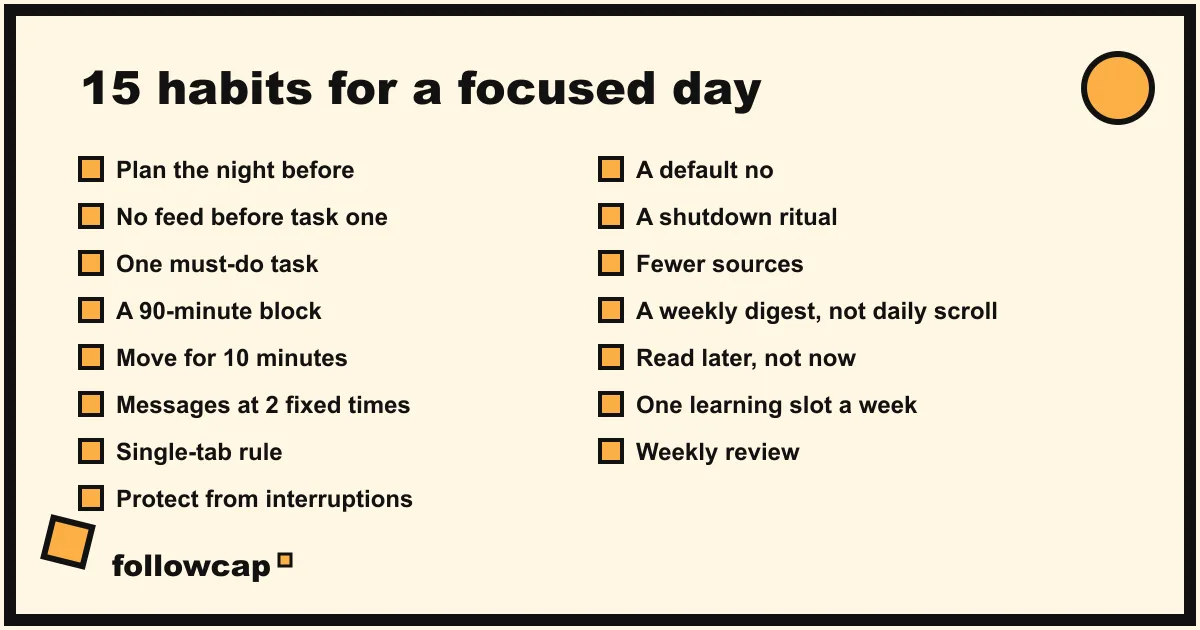
1. Plan the night before
Write tomorrow’s plan before you close the laptop today. Three lines are enough: the one task that must happen, two that should, and the first thing you’ll do when you sit down. Five minutes, and it removes the foggy “what now?” that eats the first hour of most mornings.
It works because at 6 p.m. you still have context: what’s blocked, what’s due, who’s waiting. At 8 a.m. you’d rebuild it by opening your inbox, which is the wrong place to decide what matters.
2. No feed before the first task
Don’t open Instagram, the news or your inbox until you’ve done the first real piece of work. Not “after coffee”. After the first task. The feed hands you ten small worries and three things to react to, and you’ll carry them through the morning.
Check in the first 30 minutes and other people set your agenda. Check after the first task and you’ve already won the morning. It’s the same principle behind our guide to stop doomscrolling, and it costs nothing.
3. One “must” task
Pick exactly one task that, if it’s the only thing you finish today, makes the day a success. One, not three. If your list has three “musts”, you’ll do the easiest and feel vaguely guilty about the other two.
Write it at the top of your notes. Everything else is “nice to have” until it’s done.
4. A 90-minute block
Give the “must” task a single uninterrupted block of about 90 minutes. Phone in another room, notifications off, one tab open. Ninety minutes is long enough to get past the uncomfortable first 20 minutes where you want to quit, and short enough that you can defend it on almost any calendar.
If 90 feels impossible, start with 45 and grow it. We compare block lengths (25, 52 and 90 minutes) in our time management techniques comparison if you want to pick yours more carefully.
5. Move for 10 minutes
Walk around the block, stretch, do ten push-ups. Not a workout: ten minutes of movement before the 90-minute block or right after it. It wakes you up more reliably than a second coffee, and low input is where ideas tend to show up.
Workday habits: how to focus at work when everything is loud
By mid-morning the day gets noisy: messages, meetings, “quick questions”. These five habits are about damage control.
6. Batch messages at 2 fixed times
Check email and chat at two fixed times, for example 11:30 and 16:00, and nowhere else. Tell the people who need to know. Most messages can wait three hours, and the ones that can’t will find you by phone. Batching turns 40 small interruptions into two planned sessions, and you’ll answer faster inside them because you’re in “reply mode”.
7. The single-tab rule
One tab for the thing you’re doing. Close the rest or move them into a separate window you don’t look at. Every open tab is a tiny open loop, and open loops pull attention even when you don’t click them. If you need a reference, open it, read it, close it. The rule is annoying for about two days and then it’s just how you work.
8. Respect the 23-minute cost of interruptions
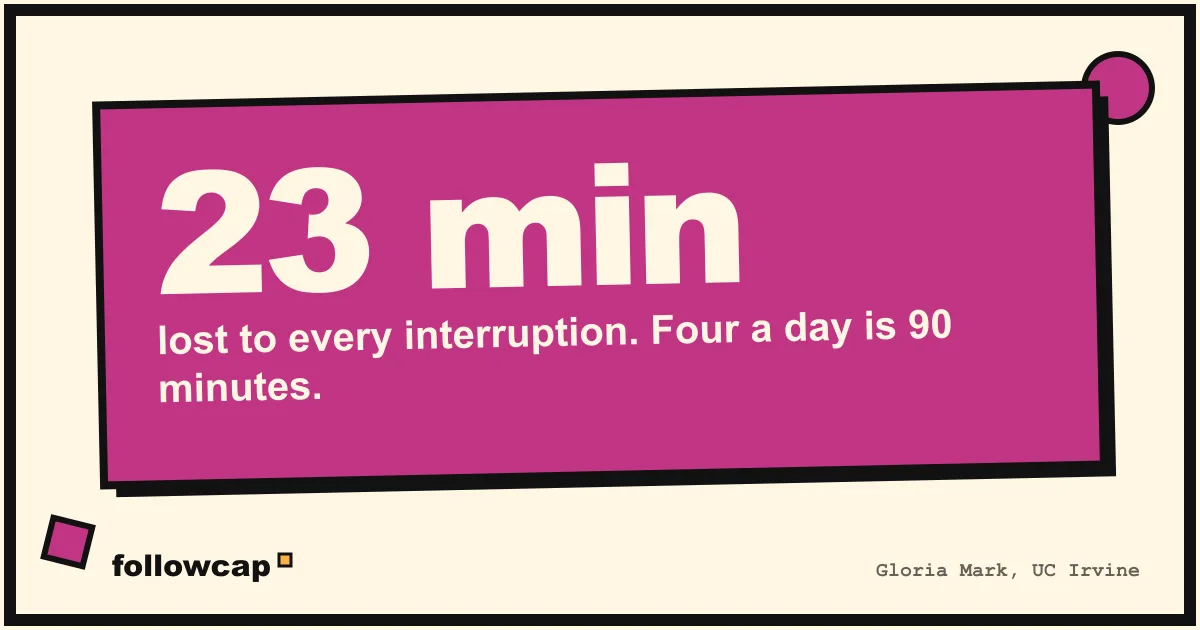
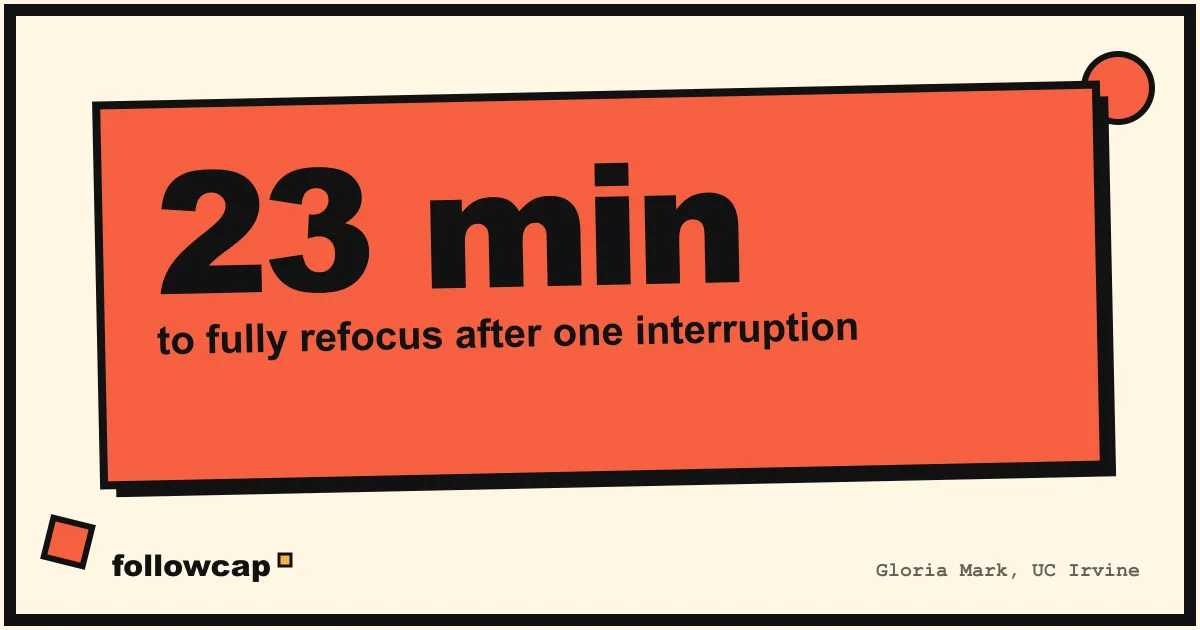
Research by Gloria Mark at UC Irvine found that it takes about 23 minutes to fully get back into a task after an interruption. Not 23 seconds: 23 minutes. A “two-minute” question or a glance at a notification costs you the better part of half an hour of real focus.
Do the maths on a normal day. Six interruptions, each with a 23-minute recovery, is more than two hours of lost focus, on top of the time the interruptions themselves took. This is why a quiet morning block beats a long, broken afternoon every time. Practically: notifications off during focus blocks, a visible “back at 11:30” status, and a note where you park the random thoughts that pop up.
9. Say no with a default
Decide in advance what you say to common requests. “I don’t take meetings before 11.” “I’ll look at it in my 16:00 batch.” A default saves you from negotiating every request on the spot, which is when you’re most likely to say yes to things you’ll regret. You’ll just stop saying yes by accident.
10. A shutdown ritual
End the day on purpose. Five minutes: tick off what’s done, move what’s not, write tomorrow’s three lines (habit 1), close the laptop. Without a shutdown, work leaks into the evening as a low background hum, and the feed becomes the thing you use to drown it out. With one, the evening is yours.
Input habits: stop wasting time on feeds you don’t need
This is the block most productivity advice skips, and the one with the biggest gains if you spend a lot of time on your phone. Feeds don’t only take time. They fill your head with things you didn’t choose and won’t use.
11. Cut the number of sources you follow
Count how many accounts, newsletters, channels and podcasts you follow. For most people it’s in the hundreds. Now count how many changed what you did in the last month. That’s usually under ten. Unfollow or mute everything that isn’t in the second group. You can always follow them again. Almost nobody does.
12. Replace daily scrolling with a weekly digest
For the handful of Instagram creators you actually learn from, you don’t need to see their posts the moment they go up. You need to see them once, in one place, with the noise stripped out. For example, 10 creators post about 58 reels, posts and stories a week, which is roughly 12 hours of scrolling to keep up with.
Followcap exists for exactly this. You pick the creators (up to 5, 10 or 20 depending on the plan) and every Sunday you get one email: a 30-second summary, the 3 posts you shouldn’t miss, a short recap of every post with the link, and what you can apply this week. The recap takes about 5 minutes to read, and you don’t need to log in to Instagram or share a password. It won’t make the feed disappear, but it removes the main excuse for opening it. There’s a 7-day free trial if you want to see whether it fits.
The same idea works with newsletters and RSS: see how to stay up to date without social media.
13. Read-later instead of read-now
When a link shows up during the day, don’t open it. Save it to a read-later list (any notes app works) and read the list in one sitting, once or twice a week. You stop breaking your focus for other people’s content, and about half the links turn out not to be worth reading.
14. One learning slot a week
Block one hour a week for learning: a course, a long article, a creator’s tutorial you saved. One slot, in the calendar, protected like a meeting. This is where the read-later list and the weekly digest get used instead of piling up.
15. A weekly review
Fifteen minutes on Friday afternoon or Sunday evening. What got done, what didn’t, what’s the “must” for Monday, which source can you unfollow this week. The review turns the other 14 habits into a system that corrects itself.
A sample day: how to be more productive without hustle
Here’s what the 15 habits look like on an ordinary Tuesday. Adjust the times to your life.
| Time | What you do | Habits used |
|---|---|---|
| 07:30 | Up, no phone. Coffee, 10-minute walk. | 2, 5 |
| 08:15 | Open yesterday’s three-line plan. Start the “must” task. | 1, 3 |
| 08:15 to 09:45 | 90-minute block. One tab. Phone in another room. | 4, 7, 8 |
| 09:45 | Short break. Now you can check the feed if you want to. | 2 |
| 10:00 to 11:30 | Second task or meetings. | 9 |
| 11:30 | First message batch, 30 minutes. | 6 |
| 12:00 | Lunch, no phone at the table. | 2 |
| 13:00 to 16:00 | Lighter work, calls, admin. Links go to read-later. | 13 |
| 16:00 | Second message batch, 30 minutes. | 6 |
| 16:30 | Shutdown ritual: tick, move, plan tomorrow. | 10, 1 |
| Evening | Yours. | |
| Sunday | Weekly recap email, read-later list, 15-minute review, one hour of learning. | 12, 13, 14, 15 |
Notice what’s missing: no 5 a.m. wake-up, no cold shower, no 12-hour day. It fits in a normal working day. It just has fewer holes in it. Some days still blow up by 9 a.m., and the habits help on those days too: a 45-minute block you salvage is still 45 minutes of real work.
FAQ
What is the single most important productivity habit?
If you only pick one, pick the 90-minute block on your one “must” task, before you open any feed. It combines habits 2, 3 and 4 and gives you a finished piece of real work by mid-morning. Everything after that is a bonus.
How long does it take to become more productive?
You’ll feel the difference the first day you run a clean 90-minute block. Making it stick takes two to three weeks of repetition, and most people drop a habit at least once before it holds. That’s normal.
Why do I feel busy all day but get nothing done?
Usually because the day is made of 47-second slices: a message, a tab, a notification, a quick check. Each feels small, but each costs around 23 minutes to recover from. Batching messages and protecting one block of focus fixes most of this.
Is social media really a productivity problem?
For many people, yes, because of how it’s used: dozens of short checks across the day, each one an interruption. Following fewer sources and moving the ones you keep into a weekly digest removes the reason for most of those checks.
The bottom line
Being more productive is not about squeezing more into the day. It’s about protecting your attention: a planned morning, one 90-minute block on the task that matters, messages in two batches, and far fewer inputs. Pick one habit from each block and run them for two weeks before adding more. And if Instagram is where your attention leaks, a weekly recap like Followcap gives you the posts worth seeing in 5 minutes on a Sunday, so the feed stops being a daily habit.