9 Time Management Techniques Compared (and How to Pick Yours)
Nine time management techniques compared side by side: Pomodoro, time blocking, Eisenhower, GTD and more, with a table and a simple way to pick the right one.
 Andrea Marino10 min read
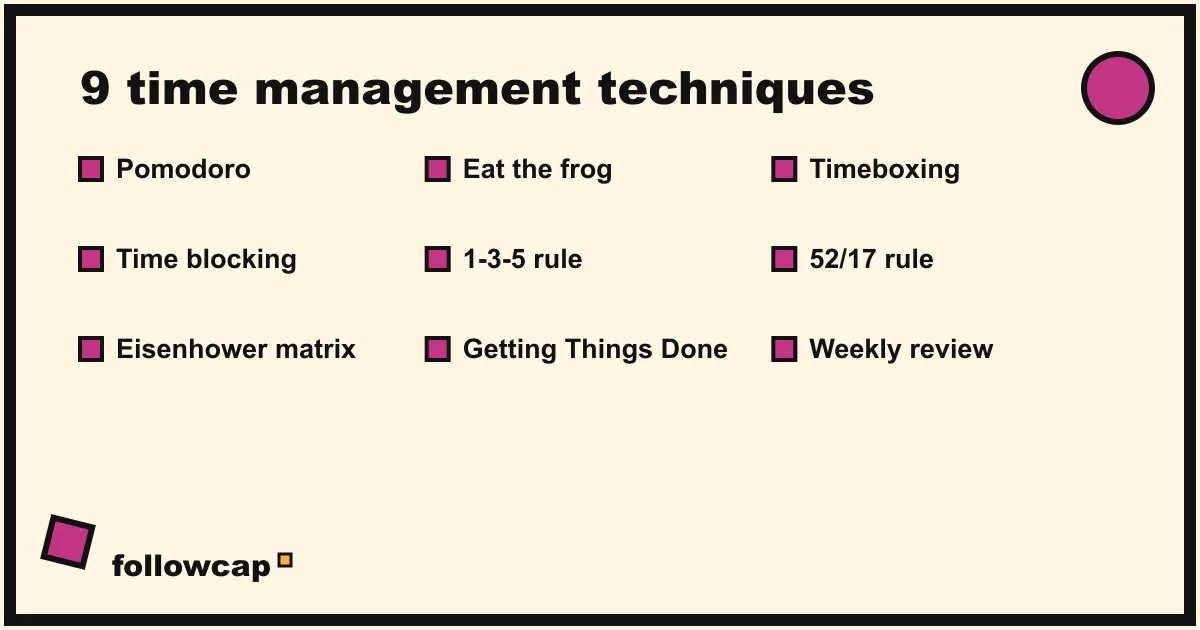
Time management techniques all promise the same thing, more done in fewer hours, but they solve very different problems. This comparison puts nine of the best-known methods side by side, from Pomodoro to GTD: how each works, who it suits, a table, and a quick way to pick yours.
Quick answer: The best time management technique depends on your main problem. Procrastination: Pomodoro or eat the frog. Interruptions: time blocking or the 52/17 rule. Too many inputs: a light version of GTD plus a weekly review. No overview: the Eisenhower matrix or the 1-3-5 rule. Start with one and run it for two weeks before adding another.
Why most time management techniques fail
They fail because they manage time, and your real problem is attention. Your calendar can be perfect and still fall apart if you check your phone around 144 times a day (Reviews.org, 2023) and switch tasks every 47 seconds on a screen (Gloria Mark, 2023). Every interruption costs about 23 minutes to fully recover from (Gloria Mark, UC Irvine). Six interruptions and the morning is gone, whatever the technique says.
Three other common reasons:
- The technique doesn’t match the problem. Pomodoro won’t fix an inbox with 300 unread messages. GTD won’t make you start the thing you’re avoiding.
- Too much setup. Some methods need a full system before they pay off. If you’re already overwhelmed, a system is one more thing.
- Nobody handles the inputs. Most techniques organise what you already have to do. None stops more coming in. More on that at the end.
So read the nine below with one question in mind: what’s my actual problem?
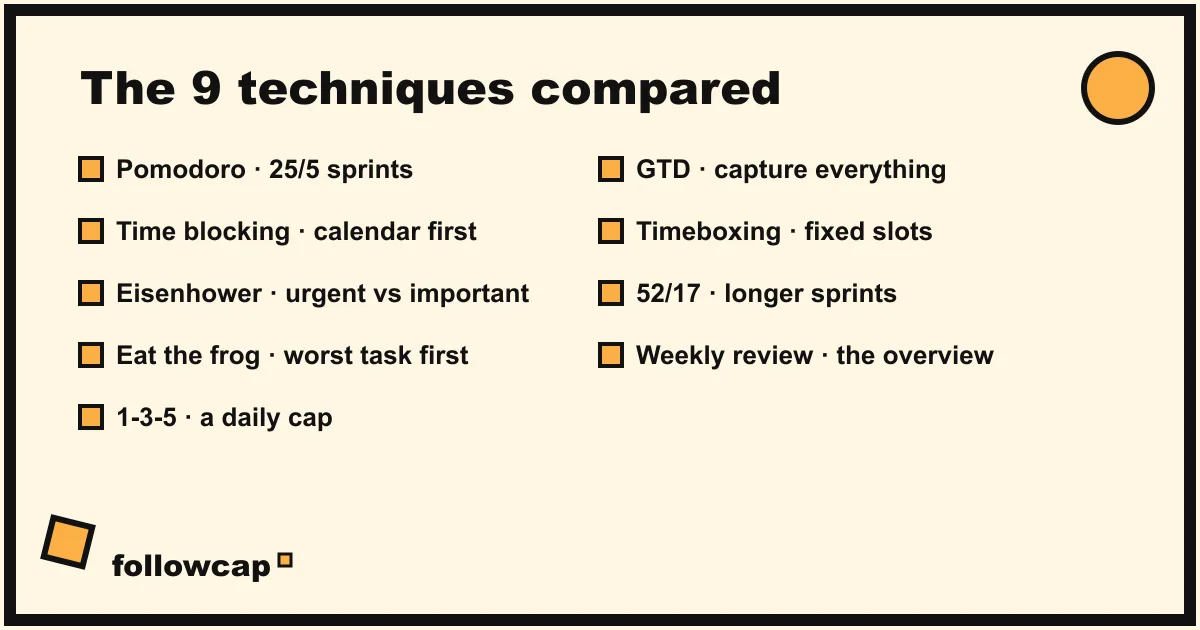
The 9 time management techniques, one by one
1. Pomodoro (25/5)
How it works. Set a timer for 25 minutes, work on one task, take a 5-minute break. After four rounds, take a longer break of 15 to 30 minutes.
Best for. Procrastination. A 25-minute block is small enough to start the task you’ve been avoiding, and starting is most of the difficulty.
Watch out. The breaks are the trap. If the 5 minutes become a phone check, each break turns into a 23-minute recovery and the method falls apart. Keep the breaks off-screen. Also, 25 minutes is short for deep work: in flow, the timer feels like interrupting yourself.
2. Time blocking
How it works. Divide the day into blocks and give each block one type of work: 9:00 to 10:30 writing, 10:30 to 11:00 messages, 11:00 to 12:30 the project. The calendar becomes the to-do list.
Best for. Interruptions, and days with many different responsibilities. Blocking makes your focus visible to other people and harder to steal.
Watch out. Blocks slip. A meeting runs over and by 2 p.m. the plan is fiction. Leave buffer, and expect to re-plan at lunch. Blocking also needs you to estimate how long things take, which most people get wrong for the first few weeks.
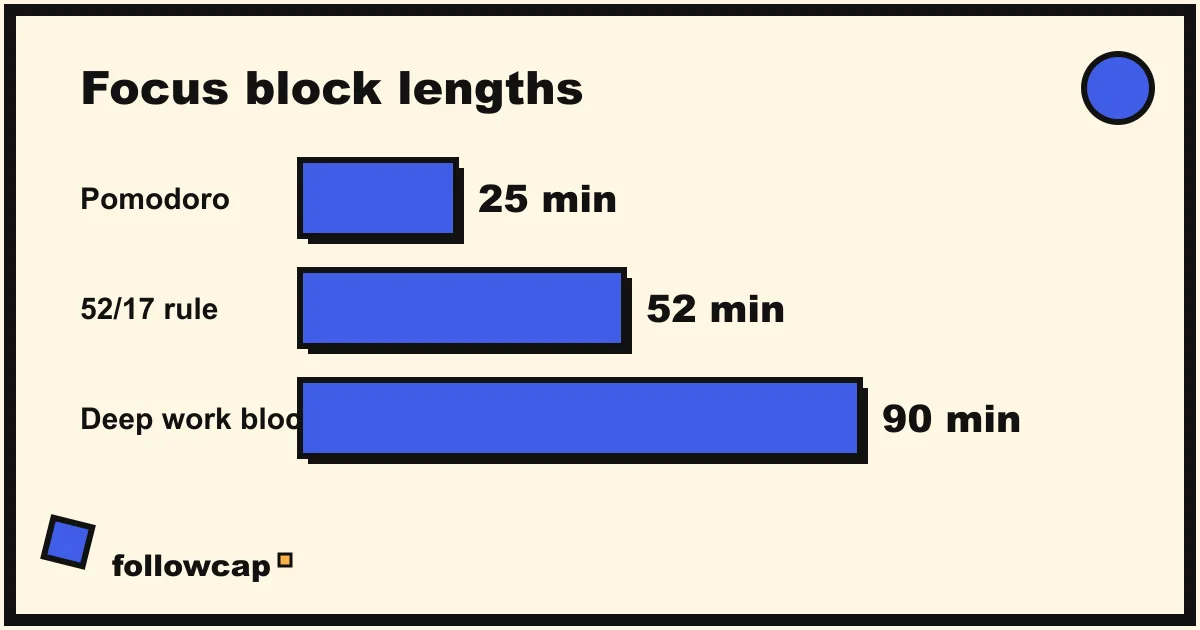
Three of these techniques come down to block length. Pomodoro gives you 25 minutes, the 52/17 rule gives you 52, and a classic time block for deep work is around 90. Shorter blocks are easier to start and easier to break; longer blocks are harder to start and produce more. Not sure? Start at 25 and grow it.
3. Eisenhower matrix
How it works. Sort tasks into four boxes: urgent and important (do now), important but not urgent (schedule), urgent but not important (delegate or batch), neither (drop). Most of the value is in noticing how much of your day sits in the “urgent, not important” box.
Best for. No overview. If you don’t know what matters, the matrix forces a decision. It’s also good for people who always do the urgent thing and never the important one.
Watch out. Everything feels urgent and important when you’re stressed, so it only works if you’re honest about the boxes. And it doesn’t tell you when to do anything: pair it with blocking or 1-3-5.
4. Eat the frog
How it works. Do the hardest, most important task first, before messages, before the feed. If you have to eat a frog, do it first thing in the morning.
Best for. Procrastination, and people whose energy is best early. One real thing done by 10 a.m. changes the whole day.
Watch out. Some people’s best hours are later, and forcing the frog at 8 a.m. means a bad hour of work. It only fixes one task a day; the rest still needs a plan.
5. The 1-3-5 rule
How it works. Each day, pick 1 big task, 3 medium tasks and 5 small ones. That’s your list. Nothing else gets added until something comes off.
Best for. No overview, and long lists that never shrink. Nine items is a limit, and limits are what most to-do lists lack.
Watch out. Nine is still a lot on a meeting-heavy day. Treat it as a ceiling, not a target, and don’t fill the five small slots with things that don’t need doing.
6. Getting Things Done (GTD)
How it works. Five steps. Capture everything that has your attention into one inbox. Clarify what each item is and what the next action is. Organise it into lists (next actions, projects, waiting for, someday). Reflect in a weekly review. Engage by picking the next action based on context and energy.
Best for. Too many inputs. If your problem is 40 open loops in your head, GTD is the one that gets them out. People juggling many projects tend to love it.
Watch out. It’s the heaviest system on this list. Full GTD takes a weekend to set up and a weekly review to keep alive; skip the review for two weeks and the lists rot. Many people keep only capture and the review and are fine.
7. Timeboxing
How it works. Give a task a fixed amount of time and stop when the time is up, finished or not. “The report gets 90 minutes, then it ships.”
Best for. Perfectionism, and tasks that expand to fill whatever time they’re given, like research or email.
Watch out. Easy to confuse with time blocking: blocking is about when, timeboxing is about how long. Stopping mid-task feels wrong at first. That’s the point, but it takes practice.
8. The 52/17 rule
How it works. Work for 52 minutes, break for 17. The numbers come from a time-tracking company’s analysis of its most productive users: a starting point, not a law.
Best for. People who find 25 minutes too short and 90 too long. Fifty-two minutes is enough to get somewhere, and the 17-minute break is long enough to actually step away.
Watch out. Same trap as Pomodoro, only bigger: a 17-minute break on the phone is a 17-minute feed session. Walk, stretch, make tea, talk to someone.
9. Weekly review
How it works. Once a week, 30 minutes: look at what got done, what didn’t and why, what’s coming, and what you can drop. Plan the “musts” for next week. Borrowed from GTD, works on its own.
Best for. Everyone, honestly. It’s the one technique that makes the others self-correcting. If you only pick one thing from this article, pick this.
Watch out. It’s the easiest one to skip, because nothing breaks the week you miss it. Put it in the calendar, same time every week, like a meeting with someone you respect.
Time management techniques compared: the table
| Technique | Best for | Effort to start | Works with a phone-heavy day? |
|---|---|---|---|
| Pomodoro (25/5) | Procrastination | Very low | Only if breaks stay off the phone |
| Time blocking | Interruptions | Medium | Yes, if blocks have notifications off |
| Eisenhower matrix | No overview | Low | Yes, but it doesn’t reduce the checks |
| Eat the frog | Procrastination | Very low | Yes, if the frog comes before the feed |
| 1-3-5 rule | No overview | Very low | Yes |
| GTD | Too many inputs | High | Partly: it organises inputs, it doesn’t cut them |
| Timeboxing | Perfectionism | Low | Yes |
| 52/17 rule | Short attention | Very low | Risky: 17 minutes is a long scroll |
| Weekly review | Everyone | Low | Yes |
Note the last column. A phone-heavy day breaks most techniques from the inside: the technique manages your calendar, the phone manages your attention.
How to pick the best time management method for you
Don’t pick by popularity. Pick by your main problem. Most people have one dominant one.
- “I can’t start.” Procrastination. Try eat the frog for the one task that matters, and Pomodoro to make starting cheap.
- “I can’t stay on anything.” Interruptions. Time blocking with notifications off, and a visible status so people know when you’re back. If 90-minute blocks feel too long, run 52/17 inside them.
- “I have too much coming in.” Too many inputs. A light version of GTD: one inbox, one list of next actions, a weekly review. Then cut the inputs themselves (next section).
- “I don’t know what matters.” No overview. Eisenhower matrix on Sunday evening, 1-3-5 every morning, weekly review on Friday.
Whatever you choose, run it for two weeks before judging. Most methods feel awkward for the first five days, and most people quit on day three. If it’s not helping after two weeks, swap it, no guilt. Our 15 habits for a focused day are a good base layer under any of these.
The input side: fewer feeds, one weekly recap
Every technique above organises what’s already on your plate. None of them stops more from arriving. And for most of us the biggest source of “more” isn’t email, it’s the feed: about 2 hours 21 minutes a day on social media worldwide (DataReportal, 2025), spread across dozens of short checks that each cost a chunk of focus. Two moves fix most of it.
Follow fewer sources. Count the accounts, newsletters and channels you follow. Keep the ones that changed what you did in the last month. Mute the rest. It takes 20 minutes.
Turn daily scrolling into one weekly check-in. For the Instagram creators you genuinely learn from, you don’t need to see every post the moment it lands. For example, 10 creators post about 58 reels, posts and stories a week, which is roughly 12 hours of scrolling to keep up. Followcap turns that into one email on Sunday: a 30-second summary, the 3 posts you shouldn’t miss, a short recap of every post with the link, and what you can apply this week, about 5 minutes to read. You pick the creators, up to 5, 10 or 20 depending on the plan, and there’s no Instagram login or password involved. Read it in your weekly review slot and the feed loses its main job. There’s a 7-day free trial if you want to try it.
For newsletters, YouTube and podcasts, our guide to staying up to date without social media covers the pull-based setup. If the feed keeps breaking your blocks, start with how to stop doomscrolling.
FAQ
What is the best time management technique?
There isn’t one. The best technique is the one that matches your main problem: Pomodoro or eat the frog for procrastination, time blocking for interruptions, GTD for too many inputs, Eisenhower or 1-3-5 for no overview. A weekly review helps with all four.
Is Pomodoro or time blocking better?
They solve different things. Pomodoro helps you start; time blocking protects longer stretches and makes your plan visible to others. Many people use both: blocks on the calendar, Pomodoros inside the blocks.
How long should a focus block be?
Long enough to get past the uncomfortable first 15 to 20 minutes, short enough to defend on your calendar. Twenty-five, 52 and 90 minutes are the common options. Start short and lengthen the block as it gets easier.
Can time management techniques help with phone addiction?
Partly. They give you a structure, but the phone will break it unless you also cut the inputs: notifications off, fewer sources, one weekly check-in instead of daily scrolling. Technique plus fewer inputs beats either alone.
The bottom line
Time management techniques work when they match your problem and when your attention isn’t being pulled apart 144 times a day. Pick one by your main problem, run it for two weeks, and add a weekly review. Then deal with the input side: fewer sources, notifications off, and a weekly recap like Followcap instead of daily scrolling, so the technique you chose has a fighting chance.