Social Media Detox: A 30-Day Plan That Doesn't Mean Quitting
A 30-day social media detox plan, week by week: cut notifications, time-box the feed, switch to pull-based sources and rebuild on purpose. Keep what matters.
 Andrea Marino10 min read
A social media detox does not have to mean deleting your accounts and announcing that you are “going offline”. This is a 30-day social media detox plan in four weekly steps: cut the parts that cost you time, keep the parts that earn their place. By day 30 you will have a feed you chose and a weekly habit that keeps you informed without the daily scroll.
Quick answer: a 30-day social media detox works best in four weeks: week 1 measure your use and kill notifications, week 2 limit the feed to fixed time boxes, week 3 replace the feed with sources you pull on purpose (newsletters, recaps, RSS), week 4 rebuild your follow list from scratch. You do not need to quit any platform.
What is a social media detox (and what isn’t it)?
A social media detox is a fixed period during which you deliberately reduce or change how you use social media, so you can see what it actually does for you and what it costs. The useful part is not the abstinence. It is the comparison: a month of lower use gives you a baseline to judge the old habit against.
What it is not:
- It is not a cure. A month off does not fix the reasons you scrolled. If you go back to the same setup, you get the same result within weeks.
- It is not all or nothing. You can detox from the feed and still message friends, still post for work, still watch the two creators who actually teach you something.
- It is not a punishment. If the plan makes you miserable, you will quit it. Build it so that each week is slightly uncomfortable, not painful.
That is the practical meaning of a social media cleanse: clear out what you did not choose, then decide what comes back in.
What are the benefits of a social media detox?
Be careful with anyone who promises a new personality in 30 days. The benefits people most often report are modest and real:
- Time back. Worldwide, people spend about 2 hours 21 minutes a day on social media (DataReportal, Digital 2025). Even halving that returns around 8 hours a week.
- Better sleep, mostly because the phone leaves the bedroom and the last hour of the day gets quieter.
- Fewer interruptions. Research by Gloria Mark at UC Irvine suggests it takes about 23 minutes to fully refocus after an interruption. Every notification you turn off is a small chunk of attention you keep.
- Less comparison. Many people feel calmer when they stop seeing other people’s highlights fifty times a day. Not everyone does.
- Clarity about what you actually like. By week three, you know which accounts you miss and which you had forgotten about.
It usually does not cure anxiety or fix procrastination on its own. Lower input helps; it does not replace the work.
How long should a social media detox last?
Long enough to get past the itch, short enough that you finish. A weekend barely interrupts the habit. A week is enough to notice the reflex. Thirty days is long enough for the reflex to weaken, for the “what did I miss” anxiety to fade, and for a new weekly routine to form. Three months is better still, but few people start a three-month plan, so thirty days is the honest compromise.
If 30 days feels like a lot, treat week one as the commitment and decide about the rest on day 7. Most people continue.
Before you start: measure your baseline and decide what you keep
Spend 20 minutes on this before day 1.
Measure where you are
Open Screen Time (iOS) or Digital Wellbeing (Android) and write down three numbers for the last 7 days: total screen time, time in your top three social apps, and number of pickups. For context, the average daily screen time worldwide is about 6 hours 38 minutes (DataReportal, 2025), and people check their phone around 144 times a day (Reviews.org, 2023). Do not judge your numbers; you just need something to compare against on day 30.
Decide what you keep
Write two short lists:
- Must keep: anything tied to work or to relationships you cannot move elsewhere. A business account, a family group, a creator whose posts you genuinely apply.
- Nice but not needed: everything else. This is most of your feed.
The detox applies hard to the second list and gently to the first.
The 30-day social media detox plan, week by week
Each week adds one change and keeps the previous ones.
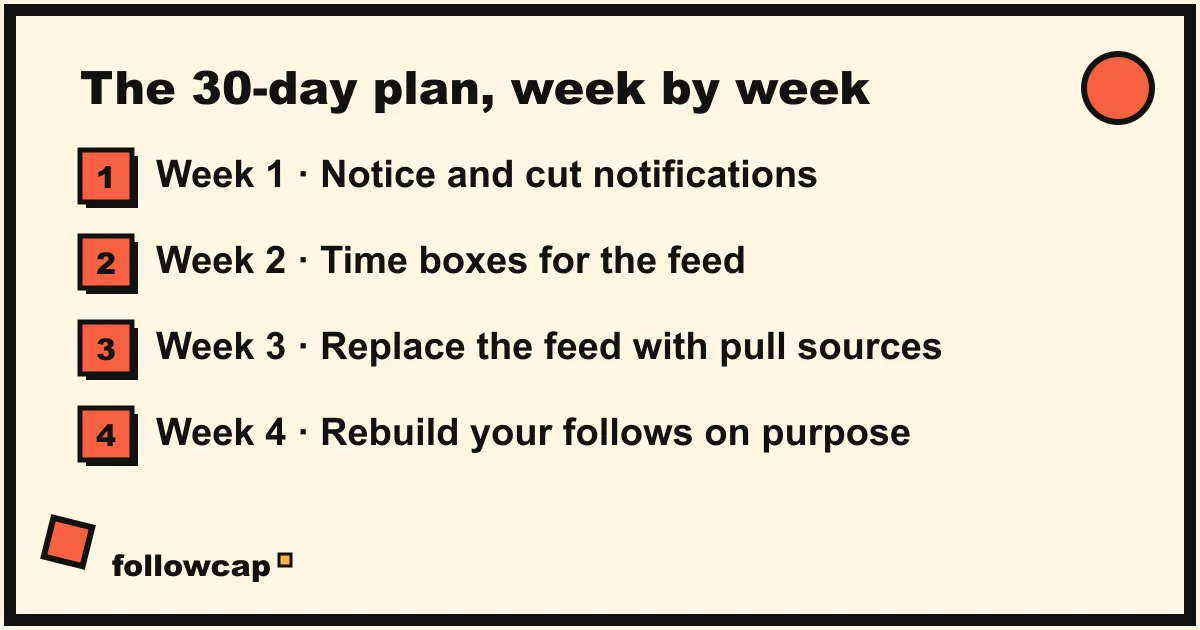
Week 1 (days 1 to 7): notice, and cut notifications
The goal this week is awareness, not restriction. Keep using the apps, but:
- Turn off every social notification that is not a direct message from a real person. Likes, mentions, “X posted a reel”, suggested posts: all off.
- Move social apps off the home screen into a folder on the last page.
- Keep a scroll log. Each time you open a feed, note the trigger in one word: bored, waiting, bed, avoiding, habit.
By day 7 you will know your real triggers; most people find two or three moments account for most of their use.
Week 2 (days 8 to 14): time boxes
Now add limits. Pick two fixed windows a day when the feed is allowed, for example 12:30 to 12:50 and 20:00 to 20:30. Outside those windows, the apps stay closed. Use an app limit in Screen Time or Digital Wellbeing as a reminder, and a pause app like one sec or ScreenZen if the system limit is too easy to skip.
Two rules make this work:
- No feed in bed. The phone charges outside the bedroom from this week on. This is the single change with the biggest effect on sleep, and the one people resist most.
- No feed as a filler. Waiting, queues, the toilet, ad breaks: these are the moments your week-one log flagged. Pick a replacement for each (a read-later app, a podcast, nothing at all).
Expect this week to feel twitchy. The urge to check peaks around day 10 and fades after. If you are struggling specifically with late-night sessions, our guide on how to stop doomscrolling has a set of habits built for that moment.
Week 3 (days 15 to 21): replace the feed with pull-based sources
This is the week that makes the detox stick, and the one most plans skip. The feed is a push system: it decides what you see and when. The alternative is pull: you decide what you want and fetch it on your own schedule.
For every account on your “must keep” list, find a pull-based way to follow it:
| What you follow | Pull-based alternative |
|---|---|
| A writer or expert | Their newsletter, or their blog in an RSS reader |
| A YouTuber or podcaster | Subscriptions in a podcast app or RSS reader, checked once a day |
| A news source | One daily or weekly briefing email, not the live feed |
| Instagram creators you learn from | A weekly recap email of their posts |
For the Instagram part, Followcap is one option: a Sunday email that summarizes what the creators you choose posted that week, highlights the three posts worth your time, and gives a short recap of each post with its link, with no Instagram login needed. For example, 10 creators post about 58 reels, posts and stories a week, which is roughly 12 hours of scrolling to keep up with, and the recap takes about 5 minutes to read. There is a 7-day free trial if you want to test it this week, and more detail at followcap.com. It covers Instagram only, so pair it with newsletters or RSS for everything else.
By the end of week three, your “must keep” list should be reachable without opening a single feed. If something still needs the app, write it down and solve it next week.
Week 4 (days 22 to 30): rebuild on purpose
With the feed closed for a week, you finally have perspective. Now rebuild:
- Unfollow in bulk. Open each app once, go through your follow list, and unfollow or mute anyone you did not miss. Be ruthless: you can always re-follow.
- Curate what stays. Keep a short list, ideally under 20 accounts per app, of people whose posts you would actually act on. Put them in a Close Friends list, a Favorites feed, or an X list so you can see only them.
- Set the permanent rules. One time box a day, or one check-in a week, whichever you kept to more easily in week two. Notifications stay off. The phone stays out of the bedroom.
- Re-measure. On day 30, pull the same three numbers from Screen Time or Digital Wellbeing and compare. Most people see social app time drop by half or more, and pickups fall noticeably.
Our list of ways to spend less time on your phone has more small tweaks to layer on in this week if you want them.
What to do after day 30
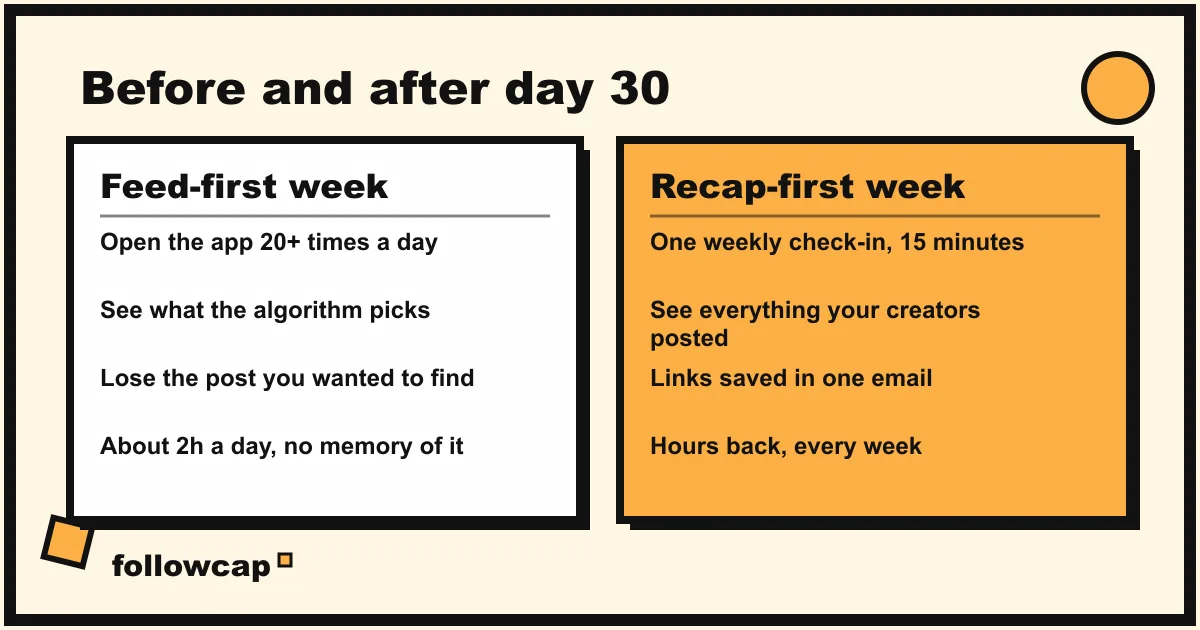
Day 31 is where most detoxes die: you “finished”, the rules relax, and within a month you are back at baseline. Treat day 30 instead as the switch from a feed-first week to a recap-first week.
| Feed-first week | Recap-first week |
|---|---|
| Open the app 10+ times a day, whenever there is a gap | Open the app once a day in a time box, or once a week |
| See whatever the algorithm picks | See the 10 to 20 accounts you chose |
| Catch up in fragments, forget most of it | Catch up in one sitting, apply one thing |
| Finish the week not sure where the time went | Finish the week with hours back and a short list of what mattered |
Keep three things from the plan permanently: notifications off, the phone out of the bedroom, and the pull-based sources from week three. Everything else can flex. If you slip, do not restart the whole 30 days; go back to the week where the rule broke, and run it for seven days.
A light repeat every few months (a week-one audit plus a week-four clean-up) keeps it that way. For more on building the pull side, see our guide to staying up to date without social media.
FAQ
Do I have to delete my social media accounts?
No. Deleting accounts creates a reinstall-and-binge cycle for many people. Changing the setup (notifications, time boxes, pull-based sources, a curated follow list) lasts longer because it survives the day you need the app for something.
What are the first days of a social media detox like?
Days one to three are usually fine, because week one still allows the apps. The hard stretch is days 8 to 12, when time boxes start and the reflex is still strong. Expect phantom pickups and more boredom than usual. It fades.
Can I do a social media detox if I need Instagram for work?
Yes. Separate the work use from the personal scroll: a work-only account, desktop-only access for posting, and a strict time box. The detox targets the unplanned personal scrolling, not the ten minutes of posting for your business.
What should I do with the time I get back?
Decide in advance, or the phone will take it back. Pick one thing per time slot you freed: a book for the bedtime slot, a walk after lunch, a hobby for the evening. The replacement has to be at least a bit rewarding.
Will I lose touch with people?
With close friends, no: messaging is not part of the detox. With acquaintances whose lives you followed passively, somewhat, and most people are fine with that by week three. For creators you learn from, newsletters and weekly recaps keep you informed without the feed.
The bottom line
A social media detox works when it changes your setup, not just your willpower for a month. Measure your baseline, cut notifications, box the feed into fixed windows, replace it with sources you pull on your own schedule, and rebuild your follow list from the people you actually missed. After day 30, keep the three rules that cost you least and gave you most. If Instagram creators are part of what you want to keep, a weekly recap such as Followcap lets you stay informed in minutes instead of hours. The scroll was never the point; the people and the ideas were.