Social Listening vs Social Monitoring: The Difference, With Examples
Social listening vs social monitoring in one table: what each is, examples per job, which teams need which, tools with prices, and the third job both names miss.
 Andrea Marino13 min read
Social monitoring is tracking and answering the individual mentions, comments and messages aimed at your brand, usually today. Social listening is analysing the whole conversation around your brand, category and competitors over weeks, to find patterns and decide what to change. Monitoring is a customer service job; listening is a research job.
Quick answer: monitoring = what people say to you, handled one message at a time, measured in response time. Listening = what people say about you and your market, handled as a dataset, measured in insights that changed a decision. Most small teams need monitoring first, listening once they have more than a few hundred mentions a month, and a third thing neither word covers: keeping up with a short list of specific accounts.
Social listening vs social monitoring at a glance
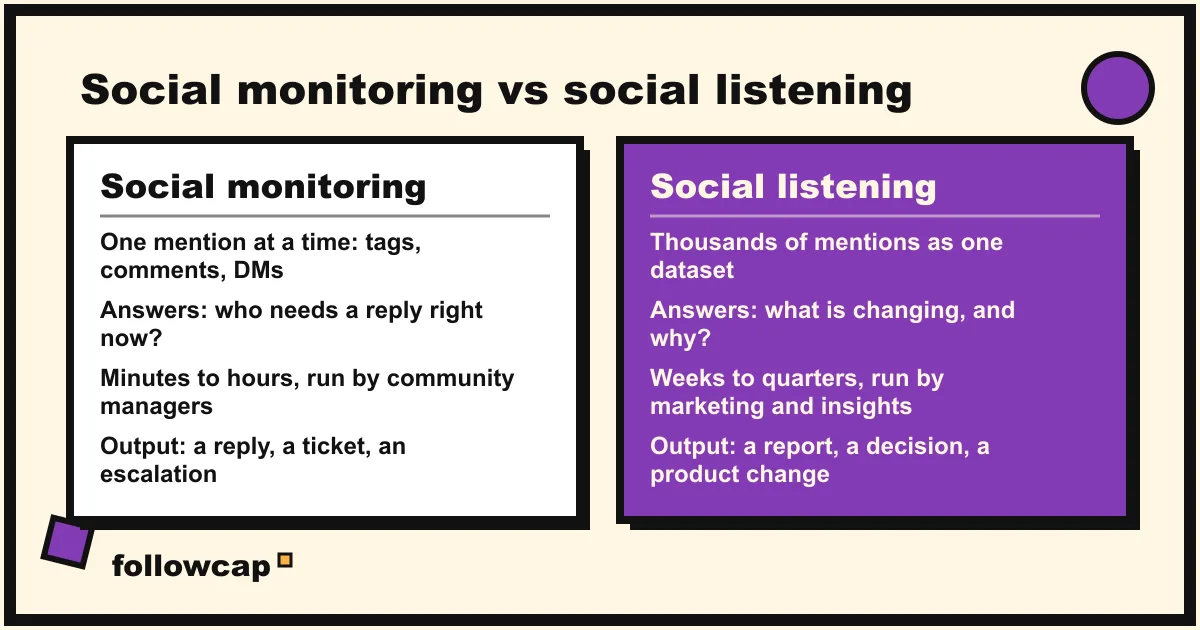
| Social monitoring | Social listening | |
|---|---|---|
| Definition | Tracking and responding to mentions, tags, comments and DMs that name your brand | Analysing conversations about your brand, competitors and industry to find trends and sentiment |
| Unit of work | One mention | A set of thousands of mentions |
| Question it answers | “Who needs an answer right now?” | “What is changing, and why?” |
| Time horizon | Minutes to hours | Weeks to quarters |
| Who runs it | Community manager, support | Marketing, insights, product |
| Output | A reply, a ticket, an escalation | A report, a decision, a content or product change |
| Typical tool | Native inboxes, Meta Business Suite, Hootsuite, Sprout | Brand24, Talkwalker, Brandwatch, Sprout Listening |
| Can be done by hand? | Yes, at small volume | Not really |
The sentence that keeps the two apart: monitoring tells you what people said, listening tells you what it means. The definition table is the part most guides get right. Where they go thin is the examples, the question of who actually needs listening, and the job that sits between the two.
What social monitoring is, with examples
Monitoring is the reactive half. Someone tags your account, comments on a post, DMs a question or writes your name without a tag, and a person on your team sees it and acts. The scope is narrow on purpose: your brand, your products, your campaign hashtags, your executives if they are public.
Three concrete examples:
- A bakery with 4,000 followers. A customer posts a Story tagged with the shop’s handle saying the croissants sold out by 9 a.m. The owner reshares it, replies with tomorrow’s batch time, and notes the complaint. That is monitoring, done in the Instagram app for free.
- A software company. A user writes “login is broken again” with the product name but no tag. A monitoring tool built on keyword alerts catches the untagged mention; support replies within the hour and opens a ticket. Native notifications would have missed it, because Instagram only notifies you of mentions in comments and tags, as its own notifications help page lists.
- A hotel. A guest comments on a competitor’s post asking whether anyone has stayed at your property. Monitoring for your brand name surfaces it and the team answers with a link.
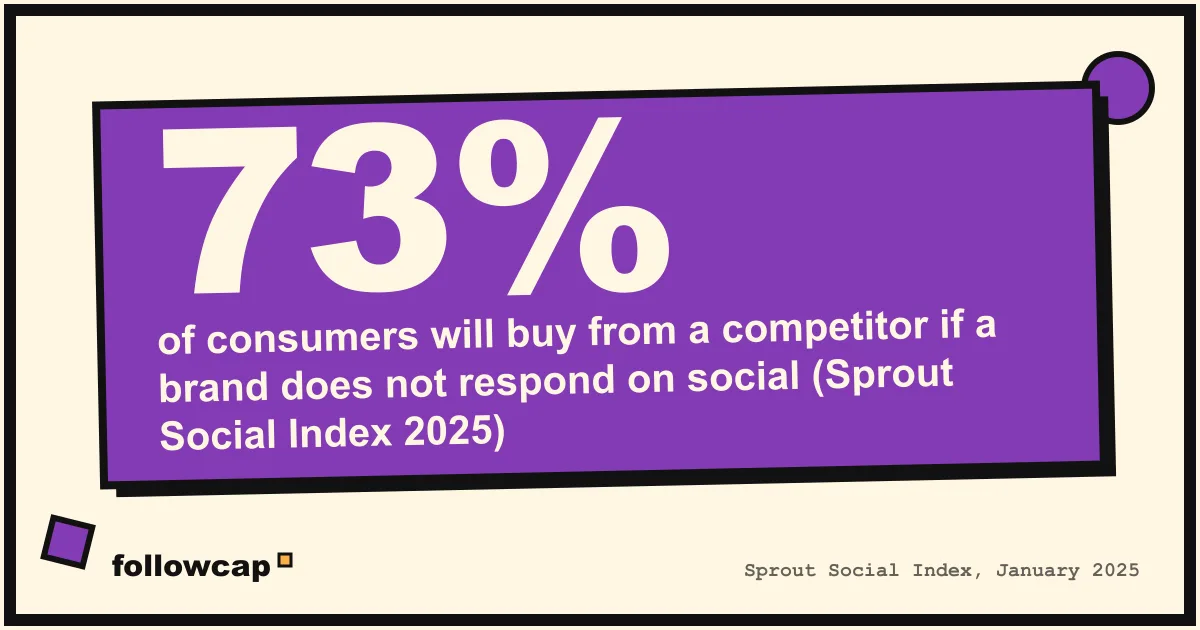
The urgency is real. In the Sprout Social Index released in January 2025, 73 percent of consumers said they will buy from a competitor if a brand does not respond on social, from a survey of 4,044 consumers in the US, UK, Canada and Australia. Monitoring is how you avoid being that brand.
What monitoring does not do: it will not tell you that complaints about shipping doubled this month, because every mention is handled and closed on its own. That is the listening question.
What social listening is, with examples
Listening is the analytical half. You collect every public post that mentions your brand, your competitors or the words your market uses, over a long window, and you look at the shape of the pile: volume over time, sentiment, recurring themes, which competitor is gaining, which complaint is new.
Three examples, each a decision rather than a reply:
- A skincare brand notices in a listening tool that “fragrance-free” appears in 18 percent of category conversations this quarter, up from 9 percent, and most of those posts are not about its brand. The product team moves a fragrance-free line up the roadmap.
- A regional bank sees that the mentions tagged negative are not about rates but about the app’s login flow, and that they spike every Monday morning. The insight goes to engineering, not to the community manager.
- A running-shoe company watches a competitor’s launch. Monitoring would show thirty tagged questions; listening shows that half of the total conversation is price comparisons with its own model. Marketing reprices the bundle before the weekend.
Listening is also how brands avoid trend-chasing badly. The same Sprout release found that 93 percent of consumers think it is important for brands to keep up with online culture, and a third think jumping on viral trends is embarrassing. You cannot tell the difference between a trend that fits your brand and one that does not by reading a few tagged comments; you need the wider conversation.
The limit of listening is the opposite of monitoring’s: it is slow, it costs money, and it only makes sense when there is enough conversation to analyse. A brand with 40 mentions a month does not have a dataset; it has 40 messages to answer.
The third job nobody names: watching specific accounts
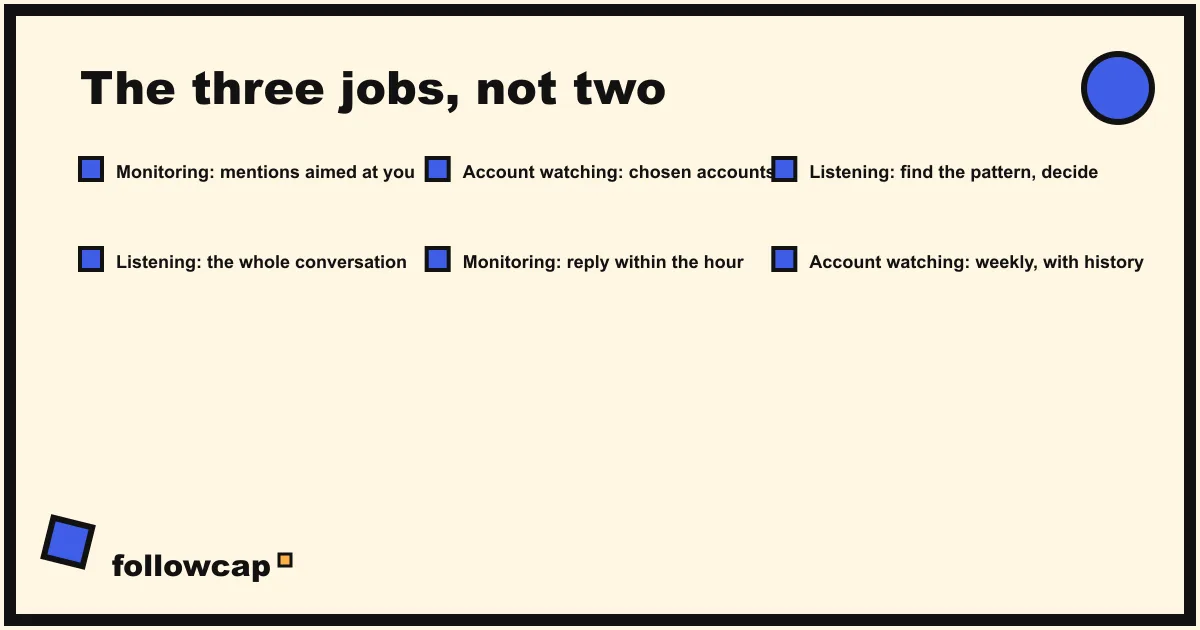
Both words start from the same place: content that talks about you, or about your market in general. Neither describes the job most small marketing teams, agencies and creators actually spend time on, which is keeping up with a chosen list of accounts. Five competitors. Ten creators you might sponsor. The twenty accounts in your niche whose hooks you study. Nobody there mentions you, and you do not care what the whole internet thinks; you care what those accounts posted this week, how it performed, and what you should take from it.
Call it account monitoring or creator monitoring. It is closer to monitoring in scope (a short, named list) and closer to listening in purpose (patterns over time, decisions rather than replies). Listening tools can do it, badly and expensively, by setting each handle as a keyword; monitoring inboxes cannot do it at all, because nothing lands in your inbox. The practical options are a spreadsheet, a weekly ritual, or a tool built for it. How to monitor competitors on social media is the routine; how to track influencers and creators for your brand is the creator side.
This is the job Followcap does, and since it is our product, read this as the maker’s description. You type the usernames of public Instagram creator or business accounts, with no Instagram login, and every Sunday you get one email with a 30-second summary, the three posts not to miss, a two to three line recap of the best posts from each account with their links, and “what you can apply this week.” Three accounts are free with no card. Premium (€9 a month, 10 accounts) adds weekly numbers per account (posts, likes, comments, best post, follower growth) and a personal archive; Business Pro (€29 a month, 50 accounts, 3 team users) adds a monitoring dashboard with alerts, CSV export and a “you vs your niche” view. The limits are the point: it is weekly, not real time; it covers public creator and business accounts only; it sees public posts, likes, comments and follower counts, so no reach, saves, views, mentions, hashtags or audience data; and it is not a listening tool, because it never searches for your brand name. Paid plans are paid after the 7-day trial, with a 30-day money-back.
Which teams need which
The honest split by situation, not by company size:
| Situation | Monitoring | Listening | Account watching |
|---|---|---|---|
| Under 100 mentions a month | Yes, by hand in the native apps | Not yet | Yes, 5 to 10 accounts |
| 100 to 2,000 mentions a month, one or two social people | Yes, with a unified inbox | Light: a keyword tool for the brand name and two competitors | Yes |
| Several brands or markets, a dedicated social team | Yes, with routing and SLAs | Yes, with a real listening platform | Yes, usually in a sheet nobody updates |
| Agency with client accounts | Yes, per client | Only for clients who pay for it | Yes, for every client’s competitors |
| Creator or solo business | Yes, your own comments and DMs | No | Yes, the accounts you learn from |
The pattern: monitoring is universal, listening is conditional on volume and budget, and account watching is the one almost everyone does and almost nobody tools. The exception is enterprise consumer brands, where listening comes first because the conversation is too large to read and the risk of missing a crisis is the cost that justifies the platform.
Tools per job, with prices from the official pages
Prices below are the lowest advertised tier on each vendor’s own pricing page as of November 2026, on annual billing where that is the default shown. Social media monitoring tools compares nine of them in depth; best Instagram monitoring tools narrows it to one platform.
| Tool | Job | What it watches | From | Best for |
|---|---|---|---|---|
| Native apps (Instagram, Facebook, X, TikTok) | Monitoring | Tags, comments, DMs on your own accounts | Free | Any account under 100 mentions a month |
| Google Alerts | Monitoring (web) | Web pages and news mentioning a term; it does not cover social posts | Free | Catching press and blog mentions |
| Hootsuite | Monitoring, basic listening | Unified inbox plus brand and competitor monitoring on Standard; advanced listening with Lumen on Enterprise | $99 per user per month | Teams that want inbox and scheduling in one |
| Sprout Social | Monitoring, listening as add-on | Smart Inbox and brand keywords; Listening is a separate add-on on Standard and up | $199 per seat per month for Standard, plus the add-on | Teams with budget for both jobs in one vendor |
| Brand24 | Listening | Mentions across social, news, blogs, video, podcasts and reviews, with sentiment | $199 per month (Individual, 3 keywords, annual) | A first real listening tool for one brand |
| Mention | Listening and monitoring | Web and social mentions, alerts, a shared inbox | See its pricing page | Agencies watching several brand names |
| Weekly account recap (ours, described above) | Account watching | Public posts, likes, comments and follower counts of chosen Instagram accounts, weekly | Free for 3 accounts | Watching competitors and creators without a login |
Two notes on the table. Google Alerts is in it because people search for it as a social listening tool and it is not one: it indexes web pages, not Instagram or TikTok posts, so it is a cheap press monitor and nothing more. And the Hootsuite and Sprout figures are per user or per seat, so a three-person team pays three times the number.
How to tell which one you are doing
A quick test when a vendor says “listening” and means “monitoring”, or when your own team conflates them:
- Count the unit. If the output is a reply to one person, it is monitoring. If the output is a chart, it is listening. If the output is “here is what the ten accounts we follow did this week”, it is account watching.
- Check the clock. Monitoring that runs weekly is broken; a complaint from Tuesday answered on Sunday is a lost customer. Listening that runs hourly is noise; patterns need weeks.
- Ask who acts. Monitoring ends with the community manager. Listening ends with someone outside the social team: product, pricing, support leadership.
- Look at the keyword list. Monitoring lists your names. Listening lists your category’s words and your competitors. Account watching lists handles.
Most “social listening” dashboards in small companies fail test 3: the chart gets made, nobody outside marketing reads it, and the subscription gets cancelled in month four. If no one else will act on the findings, run monitoring well and skip listening until that changes.
What no tool can show you
Every vendor in the table works from public data, and all three jobs share the same blind spots:
- Private conversations. DMs between other people, private accounts, closed groups and most of WhatsApp are invisible to listening tools. The share of your category’s conversation that happens there is unknown, and it is not small.
- Instagram and TikTok at full depth. Keyword search on Instagram is limited compared with X, so listening tools see tagged mentions, captions and hashtags, not every post that names you in an image or a voiceover.
- Other accounts’ reach, saves and views. Account watching sees what is public: posts, likes, comments, follower counts. Reach, saves, Story views and audience demographics belong to the account owner’s Insights and nobody else, which how to see analytics of other Instagram accounts explains in detail.
- Sentiment with nuance. Automated sentiment misreads sarcasm, slang and mixed reviews. Treat the sentiment number as a trend line, not a fact.
FAQ
Is social listening the same as social monitoring?
No. Monitoring tracks and answers the individual mentions, comments and messages that name your brand, in near real time. Listening analyses the full conversation around your brand, competitors and industry over weeks to find patterns, sentiment and decisions. Monitoring is reactive and tactical; listening is proactive and analytical. Most teams need both, in that order.
What is an example of social monitoring?
A customer tags your account in a Story saying their order arrived damaged; your community manager replies within the hour, apologises and sends a replacement link. Another: a keyword alert catches an untagged “your-brand login broken” post and support opens a ticket.
What is an example of social listening?
A listening tool shows that negative mentions of a bank are not about rates but about the app’s login, and that they spike on Monday mornings. The finding goes to engineering and the release schedule changes. No individual mention was answered; a pattern was found and acted on.
Which should a small business start with?
Monitoring, in the native apps, until the volume stops fitting in one person’s day. Add a keyword tool when untagged mentions start slipping through. Add listening when there is enough conversation to analyse and someone outside the social team who will act on it. In parallel, keep a short list of competitors and creators you check every week.
Can you do social listening for free?
Partly. Native search in each app, Google Alerts for web mentions and a spreadsheet get you a thin version of listening for one brand name. What you cannot get free is history, sentiment at scale and cross-platform volume; the first paid tier of a dedicated tool starts around $199 a month.
Is social listening the same as competitor analysis?
They overlap. Listening tools compare share of voice and sentiment between you and competitors across the whole conversation. Instagram competitor analysis is narrower and more concrete: what specific competitor accounts post, how often, which formats, and how their likes and comments move, which is account watching rather than listening.
Related reading
- How to Keep Track of Competitors on Social Media Without a Big Budget
- How to See Competitors’ Ads on Instagram (Meta Ad Library, Step by Step)
- Instagram Monitoring: What It Is and How to Do It in 20 Minutes a Week
The bottom line
Social monitoring is answering what people say to you, one mention at a time, today. Social listening is analysing what people say about you and your market, as a dataset, over weeks. Start with monitoring, because an unanswered mention costs a customer; add listening when the volume justifies the price and someone outside the social team will act on it. And name the third job honestly: keeping up with a short list of competitors and creators, which is neither, and which a spreadsheet or a weekly recap such as Followcap, which we make, covers from public posts, likes, comments and follower counts alone.