How to Track Influencers and Creators for Your Brand Without an Agency
Build a list of 20 to 50 creators in your niche, log the public numbers weekly, score fit, spot sponsored posts and time your outreach, with no agency and no scraper.
 Andrea Marino10 min read
Influencer marketing has a small-business problem: the agencies and platforms are priced for brands with a budget line, and everyone else scrolls Instagram hoping to notice the right creator. Influencer Marketing Hub’s 2025 benchmark report estimated the industry at roughly 32.5 billion dollars worldwide, and found that nano creators, under 10,000 followers, made up about three quarters of Instagram’s influencer base in 2024. That second number is the opportunity. The creators who fit a small brand are small themselves, on no agency’s roster, and everything you need to evaluate them is public. This is the system we use: a list, a weekly log, a fit score and a sense of timing.
Quick answer: build a list of 20 to 50 public creators in your niche. Once a week, record for each one the posts published, average likes and comments, follower change, and any brand mentions or paid partnership labels. Score fit out of 10 on audience match, engagement, content quality, posting pace and existing deals. Reach out to the top ten when their numbers are rising and they have not just posted a competitor’s campaign.
What can you see on a creator’s Instagram account?
Everything a brand needs for a first decision is on the public profile, and everything it needs for the final decision is not.
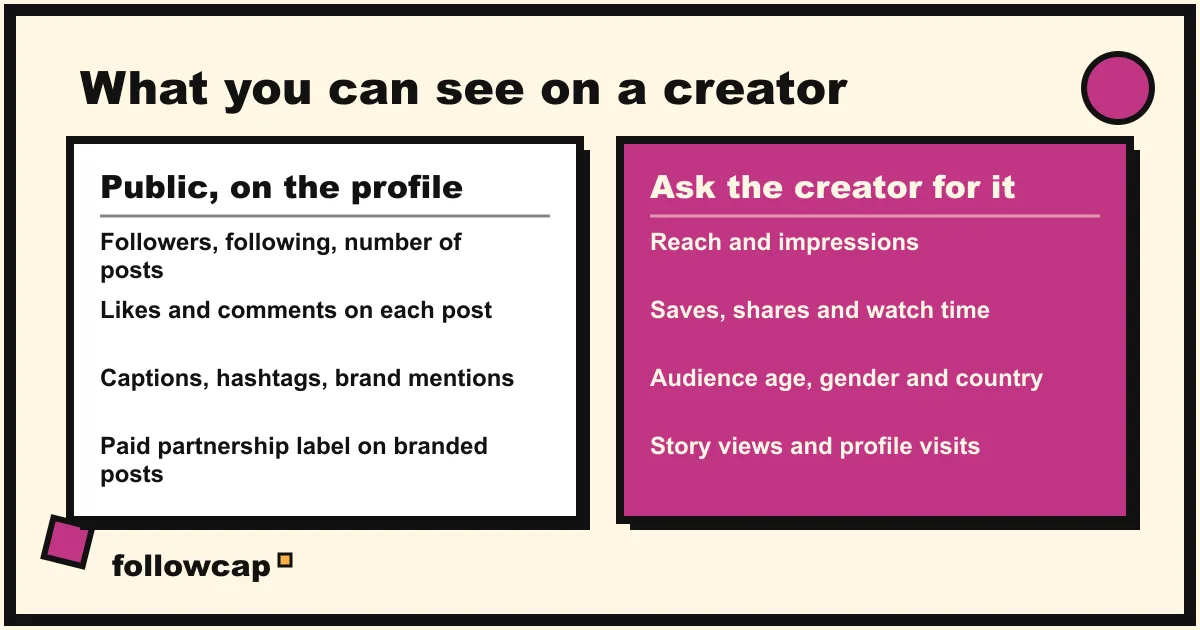
Public, on any creator or business account as of 2026: follower and following counts, number of posts, likes per post unless the account hides them, comments, the view count shown on reels, captions, hashtags, mentions, posting dates, and the paid partnership label on branded content. Private, visible only in the creator’s Instagram Insights: reach, impressions, saves, shares, watch time, story views, and audience age, gender and country.
The private half is what you ask the creator for once you are interested. Any tool that claims to show it without the creator is estimating. The full split is in how to see analytics of other Instagram accounts.
How do you build a list of 20 to 50 creators?
Twenty is enough to compare, fifty is the most one person can log in an hour a week. Build it over two weeks, from four sources.
- Your own commenters. Open your last 20 posts and note any commenter with a creator or business account in your niche. They convert fastest.
- Hashtags and locations. Pick the five hashtags your customers use, open each, switch to recent, and note accounts that appear more than once. Do the same with your city if you sell locally.
- Tagged photos on competitors. A competitor’s tagged tab shows who posts about them, including creators they have paid.
- Suggested accounts. Open a creator who fits and tap the arrow next to Follow. Take two or three suggestions and move on.
Record each one with four columns: handle, follower count, niche fit in one line, and where you found them. For a small brand, keep most of the list between 2,000 and 50,000 followers.
What should you record every week?
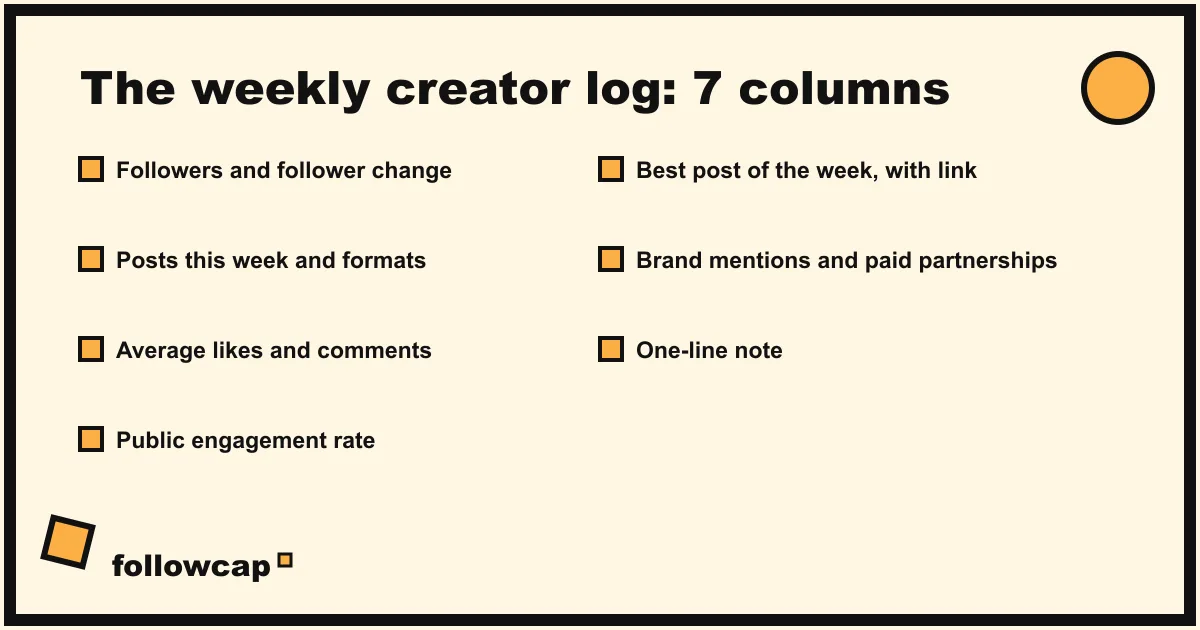
One row per creator per week, logged the same day so each row covers the same seven days.
- Followers and follower change. The total, and the difference from last week. A jump of thousands in one week, with no post to explain it, is a reason to look closer. The curve shapes to watch for are in Instagram follower growth tracker.
- Posts this week, and their formats. A creator posting five times a week has room for a brand post; one posting twice a month will deliver it later.
- Average likes and comments. Add up across the week’s posts, divide by the number of posts. Skip likes for accounts that hide them.
- Public engagement rate. Average likes plus comments, divided by followers, times 100. Benchmark reports place typical rates roughly between 1 and 3 percent, higher for small accounts and creators; Rival IQ’s 2024 Social Media Industry Benchmark Report put the all-industry median for brand accounts at roughly 0.43 percent per post, and its 2025 edition reports a further dip. The formula is in Instagram engagement rate.
- Best post of the week, with its link. Read the first ten comments. They tell you whether the audience is customers (“where can I buy this”) or other creators.
- Brand mentions and collaborations. Any brand tagged or named in a caption, and whether the post carries the paid partnership label or #ad. This is how you learn whether a competitor got there first.
- One-line note. What they posted about, a shift in tone, a new format.
How do you spot sponsored posts?
Two signals are explicit, and a third is a judgment call.
The paid partnership label. Instagram’s branded content policies require creators to use the paid partnership label on content a brand has paid for or gifted, in Feed, Stories, Reels and Live. Once the brand approves the tag, the post shows “Paid partnership with” and the brand’s name. Log the brand every time.
Disclosures in the caption. In the United States, the FTC’s Endorsement Guides require a disclosure whenever a creator has a financial, employment, personal or family relationship with the brand, and the FTC’s guidance for influencers says not to assume a platform’s disclosure tool is enough on its own. So a careful creator also writes “#ad”, “sponsored” or a plain sentence such as “thanks to the brand for the free product”. A creator who discloses properly will disclose your campaign properly too.
The judgment call. A product shown prominently with a discount code and a tagged brand, with no label and no disclosure, is probably a deal the creator did not mark. Treat it as a point against fit.
How do you score creator fit?
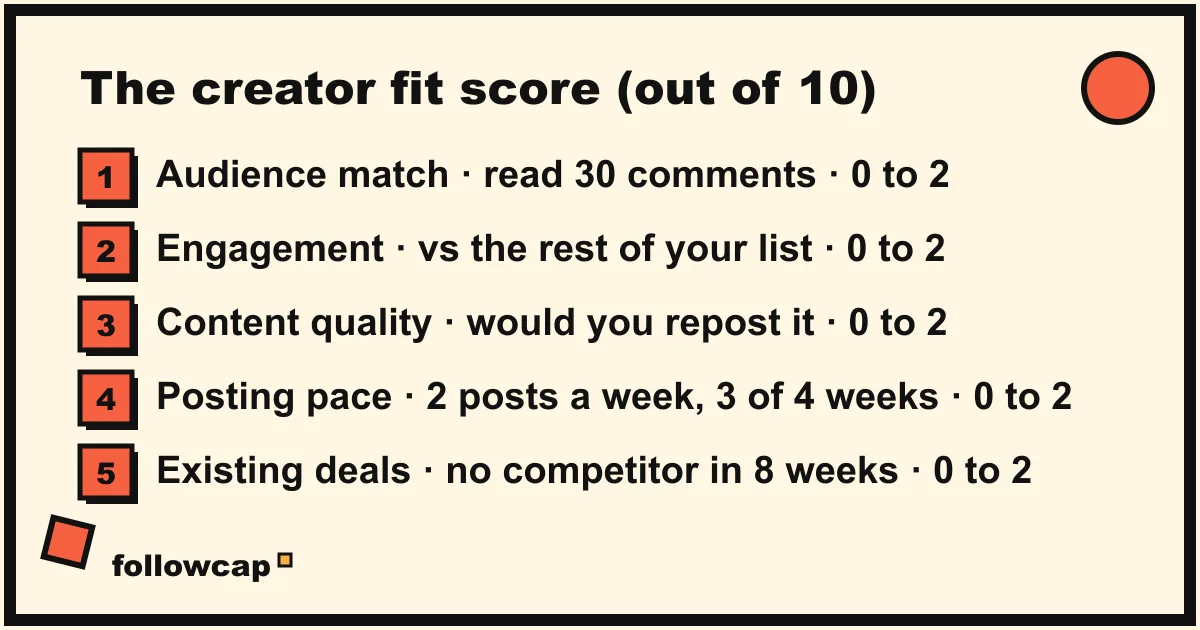
After four weeks of logging you have enough to score. Five criteria, two points each. Score once a month and keep the old scores.
- Audience match (0 to 2). Read 30 comments across three posts. Two if the commenters look like your customers, one if mixed, zero if they are mostly other creators or empty emojis.
- Engagement (0 to 2). Two for a public engagement rate above the median of your list, one for around it, zero for well below.
- Content quality (0 to 2). Would you repost their best post on your own account, with credit? Two for yes, one for with edits, zero for no.
- Posting pace (0 to 2). Two for at least two posts a week in three of the last four weeks. One for irregular. Zero for a gap of a month or more.
- Existing deals (0 to 2). Two if their sponsored posts are for brands you would sit next to. One if there are none. Zero if they posted a direct competitor in the last eight weeks, or take every deal offered.
Anything at 8 or above goes on the outreach list. Six and seven stay on the watch list. Below six, drop the creator after one more month.
When should you reach out?
Timing matters more than the message. Three moments work.
- A rising month. Follower change positive for three or four weeks in a row and average likes above the creator’s own past average. A creator noticing their growth is more open to a first brand deal.
- Right after a post about your category. A creator who just posted about the problem your product solves, with no brand attached, has told you what they want to talk about. Reply to that post first, then message.
- Not right after a competitor’s campaign. If the log shows a paid partnership with a direct competitor, wait a few weeks. Many creator contracts carry an exclusivity window, and two rival products in a month reads as a sellout.
Keep the first message short: which post made you write, what you propose, and a question.
How do you keep a team in sync?
With two or three people on the list, the log needs rules.
- One owner per creator. That person logs the numbers and makes the outreach call; nobody else messages them.
- A status column with five values. Watching, scored, contacted, in talks, done. Anyone unchanged for eight weeks goes back to watching or off the list.
- A weekly 15-minute review. Read the status column together, look at anyone who crossed 8, and agree on at most three messages for the week.
Logging 50 creators by hand takes about an hour a week, fine for a month and tiring after that. The influencer platforms do it at agency prices. Here we have to be transparent: Followcap is our product, so read this as the maker’s description. You type the usernames of the public creator accounts on your list, with no Instagram login, and every Sunday one email arrives with each account’s week: a short summary, the three posts not to miss and a recap of the best posts from each account with their links. Premium (€9 a month, up to 10 accounts) adds weekly numbers per account: posts, likes, comments, best post and follower growth. Business Pro (€29 a month, up to 50 accounts, three team users) adds a monitoring dashboard with alerts on spikes in likes and comments, followers and posting pace, a brand radar, CSV export and a monthly PDF report. The limits: it is weekly, not a live dashboard; public creator and business accounts only; it cannot show a creator’s reach, saves, views, watch time or audience, because nobody outside the account can; and it is paid after the 7-day trial. If the hour of logging is what you keep skipping, you can start a trial with your list. The fit score and the outreach stay yours.
Which mistakes waste the most time?
- Starting with follower count. A 4,000-follower creator whose commenters are your customers beats a 200,000-follower creator whose commenters are other creators.
- Trusting one week. One strong post is a mood. Four weeks of rising comments is a pattern.
- Letting the list rot. Add five and drop five every month.
- Messaging everyone at once. Three messages a week, written from the log, outperform thirty templates.
FAQ
How many influencers should a small brand track?
Twenty to fifty. Fewer than twenty and you are not comparing, just hoping. More than fifty and the weekly log takes longer than the thinking. Keep most of the list between 2,000 and 50,000 followers, where fit is easier to judge.
How can I tell if a creator’s followers are real?
From outside you cannot be certain, but the public numbers give strong hints: a follower count far above average likes and comments, a jump of thousands in one week with no post to explain it, and comments that are mostly emojis from empty accounts.
Can I see a creator’s audience demographics without asking them?
No. Age, gender and country of followers are in Instagram Insights, visible only to the account owner. Tools that show them for other accounts are estimating. Ask the creator for a screenshot once you are in talks; serious ones expect the question.
How do I know if an Instagram post is sponsored?
Look for the “Paid partnership with” label above the post, which Instagram’s branded content policies require for paid or gifted content, and for “#ad”, “sponsored” or a plain disclosure sentence in the caption, which the FTC’s Endorsement Guides require in the United States.
Related reading
- Best Time to Post on Instagram in 2026 (and How to Find Yours)
- Instagram Competitor Analysis: A 30-Minute Weekly Routine
- The Best Instagram Analytics Tools in 2026 (Yours and Others’)
The bottom line
Tracking creators without an agency is a list and a habit: 20 to 50 public accounts in your niche, seven public numbers logged the same day every week, a ten-point fit score once a month, and outreach timed to a rising month and away from a competitor’s campaign. Read the comments, watch for the paid partnership label, and ask the creator for the private numbers once you are interested. When the weekly logging is the part that slips, a weekly recap such as Followcap Premium or Business Pro, which we make, can collect the public numbers and alert the team, with the trade-off that it is weekly and public accounts only. The judgment stays yours, and the judgment is the job.