How Often Should You Post on Instagram? What the Accounts in Your Niche Actually Do
How often to post on Instagram in 2026: what Instagram itself has said, what benchmark reports measure, and how to find the cadence of your own niche in one week.
 Andrea Marino9 min read
“How often should I post on Instagram” has a thousand answers online and almost none of them are measured. Instagram has given a few careful statements, benchmark reports publish medians across thousands of brands, and both are worth knowing. But the number that actually matters is the one nobody publishes: what the accounts in your niche, at your size, are doing right now. This guide covers the public statements, the benchmarks, and a one-week method to measure your own niche.
Quick answer: the head of Instagram has said there is no single right frequency, that posting more generally brings more reach, and that burnout is the real limit. Benchmark reports put the brand median at roughly 4 to 5 feed posts a week. The better answer comes from your niche: log the weekly posts of 10 accounts near your size for one week, take the middle value, and start there.
What has Instagram itself said about posting frequency?
Instagram does not publish a recommended number. What exists are statements from Adam Mosseri, the head of Instagram, and they are more modest than the advice built on them.
In a creator Q&A in 2021, as widely reported by marketing blogs at the time, Mosseri suggested a couple of feed posts a week and a couple of stories a day as a reasonable starting point, while stressing there was no formula. We could not find a transcript, so treat the exact wording as secondhand.
In a reel in late 2024, covered by RouteNote in December 2024, he said there is no single answer for every creator, that some successful accounts post once a month and others several reels a day, that in general the more you post the more reach you get, and that creators should pick a schedule they can sustain because burnout is the real risk.
Three things follow. No cadence is rewarded on its own. More posts generally mean more total reach, because each post is another chance to be shown. And the ceiling is you, not the algorithm.
What do benchmark reports say about posting frequency?
Benchmark reports measure what brands do, not what works for you, but they give a useful floor.
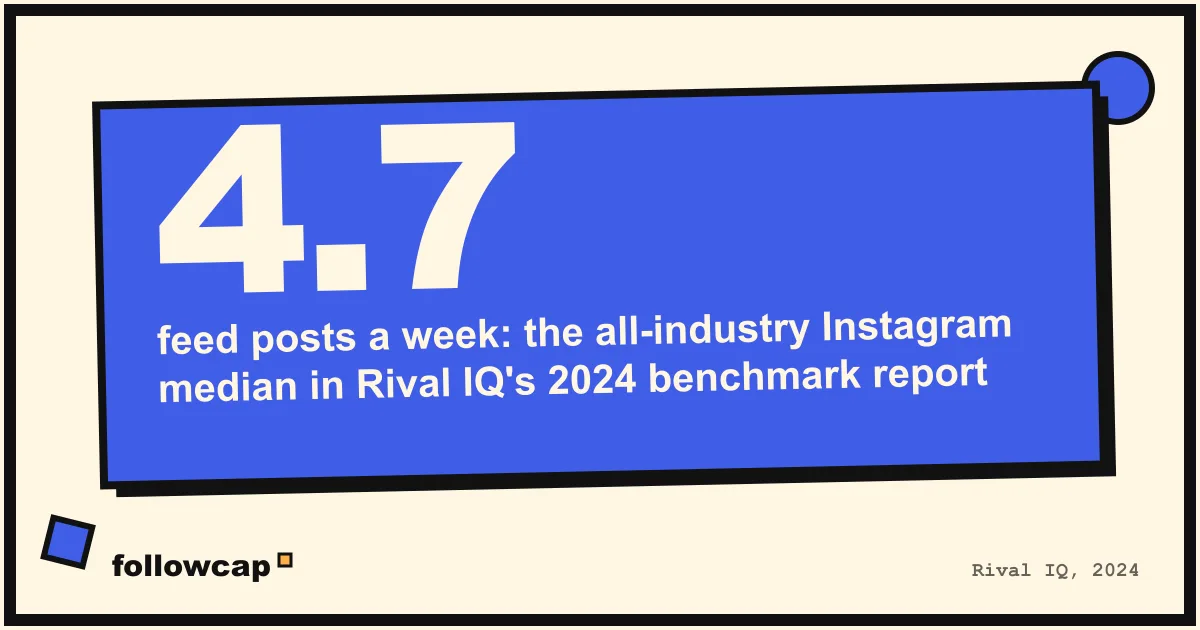
- Rival IQ’s 2024 Social Media Industry Benchmark Report put the all-industry median at about 4.7 posts a week on Instagram. Its 2025 edition said the median dipped slightly for the first time in three years, without a figure we could confirm from the report itself.
- Socialinsider’s 2026 benchmarks, as reported by Social Media Today and based on roughly 70 million posts across four platforms, put brands at about 5 Instagram posts a week.
- Dash Social’s 2025 Instagram benchmark, built on about 3,000 brands over twelve months, found that 2 to 3 feed posts a week produced the highest engagement rates, while the average brand posted more than that.
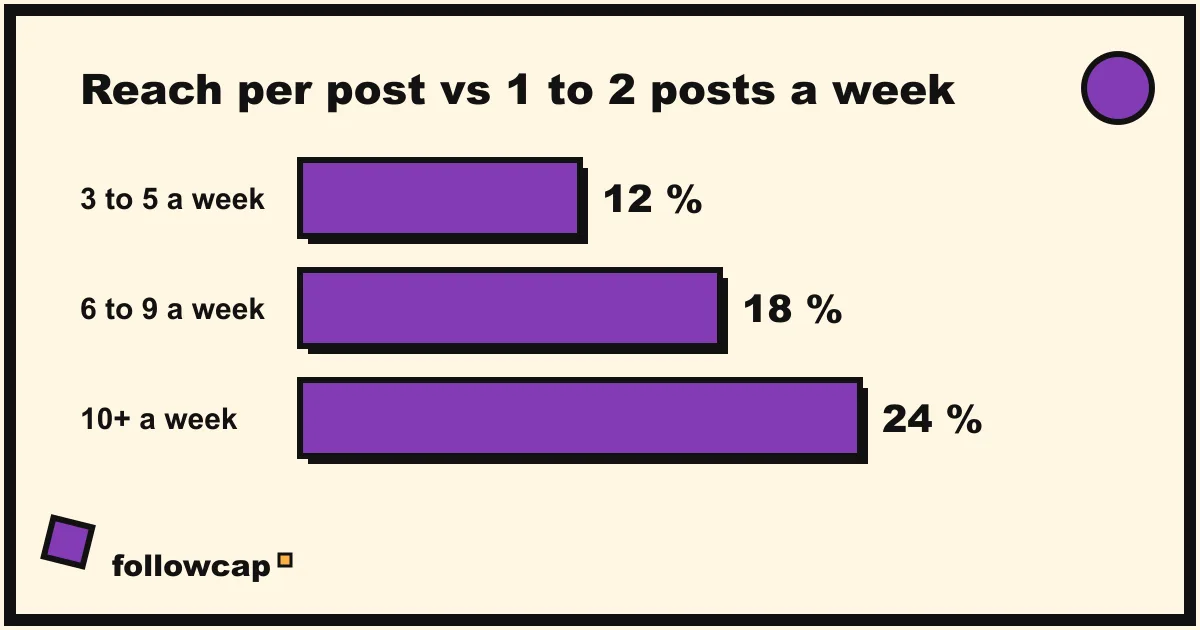
- Buffer’s August 2025 study of 2.1 million feed posts from about 102,000 accounts measured reach per post against accounts posting 1 to 2 times a week: about 12 percent more for 3 to 5 posts, about 18 percent for 6 to 9, and about 24 percent for 10 or more. The gains shrink at each step, and Buffer suggested 3 to 5 a week as the sustainable range.
Read together: the brand median sits around 4 to 5 feed posts a week, engagement per post is often highest a little below that, and reach per post keeps rising with volume but with diminishing returns. None of these reports measured your niche.
Why does your niche’s cadence matter more than any benchmark?
A benchmark averages a sports team posting 30 times a week with a ceramics studio posting twice. Neither number helps either of them.
Your audience has a tolerance set by the accounts it already follows. If every creator in your niche posts daily reels, two posts a week makes you invisible between them. If your niche posts twice a week with long carousels, a daily reel can look like noise. The right cadence is relative, and the comparison set is the 10 to 20 accounts your followers also follow.
Size matters too. A small team cannot sustain what a media brand does, and the Dash Social finding above suggests it may not need to. What you want is the cadence of accounts at your size, in your niche, that are growing.
How do you measure your niche’s posting cadence in one week?
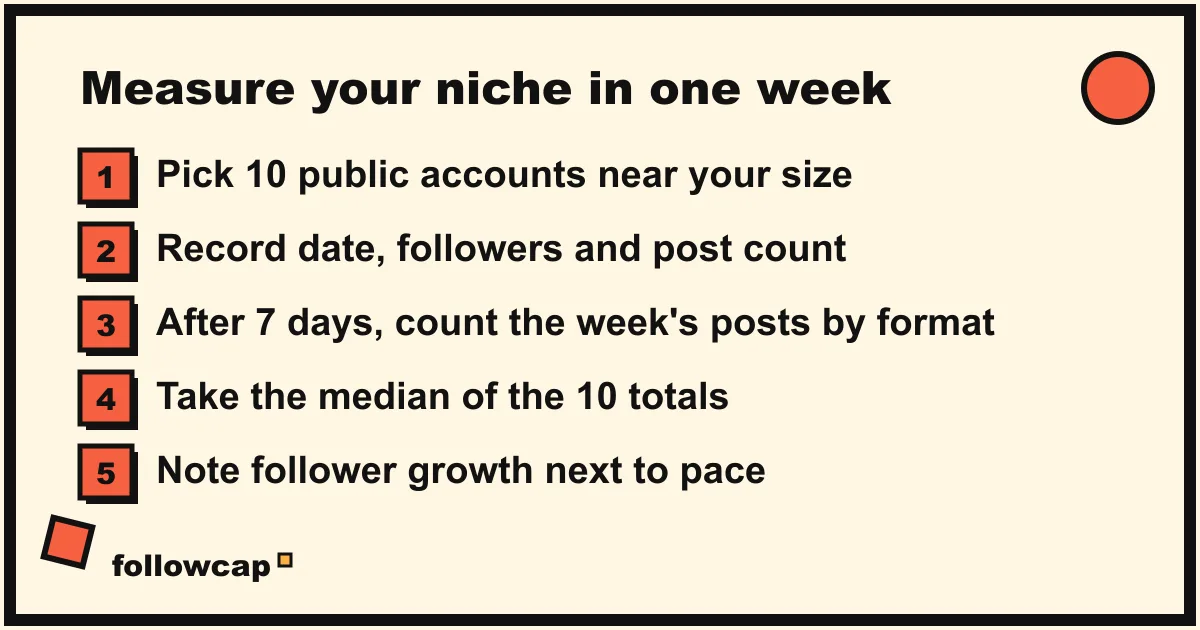
This takes about 20 minutes on day one and 20 on day seven.
- Pick 10 public accounts. Most within a few multiples of your follower count, two or three a step ahead, one large account for reference. The method for building the list is in Instagram competitor analysis.
- Record the starting point. For each account, note the date, the follower count and the total post count shown on the profile.
- Wait seven days, then count. Open each profile again and count what was published: reels, carousels and single images, with the split. Write it as three numbers, for example 3 / 2 / 1. Stories do not stay public, so leave them out.
- Take the median, not the average. Sort the 10 weekly totals and take the middle one. One account posting 20 times would wreck the average; the median ignores it.
- Note growth next to pace. Subtract the starting follower count from the new one. The accounts to copy are not the ones posting most, but the ones growing most per post.
One week is enough to pick a starting cadence. Four weeks gives you a trend and shows you which accounts are consistent and which are bursty. Keep the same sheet, add a row per account per week, and the follower growth column becomes a follower growth tracker at no extra cost.
How do you read a change in posting pace?
Posting pace is one of the few public signals that tells you what an account is planning. Three patterns are worth recognising.
A jump. An account that posts 3 times a week suddenly posts 10. Usually a launch, a campaign or a new team member. Watch the next two weeks: if likes per post fall while total likes rise, they are trading quality for volume. If both rise, they found something.
A drop. From 5 a week to 1. Burnout, a pivot or a holiday. If the drop lasts a month and follower growth goes flat or negative, you have just watched the cost of inconsistency on someone else’s account.
A format shift at constant pace. Still 4 posts a week, but reels replaced carousels. This is the most informative change, because it says the account tested something and chose. Check whether their likes and comments moved with it.
An account that doubles its pace and grows is evidence; one that doubles its pace and stalls is a warning you got for free.
How do you choose your own cadence from the data?
Start at your niche median, or one step below it if that is what you can sustain for three months. Consistency over a quarter beats a strong month followed by silence, and the Mosseri reel above says the same thing from the inside.
Then test one direction at a time. Hold your cadence for four weeks, log likes, comments and follower growth, then add one post a week for the next four and compare. Your own Instagram Insights add reach and saves to that comparison. Change pace or format, not both at once, or you will not know which one moved the result.
Tracking 10 accounts by hand every Monday is where this breaks for most people, so here we have to be transparent: Followcap is our product. You type the usernames of public creator or business accounts, no Instagram login needed, and every Sunday one email summarises their week with a recap of the best posts from each account. Three accounts are free. Premium (€9 a month, up to 10 accounts) adds a weekly line of numbers per account, including posts, likes, comments and follower growth, which is the sheet above filled in for you. Business Pro (€29 a month, up to 50 accounts, 3 team users) adds alerts when an account’s posting pace spikes, a “you vs your niche” comparison and CSV export. The limits: it is weekly, not a live dashboard, so you see last week’s pace on Sunday; it covers public creator and business accounts only; it cannot show reach, saves, views, watch time or audience data, which nobody outside an account can see; and it is paid after the 7-day trial, with a 30-day money-back after the first charge. If you would rather have the counting done, you can start with your list. For other options, including Instagram Insights and Meta Business Suite for your own account, see the best Instagram monitoring tools.
FAQ
How many times a week should a small account post on Instagram?
Start with the median of 10 accounts your size in your niche, which for many niches lands near 3 to 5 feed posts a week, in line with the range Buffer’s 2025 study called sustainable. If that is more than you can keep up for three months, post less and hold it. A steady 3 beats an unsteady 7.
Is it bad to post every day on Instagram?
Not according to Instagram: Mosseri has said that more posts generally mean more reach and that the real limit is burnout. The benchmark data adds a nuance: Dash Social’s 2025 report found engagement per post highest at 2 to 3 feed posts a week, so daily posting tends to buy total reach at the cost of engagement per post. Whether that trade is worth it depends on your goal.
Does posting more hurt your reach?
The published data points the other way. Buffer’s 2025 analysis of 2.1 million posts found reach per post rose with frequency, by about 24 percent for accounts posting 10 or more times a week compared with 1 to 2, though the gains shrink as you go up. What drops at high volume is usually engagement per post, not reach.
How often should I post stories and reels?
Stories do not stay public, so you cannot measure your niche’s story cadence from outside; Mosseri’s reported 2021 suggestion of a couple a day is the only guidance from Instagram we know of. Reels count as feed posts in the benchmark reports above, so the 4 to 5 a week figures already include them.
How long before I know if a new cadence works?
Four weeks at the new pace, compared with the four weeks before: likes and comments per post, weekly totals, follower growth, plus reach and saves from your own Insights. If per-post numbers fall but weekly totals and growth rise, the new pace is working.
Related reading
- Best Time to Post on Instagram in 2026 (and How to Find Yours)
- Instagram Shadowban: How to Check, What Causes It and How to Fix It (2026)
- Why Am I Losing Followers on Instagram? 9 Causes and What to Do
The bottom line
Instagram’s own answer is that there is no fixed number, more posting brings more reach, and burnout is the limit. Benchmark reports put the brand median at roughly 4 to 5 feed posts a week, with engagement per post often highest a little below that. The number that matters is your niche’s: log 10 public accounts near your size for one week, take the median, start there, and test one step at a time over four-week blocks. Watch the pace of the accounts you track, because a jump or a drop tells you what they are trying before their results do. A weekly recap such as Followcap, which we make, can count posts, likes, comments and follower growth for your list and flag pace spikes, with the trade-off that it is weekly and covers public accounts only. The cadence you can hold for a year is the right one.