How to Get Instagram Content Ideas From the Accounts You Follow (a Weekly System)
A weekly 30-minute system for turning the accounts you follow into Instagram content ideas: a swipe file that respects authorship, 12 idea patterns and a simple log.
 Andrea Marino9 min read
You already follow the accounts that would give you your best content ideas. The problem is how you read them: scrolling, in a feed that shows you a fraction of their posts, at moments when you are not looking for ideas. This guide replaces that with a weekly 30-minute system, a swipe file that takes the question and the format but never the content, 12 idea patterns you can apply to any post, and a log that keeps ideas from evaporating. It is the system we use ourselves.
Quick answer: pick 10 to 20 public accounts in your niche. Once a week, read their posts in one sitting, mark the three that got the most likes or comments, and for each one write down the question it answered and the format it used, not the content. Run those through 12 idea patterns, log three ideas with a link to the source post, and schedule one. Thirty minutes, same day every week.
What is a swipe file that respects authorship?
A swipe file is a collection of posts you keep because they worked. The problem with most of them is what gets swiped. Reposting someone’s idea with a new caption is copying, and it gets you a weaker version of their result.
The version that works takes three things from a post and leaves one.
- Take the question it answered. Every post that performs answers something its audience wanted to know. “How do I make a small kitchen look bigger?” is not owned by anyone.
- Take the format. A talking-head reel, a carousel of five slides, a before-and-after image, a text-only post. Formats are shared property.
- Take the structure. Hook, three points, a close that asks for a comment. The skeleton is reusable; see 50 Instagram hook examples for the openers.
- Leave the content. Their examples, their wording, their footage, their story. That part is theirs, and it is also the part that would not work for you anyway, because your audience follows you for your experience.
A quick test before you post: if the original creator saw your post, would they recognise their work or recognise a shared question? The second is fine. The first is not.
The 30-minute weekly system
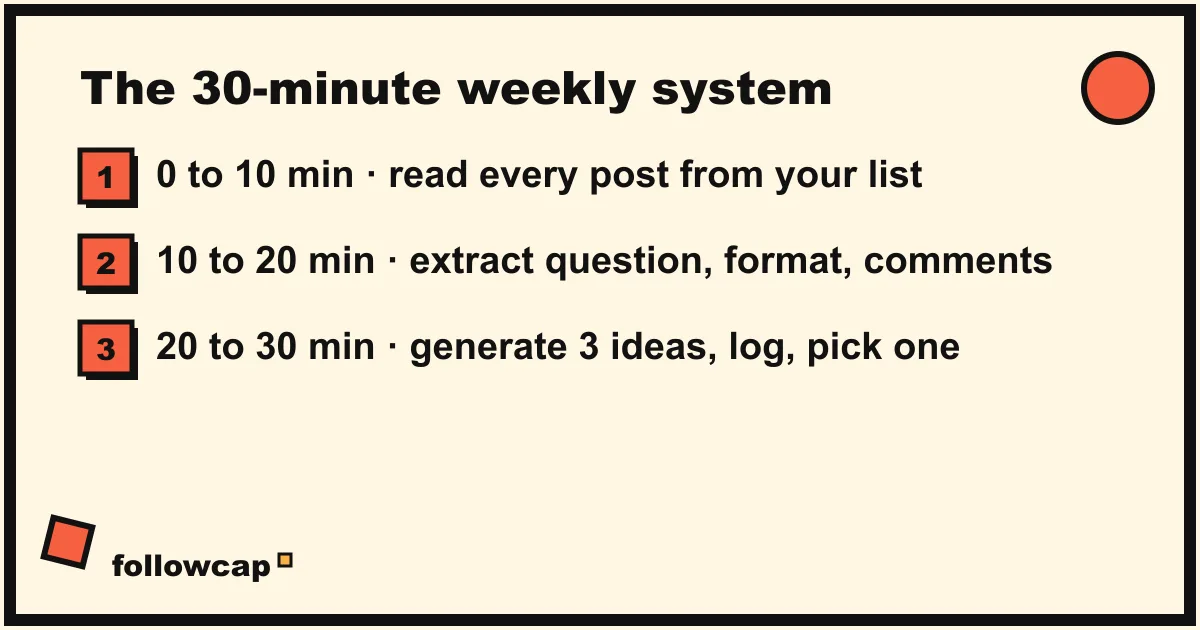
Book it as one block, same day and time every week. Ours is Monday morning, so the ideas land in the same week’s plan. The feed is not the place for this; open each profile directly so you see every post, not the ones the ranking chose for you.
Minutes 0 to 10: read
Open each of your 10 to 20 accounts and read everything from the last seven days, including the first few comments on each post. Do not take notes yet. You are looking for two things: posts that clearly did better than the account’s usual, meaning two to three times its typical likes or comments, and posts that made you stop even if the numbers were ordinary.
Minutes 10 to 20: extract
Pick the three posts that stood out most. For each, write three lines: the question it answered, the format, and what the comments asked for that the post did not give. That third line is where most of your ideas will come from. The comment section is the audience telling you what they want next.
Minutes 20 to 30: generate and log
Run each of the three posts through the 12 patterns below and write down whatever comes out, three ideas minimum. Add them to the log with the source link, choose one for this week, and close everything. The block ends at 30 minutes whether or not you feel finished. Regularity does more than a long session, the same principle behind time management techniques.
The 12 reusable idea patterns
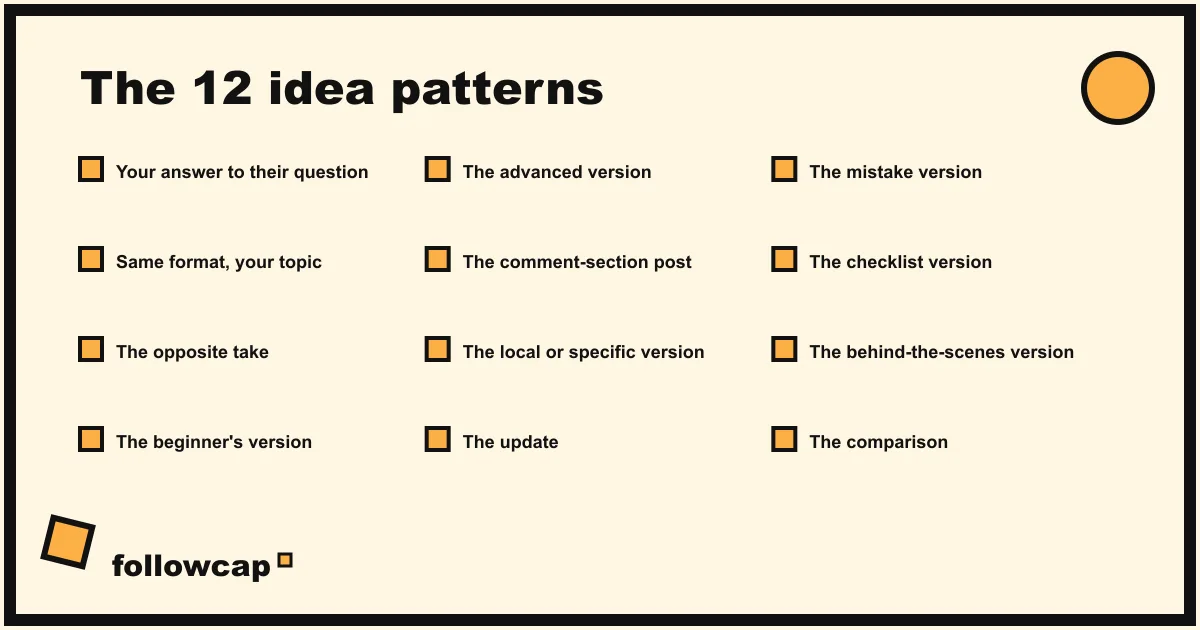
Each pattern takes a post that worked and turns it into something that is yours. Not every pattern fits every post; usually three or four do.
- Your answer to their question. Same question, your experience, your examples. The baseline pattern and the most honest one.
- Same format, your topic. They did a five-slide carousel on skincare routines; you do a five-slide carousel on your own subject.
- The opposite take. They said do X. You explain when not to, with reasons. Only if you believe it.
- The beginner’s version. Their post assumed knowledge. Yours starts from zero.
- The advanced version. Their post was the basics. Yours is what to do after the basics stop working.
- The comment-section post. Answer the question that appeared most in their comments. It is proven demand.
- The local or specific version. Their post was general. Yours is for your city, your budget, your type of client.
- The update. Their post is a year old and still circulating. What has changed since?
- The mistake version. They showed how to do it. You show the three ways it goes wrong.
- The checklist version. Turn their narrative into something people can save and follow.
- The behind-the-scenes version. They showed the result. You show the process, including the parts that failed.
- The comparison. They covered one option. You put it next to the alternative you actually use.
Three posts times three or four fitting patterns is ten ideas a week. You only need one.
How to log ideas so they do not disappear
Any spreadsheet works. The log is the real product of the routine; after three months it is a backlog you can post from on bad weeks.
| Column | What goes in it |
|---|---|
| Date | The week you logged it |
| Idea | One sentence, written as a hook if you can |
| Source | Link to the post that inspired it |
| Pattern | Which of the 12 you used |
| Format | Reel, carousel, image, text |
| Status | Not started, drafted, posted |
| Result | Your own likes and comments once it is live |
Two rules. Write the idea as a sentence, not a topic: “small kitchens” is not an idea, “the 3 things I removed from my kitchen to make it feel bigger” is. And always keep the source link, so you can check later that you took the question and not the content.
The result column turns the log into a learning tool. After ten posts you can sort by pattern and see which ones your audience rewards, using the formula in Instagram engagement rate.
How do you tell a trend from a one-off?
One post doing well is a hint. The same question or format doing well on two or three accounts in the same fortnight is a trend, and trends are worth moving on quickly, because they fade.
- Count accounts, not posts. One account with a breakout post may have paid to promote it, and you cannot tell from outside. Three accounts with the same breakout is real.
- Check the comments. A trend has comments that ask for more. A one-off has comments about the specific creator.
- Give it a second week. If the format appears again in the next session, log it as a trend and make it this week’s pick. If it does not, keep it in the backlog.
- Watch the format more than the topic. Topics come and go in days. Formats tend to last weeks, which gives you time to make your own version well.
For a fuller method, including hashtag and audio pages, see how to find trending content in your niche.
Do you need a tool for this?
No, and we suggest you start without one. The first month by hand teaches you what a good source post looks like, and it costs nothing. The weak point is the reading block: opening 15 profiles every Monday is where the habit tends to break, and once you skip two weeks the log stops growing.
If that is where you are, here we have to be transparent: Followcap is our product. You type the usernames of public creator or business accounts, no Instagram login needed, and every Sunday one email gives you a 30-second summary of their week, the three posts not to miss, a 2 to 3 line recap of the best posts from each account with their links, and a short “what you can apply this week”. That covers the reading block in one sitting. Three accounts are free. Premium (€9 a month, up to 10 accounts) adds weekly numbers per account, including the best post, plus an archive page with every recap. Business Pro (€29 a month, up to 50 accounts, 3 team users) adds weekly content ideas and a hook library. The limits: it is weekly, not a live dashboard; public creator and business accounts only; it cannot show reach, saves, views, watch time or audience data, which nobody outside an account can see; and it is paid after the 7-day trial, with a 30-day money-back after the first charge. The extract and generate blocks stay yours. If the reading is the part you want handled, you can start with your list.
Which mistakes make the system fail?
- Following too many accounts. Twenty is the ceiling. Past that, the reading block eats the half hour and nothing gets extracted.
- Only reading the big accounts. Their formats are useful; their topics reflect a reach you do not have yet. Keep most of your list near your own size.
- Logging topics instead of ideas. A topic is not postable. Write the sentence.
- Skipping the source link. Without it you cannot check your own authorship later.
- Never posting from the log. Ideas that sit for a month lose the context that made them good. Pick one every week.
FAQ
How many accounts should I follow for content ideas?
Ten to twenty public accounts in your niche, most of them close to your own size, with two or three a step ahead and at most one large account for format ideas. Fewer than ten gives too few outliers in a week; more than twenty makes the reading block too long.
Is it copying to take ideas from other accounts?
Taking the question a post answered, its format or its structure is how every creative field works. Taking the content, meaning the examples, the wording, the footage or the story, is copying. The test is whether the original creator would recognise their work in yours or only a shared question.
How often should I do this?
Once a week, in one 30-minute block, same day and time. Daily scrolling feels like research but produces nothing you can post from. A weekly session produces three logged ideas and one scheduled post, which is what moves an account.
What if nothing in my niche is doing well this week?
Lower the bar from outliers to posts that made you stop, and lean on the comment-section pattern: questions in the comments are demand even when the post itself was ordinary. Quiet weeks are also when the backlog in your log earns its keep.
Related reading
- Best Time to Post on Instagram in 2026 (and How to Find Yours)
- How Often Should You Post on Instagram? What the Accounts in Your Niche Actually Do
- How the Instagram Algorithm Works in 2026 (Feed, Stories, Reels, Explore)
The bottom line
The accounts you follow are already the best idea source you have; the fix is how you read them. Pick 10 to 20 public accounts, read them once a week in one block, extract the question and the format from the three posts that stood out, run them through the 12 patterns, and log three ideas with their source. Take the question, never the content. If the weekly reading is what breaks the habit, a Sunday recap such as Followcap, which we make, can put the best posts from your list in one email, with the trade-off that it is weekly and covers public accounts only. The ideas, and the posts you make from them, are yours.