50 Instagram Hook Examples That Worked, and Why
50 original Instagram hook formulas in 10 families, with the mechanism behind each one, a way to test hooks on your own account and the mistakes that kill them.
 Andrea Marino10 min read
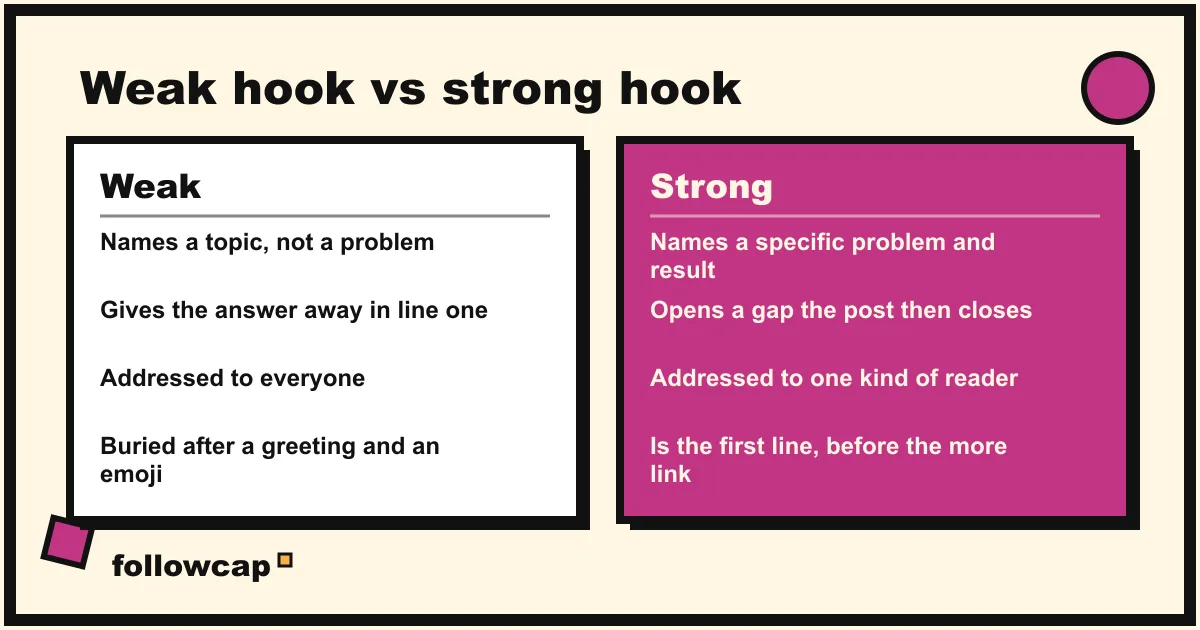
A hook is the first line of a caption, the first two seconds of a reel, or the first slide of a carousel. It is the only part of a post every viewer sees, and it decides whether anyone sees the rest. Most hook lists are screenshots of other people’s reels. This one is different: all 50 formulas are ours, grouped into 10 families, with the mechanism of each family explained so you can write your own.
Quick answer: a hook works when it makes a specific promise to a specific person and leaves a gap the post then closes. The 10 families that do this reliably are curiosity gap, number plus promise, mistake, contrarian, “nobody tells you”, before and after, question, story opener, proof, and call-out. Write three versions per post and post the one you would stop for yourself.
What makes an Instagram hook work?
Three things, for captions, reels and carousels alike.
Specificity. “Tips for better photos” is a topic. “The one camera setting that fixes blurry indoor photos” is a hook: a problem the viewer recognises and a result they want.
A gap. The hook raises a question the viewer cannot answer yet, and the post answers it. Give the answer away and there is no reason to keep watching; never answer it and people feel tricked.
A reader. The best hooks are addressed to someone: a beginner, a parent, a freelancer, someone who tried and gave up. The more precise the reader, the more that reader stops.
One practical limit: caption guides from scheduling tools such as Hootsuite report that the feed hides captions behind “more” after roughly 125 characters. Instagram does not publish the number, so treat the first line as the whole hook.
The 10 hook families and 50 examples
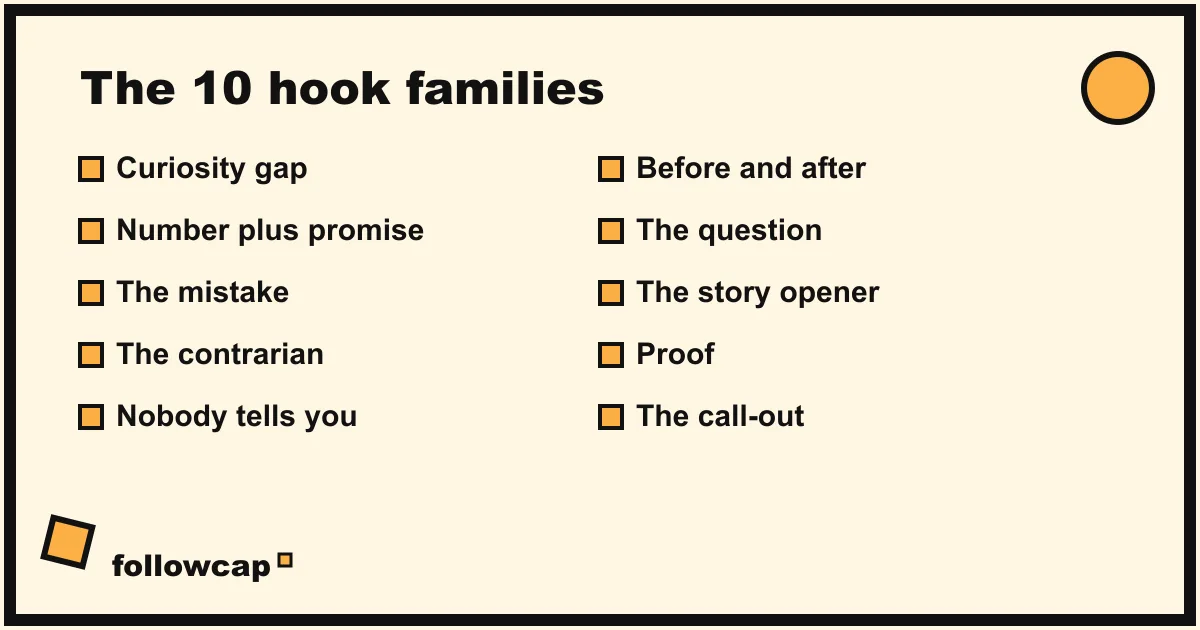
Square brackets mark the part you replace with your own niche, result or number. None of these is quoted from a creator or a site.
1. The curiosity gap
Mechanism: you state that something happened or matters, and withhold what. People stay to close the loop. It fails when the payoff is smaller than the gap.
- I changed one thing about my [routine] and the result surprised me.
- The part of [topic] everyone skips is the part that matters most.
- This is what happens to [thing] after 30 days of [habit].
- There is a reason your [result] stalls at exactly this point.
- I was doing [task] wrong for years. Here is what fixed it.
2. Number plus promise
Mechanism: the number sets the size of the commitment, the promise names the reward. It fails when the number is big and the promise is vague.
- 3 [tools] under [price] that replaced the expensive one.
- 5 questions to ask before you [decision].
- The 2-minute check that saves me an hour every week.
- 4 signs your [thing] needs replacing, not fixing.
- 7 days, one rule: here is what changed.
3. The mistake
Mechanism: fear of doing something wrong is stronger than the wish to do it right, so the viewer stays to find out if they are guilty. It fails when the “mistake” is obvious or made up.
- The [niche] mistake I see in nine accounts out of ten.
- Stop doing this to your [thing]. It is costing you [result].
- I made this mistake with [topic] so you do not have to.
- If your [result] is flat, check this first.
- The advice about [topic] that sounds right and quietly hurts you.
4. The contrarian
Mechanism: it contradicts something the viewer believes, and friction holds attention. It fails when you cannot back the claim up; the comments will do it for you.
- You do not need [popular thing] to get [result].
- [Common practice] is overrated. Here is what I do instead.
- Everyone says [advice]. I tried the opposite for a month.
- The “best” [tool] in [niche] is not the one you have been told.
- Posting less is how I got more [result]. Let me explain.
5. “Nobody tells you”
Mechanism: it promises inside knowledge, the thing people learn only by doing, and lets the viewer skip the hard way. It fails when what follows is common knowledge.
- Nobody tells you this when you start [activity].
- What I wish someone had told me before my first [milestone].
- The unglamorous part of [niche] that nobody films.
- Things [professionals] know that [beginners] do not.
- The question nobody asks before buying [thing].
6. Before and after
Mechanism: a visible change is proof, and proof is the most convincing hook there is. It fails when the “after” is not clearly better, or when the change took something the viewer does not have.
- Same [thing], one change. Watch the difference.
- Day 1 versus day 90 of [habit], honest version.
- This is my [space] before I learned [principle].
- I rebuilt [thing] from scratch. Here is the before and the after.
- Two [items], same price. Only one is worth it.
7. The question
Mechanism: the viewer answers in their head, then wants to see if it matches yours. It fails when the question can be answered with a shrug.
- Why does your [thing] look fine in [context A] and wrong in [context B]?
- Would you keep [doing X] if you knew this?
- What is the one [niche] habit you would never give up?
- How long should a [thing] actually last?
- Which of these two [options] would you choose? Most people pick wrong.
8. The story opener
Mechanism: start in the middle, with a person and a moment, and the viewer waits for the ending. It fails when the story takes too long to reach the point.
- Last week a client asked me something I could not answer.
- Three years ago I quit [job] with no plan. This is what happened next.
- I almost deleted this post. Then I noticed something.
- A stranger stopped me to ask about my [thing]. Here is what I told them.
- The day I stopped [habit] started like any other.
9. Proof
Mechanism: specific numbers and a real test signal effort, and effort signals the post is worth the viewer’s time. It fails when the numbers are round or borrowed.
- I tracked every [thing] for 60 days. Here are the numbers.
- From [number A] to [number B] in [time], with one change.
- I tested [N] [products] so you only need to try one.
- The exact [thing] I use, with the price and where I got it.
- I read every comment on my last 20 posts. Here is what you asked for.
10. The call-out
Mechanism: it names the reader. People stop for things addressed to them and scroll past things addressed to everyone. It fails when the group is too wide for anyone to feel named.
- If you [situation], this one is for you.
- For anyone who has tried [thing] and given up.
- You are not bad at [skill]. You were taught the wrong order.
- Beginners, skip this. Everyone else, watch to the end.
- If you run a [type of business], you have this problem too.
How do you test which hooks work for your account?
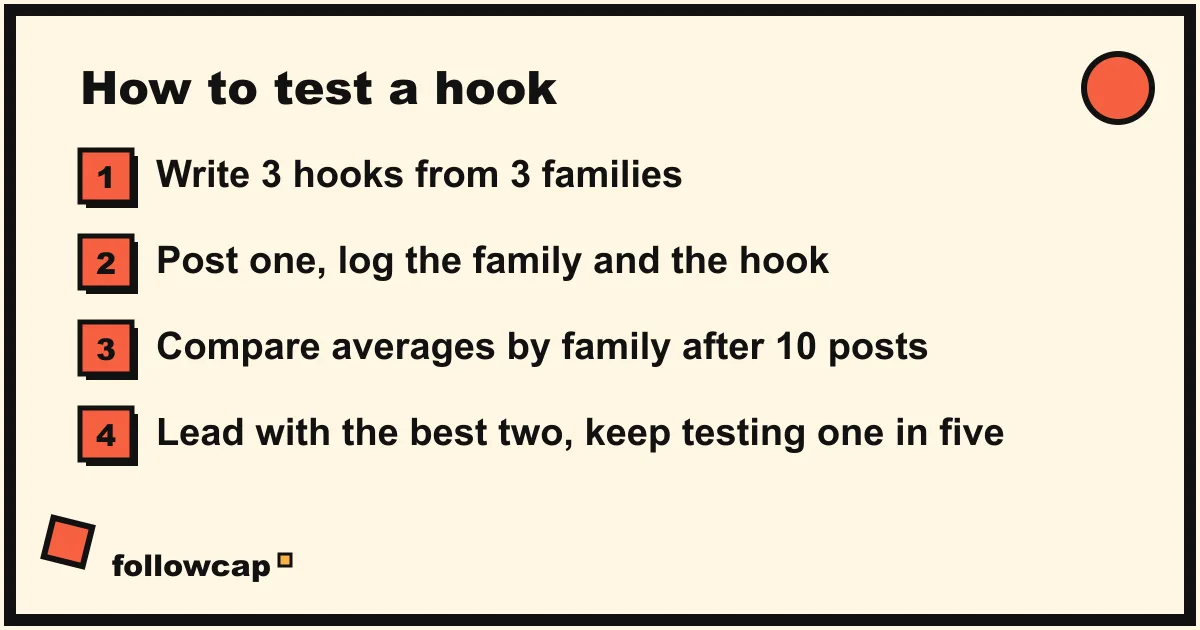
Only your own numbers can tell you which family works for your audience. The test is simple.
- Write three hooks per post, from three families. Writing three forces you past the first obvious one.
- Post one and log the family. A sheet with the date, the post link, the family and the hook text. Add likes and comments a week later.
- Compare by family after ten posts. Average likes and comments per family. Two or three will be clearly ahead.
- Rotate, do not settle. Lead with your best two families, but keep one post in five for one you have not tried. Audiences tire of a single pattern.
Your own Instagram Insights add reach and saves to this picture; for reading those next to the public numbers, see Instagram engagement rate.
Where do you find hooks that worked in your niche?
The hooks that will work best for you are already working on accounts your audience follows, and you can see those without any tool. Pick 10 to 20 public accounts in your niche and once a week look for their outliers: posts at two to three times the account’s usual likes or comments. Read the opener and note the family. After a month you know which three or four families your niche rewards. The routine and the spreadsheet are in Instagram competitor analysis; the outlier method is in how to find trending content in your niche.
If reading 20 accounts a week is the part that does not fit, here we have to be transparent: Followcap is our product. You type the usernames of public creator or business accounts, no Instagram login needed, and every Sunday one email summarises their week with a 2 to 3 line recap of the best posts from each account and their links. Three accounts are free. Premium (€9 a month, up to 10 accounts) adds weekly numbers per account, including the best post. Business Pro (€29 a month, up to 50 accounts) adds a hook library built from those posts, weekly content ideas and alerts on spikes. The limits: it is weekly, not a live dashboard; public creator and business accounts only; it cannot show reach, saves, views or watch time, which nobody outside an account can see; and it is paid after the 7-day trial, with a 30-day money-back after the first charge.
Which mistakes kill a good hook?
- Hook and post do not match. The opener promises a mistake, the post is a product tour. People leave, and your next hook is trusted less.
- Two hooks in one. “5 mistakes nobody tells you about that I made before and after” is three families fighting. One gap per post.
- Borrowing the content with the hook. Taking a family from a competitor is learning; taking their wording and examples is copying, and it gets you a weaker version of their post.
FAQ
What is a hook on Instagram?
The opening of a post: the first line of a caption, the first two seconds of a reel, or the first slide of a carousel. Its job is to earn the next few seconds.
How long should an Instagram hook be?
One line, ideally under 10 words. Caption guides from scheduling tools report that the feed hides captions behind “more” after roughly 125 characters, a figure Instagram does not publish, so assume only the first line is read. For reels, say the hook in the first two seconds and show it as text too.
Can I use these hooks as they are?
Yes. They are formulas with brackets so you can drop in your own niche and result. They work better once you adapt the wording to how you talk, and far better once your log shows which families your audience responds to.
Do hooks work the same for reels, carousels and captions?
The families are the same; the delivery changes. A reel hook is spoken and shown as text in the first two seconds, a carousel hook is the first slide in large type, a caption hook is the first line.
How do I know if a hook worked?
Compare likes and comments against your own average for the same format, and add reach and saves from Instagram Insights on your own account. A hook that worked usually shows up as more comments, because the gap it opened makes people answer.
Related reading
- Best Time to Post on Instagram in 2026 (and How to Find Yours)
- How Often Should You Post on Instagram? What the Accounts in Your Niche Actually Do
- How the Instagram Algorithm Works in 2026 (Feed, Stories, Reels, Explore)
The bottom line
A hook is a specific promise, to a specific reader, with a gap the post closes. The 50 formulas above cover the 10 families that do this reliably, and they are yours to adapt. Then let your own log decide: three hooks per post, one posted, averages compared by family after ten posts. The outliers of 10 to 20 public accounts in your niche show which families your audience already rewards; a weekly recap such as Followcap, which we make, can put those posts in one Sunday email, with the trade-off that it is weekly and covers public accounts only. The writing stays yours.