How the Instagram Algorithm Works in 2026 (Feed, Stories, Reels, Explore)
How does the Instagram algorithm work in 2026? The ranked signals for Feed, Stories, Reels and Explore, taken from Instagram's own explainers, and what they mean for you.
 Andrea Marino11 min read
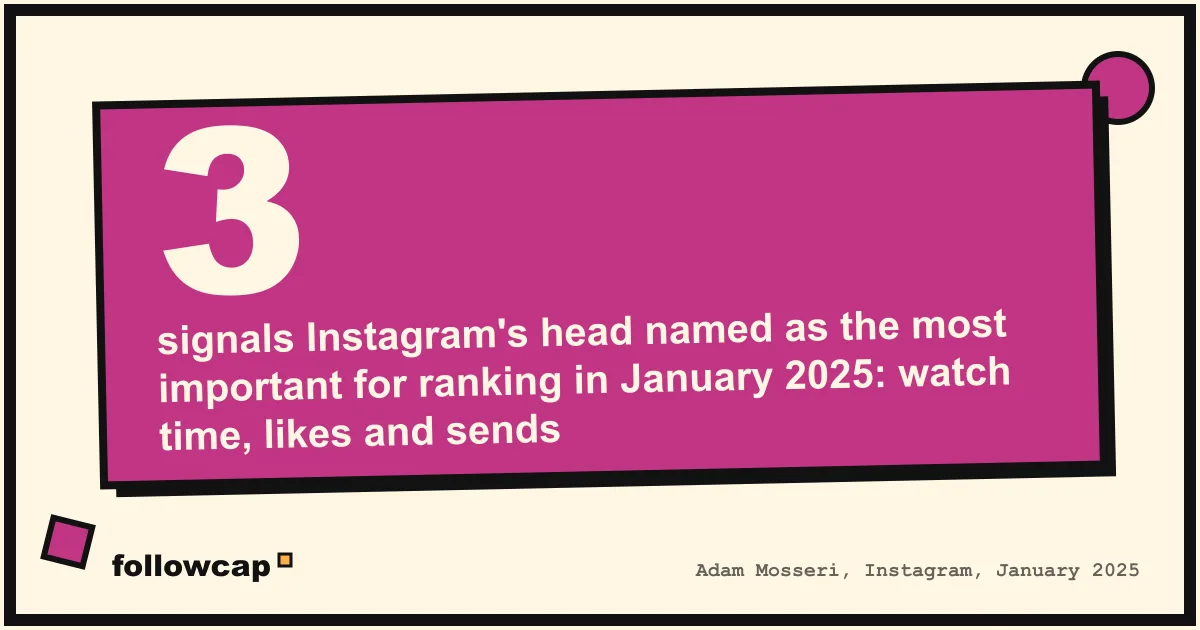
The Instagram algorithm is not one algorithm. Instagram runs a separate ranking system for Feed, Stories, Reels and Explore, and each one predicts different actions: whether you will spend time on a post, reply to a story, watch a reel to the end or save something from Explore. The three signals Instagram’s head says matter most are watch time, likes and sends.
Quick answer: Feed ranks posts from people you follow by how likely you are to spend a few seconds, like, comment, share or tap the profile. Stories rank by viewing history, engagement history and closeness. Reels and Explore rank mostly content from accounts you do not follow, by predicted reshares, full watches, likes and saves. As of 2026, original content is shown to a small audience first and travels further if watch time, likes and sends hold up.
Sources: Adam Mosseri’s “Instagram Ranking Explained” post of May 2023, his January 2025 video on ranking signals, and Instagram for Creators posts from April 2024 onwards. Where press coverage is the only source, the article says so.
Is there really one Instagram algorithm?
No. Mosseri’s 2023 explainer is blunt about it: Instagram does not have a single algorithm that decides what people see. Each part of the app, Feed, Stories, Explore, Reels and Search, has its own ranking system, built for how people use that surface. Feed is where you catch up with people you follow. Reels and Explore are where you discover accounts you do not follow yet.
When someone says “the algorithm changed”, the first question is which surface they mean.
How does the Feed algorithm work?
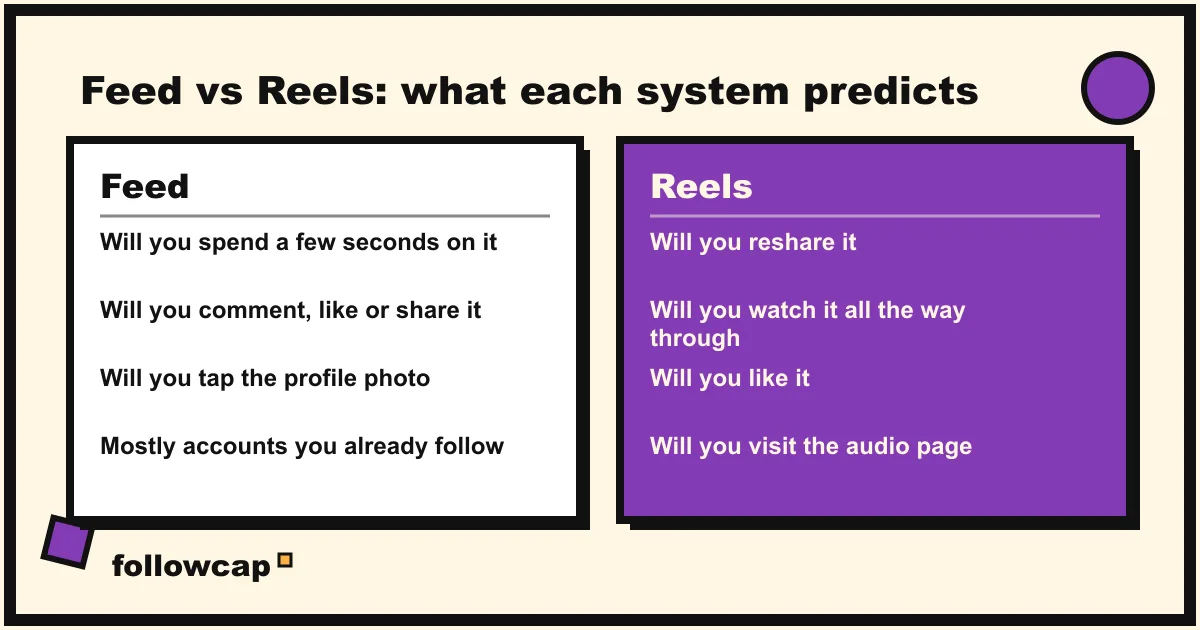
Feed starts with the recent posts from accounts you follow, plus recommended posts from accounts you do not follow, then orders them. Instagram lists the signals “roughly in order of importance”:
| Rank | Signal | What it means |
|---|---|---|
| 1 | Your activity | What you have liked, shared, saved or commented on recently |
| 2 | Information about the post | How popular it is, when it was posted, its format, length and location |
| 3 | Information about the person who posted | How often people have interacted with that account recently |
| 4 | Your history of interacting with them | Whether you comment on each other’s posts, message, and so on |
From those signals the system makes predictions. The five it watches most closely, in Instagram’s words, are whether you will spend a few seconds on the post, comment on it, like it, share it, or tap the profile photo. The more likely you are to do one of those, the higher the post sits. Because “your activity” is at the top, your own behaviour shapes your Feed faster than anything a creator does.
Feed is also the surface with the most user controls. The Following feed shows only accounts you follow in chronological order, the Favorites feed shows only accounts you pick, and both are explained in how to see your Instagram feed in chronological order. Suggested posts can be snoozed for 30 days, covered in how to turn off suggested posts on Instagram.
How do Stories get ranked?
Stories are the simplest surface. Instagram names three signals, without ordering them: viewing history (how often you watch an account’s stories), engagement history (how often you like or reply to them), and closeness (your overall relationship with that person). The predictions are whether you will tap into a story, reply to it, or move on to the next one. For a creator, stories are a loyalty surface, not a reach surface: there is no discovery mechanism to speak of.
How does the Reels algorithm work?
Reels is built for discovery, so most of what you see there comes from accounts you do not follow. Instagram’s ordered signals:
| Rank | Signal | What it means |
|---|---|---|
| 1 | Your activity | Reels you liked, saved, reshared, commented on or recently watched |
| 2 | Your history of interacting with the person who posted | Even if you do not follow them, any past interaction counts |
| 3 | Information about the reel | The audio track, the visuals, and how popular it is |
| 4 | Information about the person who posted | Follower count and level of engagement, used to give everyone a chance |
The predictions are different from Feed: whether you will reshare the reel, watch it all the way through, like it, and visit the audio page, which Instagram calls a proxy for whether it might inspire you to make your own.
In January 2025 Mosseri said which signals matter most: “The top three signals that matter most for ranking are watch time, likes and sends.” He told creators to watch average watch time, likes per reach and sends per reach in Insights, and added that likes are slightly more important for content shown to followers, while sends are slightly more important for content shown to people who do not follow you.
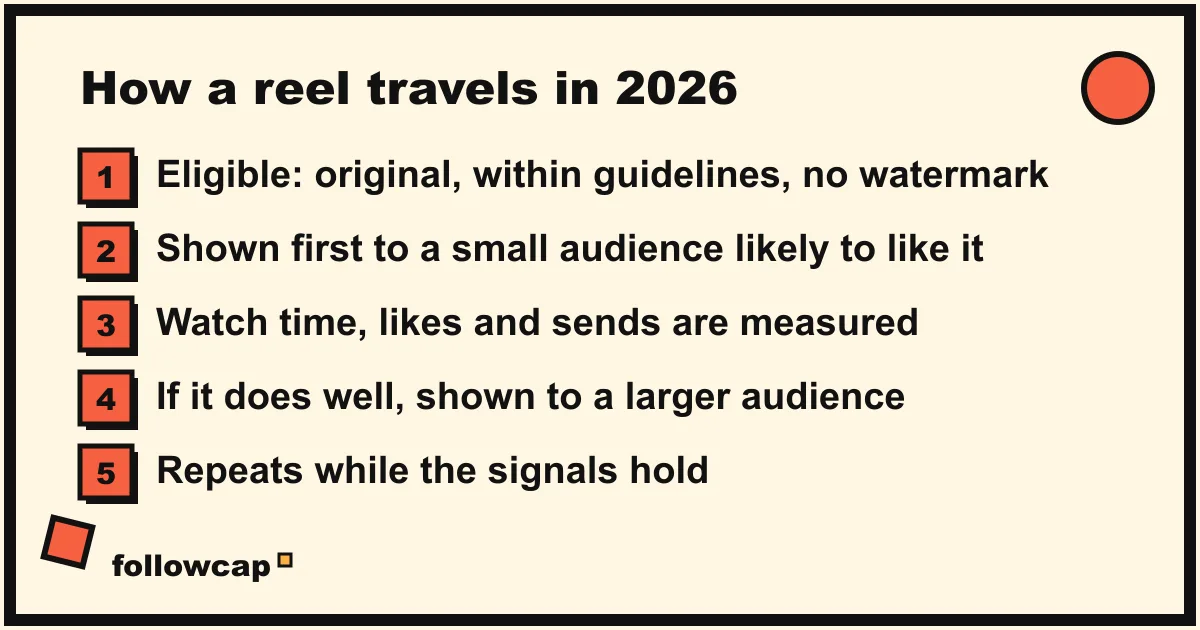
Since April 2024 there is also a distribution mechanism worth understanding. Instagram said that eligible content (original, within the Recommendations Guidelines, without a visible watermark) is shown first to a small audience likely to appreciate it, whether or not they follow the account, and that reels that do well then reach progressively larger audiences. This is why a reel can sit flat for a day and then take off, or never leave the first audience.
How does Explore pick posts?
Explore is the grid of recommendations, almost entirely from accounts you do not follow. Instagram’s ordered signals:
- Information about the post. How many and how quickly people are liking, commenting, sharing and saving it. Instagram says these signals “matter much more in Explore than they do in Feed or in Stories”.
- Your activity in Explore. What you have liked, saved, shared or commented on there.
- Your history of interacting with the person who posted. Usually none, but any interaction counts.
- Information about the person who posted. How many people have interacted with them recently.
The predictions in Explore are likes, saves and shares.
Explore and Reels share the Recommendations Guidelines, a stricter standard than the Community Guidelines. Content that is allowed on Instagram but goes against them (sensitive, low quality, clickbait, unoriginal) is not recommended, and an account that repeatedly posts it loses recommendation eligibility for a period. The Account Status screen in Settings shows whether your account and recent posts are eligible, and lets you appeal.
What changed between 2024 and 2026?
| When | What Instagram changed | Source |
|---|---|---|
| April 2024 | Original content ranked above reposts in recommendations; reposts get a label linking to the original; accounts reposting others’ content 10 or more times in 30 days are removed from recommendations | Instagram for Creators |
| November 2024 | A recommendations reset that clears suggested content in Explore, Reels and Feed, announced as a test with a global rollout to follow | Instagram announcement |
| December 2024 | Trial reels, which show a reel to non-followers first so you can test it before followers see it | Instagram for Creators |
| January 2025 | Mosseri names watch time, likes and sends as the top three ranking signals | Mosseri video, widely reported |
| December 2025 | “Your algorithm”, a screen in the Reels tab listing the topics Instagram thinks you like, which you can add to or remove from; US first, English-language users from January 2026 | Press coverage |
| April 2026 | “Your algorithm” extended to Explore, with Instagram saying changes in Reels or Explore carry across both; originality rules extended from reels to photos and carousels, so accounts that mostly post content they did not make or materially edit are no longer recommended to non-followers | Press coverage of Instagram’s announcements |
Some outlets reported “Your algorithm” reaching the main Feed in mid 2026; we found no Instagram announcement confirming it. The April 2026 originality change applies to recommendations only: followers of an aggregator still see its posts in Feed.
What does the algorithm mean if you post?
Strip away the mystique and the system asks four questions about every post. Will people watch it? Will they like it? Will they send it to someone? Is it original?
- Make the first seconds count. Watch time and “spend a few seconds on it” are both predictions about the opening. The patterns that work are collected in Instagram hook examples.
- Design for sends, not just likes. Sends per reach is the signal Instagram weights more for non-followers. Posts people forward tend to be useful, surprising or specific to a group.
- Post original work, or materially edit what you reuse. Since April 2026 this applies to photos and carousels as well as reels. A credit tag on a plain repost does not make it original.
- Judge by your own numbers over weeks, not by one reel. Compare average watch time, likes per reach and sends per reach across your last twenty posts, and check Account Status before assuming you have been shadowbanned.
Posting more helps reach in general, according to Mosseri, but only if you can keep it up; that trade-off is the subject of how often you should post on Instagram.
What does it mean if you just follow people?
The same systems decide what you see, and the honest summary is that Feed is ranked for your attention, not for completeness. A post from an account you follow is shown if the model predicts you will engage with it; if you have scrolled past that account a few times, its posts sink, and you may stop seeing them without unfollowing anyone. Instagram not showing posts from people you follow walks through the causes and the fixes.
The controls Instagram gives you, as of 2026: the Following feed, Favorites, Not interested and Snooze for suggested posts, Hidden Words, the Sensitive Content Control, the recommendations reset in Content preferences, and “Your algorithm” for Reels and Explore topics. None of them turns ranking off. The Following feed is the closest, and the app returns to the ranked Home feed each time you reopen it.
If there are a few creators or businesses you never want to miss, the app is not built to promise that, and this is where our own product fits, so read this as the maker’s description. Followcap sends one email every Sunday on the public accounts you choose: a 30-second summary, the three posts not to miss, a two to three line recap of the best posts from each account with their links, and one thing to apply this week. Three accounts are free with no card. It is weekly, not real time, it covers public creator and business accounts only, it cannot show reach, saves, views, watch time or audience data, and the paid plans (Premium at €9 a month for 10 accounts with weekly numbers per account, Business Pro at €29 a month for 50 accounts and a team dashboard) are paid after a 7-day trial, with a 30-day money-back. It replaces scrolling for the accounts that matter; it does not change what Instagram shows you.
FAQ
Does the Instagram algorithm favour Reels over photos?
Not in the sense of one system choosing a format. Reels has its own ranking system aimed at discovery, so a reel can reach far more non-followers than a photo in Feed. Inside Feed, photos and videos are ranked by the same predictions, and since 2026 original carousels are covered by the same originality rules for recommendations.
How do I reset my Instagram algorithm?
Instagram announced a recommendations reset in November 2024 that clears suggested content in Explore, Reels and Feed and lets you review who you follow. As of late 2026 the path reported by users is Settings and activity → Content preferences → Reset suggested content, and Instagram’s help center has an article titled “Reset your suggested content”. Your posts, followers and follows are unchanged.
What are the most important ranking signals in 2026?
For reach, the three Mosseri named in January 2025: watch time, likes and sends, read in Insights as average watch time, likes per reach and sends per reach. For your own Feed, the top signal is your activity: what you have recently liked, saved, shared and commented on.
Is shadowbanning real?
Instagram’s position, from the 2023 explainer, is that “shadowban” has no shared definition, that limiting reach without explanation is not the intention of its ranking, and that it does not suppress content to sell ads. What exists is recommendation ineligibility for posts or accounts that break the Recommendations Guidelines or repost repeatedly, and Account Status shows it. If Account Status is clear, the first small audience most likely did not watch, like or send enough.
Related reading
- Best Time to Post on Instagram in 2026 (and How to Find Yours)
- How to Get Notified When Someone Posts on Instagram (5 Ways)
- How to Find Trending Content in Your Niche on Instagram
The bottom line
How the Instagram algorithm works in 2026 is less mysterious than it looks: four ranking systems, each predicting a short list of actions, with your own activity at the top of every list. For posting, the signals Instagram says to watch are watch time, likes per reach and sends per reach, plus originality, which now covers photos and carousels as well as reels. For following, the controls that exist steer the ranking without switching it off, and a weekly email such as Followcap, which we make, is one way to make sure a handful of accounts reach you whatever the feed decides.