How to Spot Fake Followers on Instagram (Any Account, 2026)
How to spot fake followers on Instagram: engagement rate vs follower count, comment quality, follower list patterns, growth spikes, free checkers and weekly tracking.
 Andrea Marino11 min read
To spot fake followers on any public Instagram account, compare its engagement rate with its follower count, read the comments on its last ten posts, sample its follower list, check for sudden growth spikes, and run the username through a free checker. No single sign proves anything; three together make a strong case.
Quick answer: work out likes plus comments per post divided by followers. Under half the typical rate for the account’s size, with generic comments (“Nice!”, emoji strings), followers that have no posts and no profile photo, and a follower count that jumped by thousands in a day, means bought followers. Confirm with HypeAuditor’s or Modash’s free checker, then watch the account weekly: a fake audience never engages, and bought spikes show up as flat lines.
Why it matters in 2026
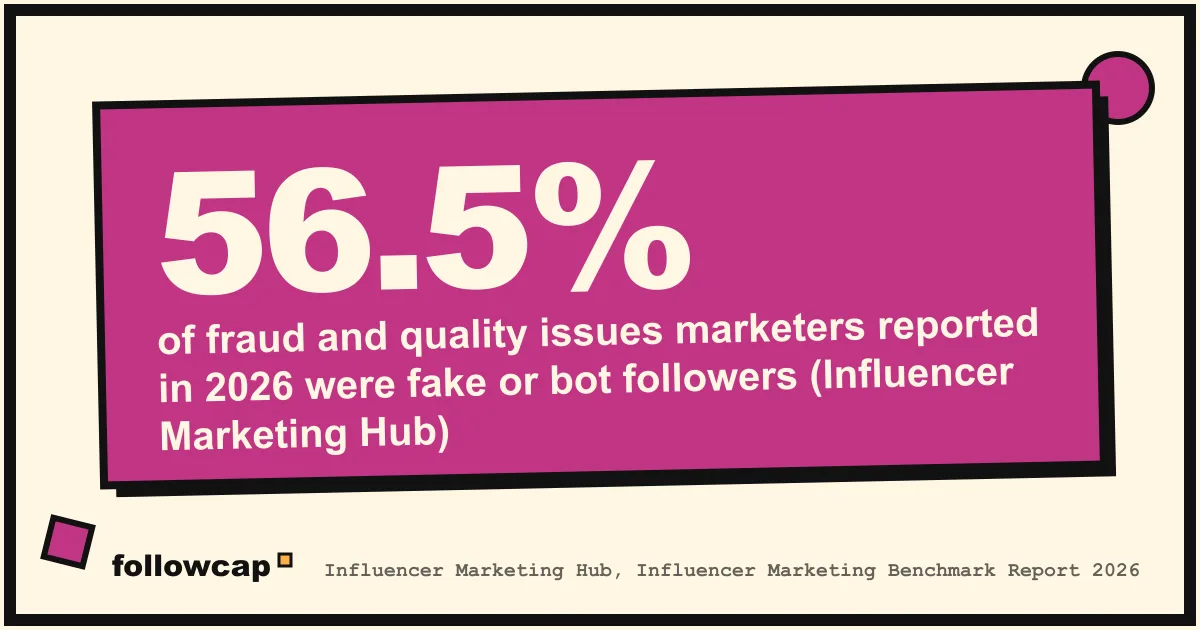
Fake followers are a pricing problem for brands and a credibility problem for creators. Influencer Marketing Hub’s 2026 Benchmark Report found that fake or bot followers account for 56.5 percent of all fraud and quality issues marketers reported, and only 10.9 percent of respondents reported none. If you pay a creator by follower count, you pay for whatever share of that count is empty.
Meta’s rules are clear. Its Spam policy, which covers Instagram, forbids attempting to or successfully selling, buying or exchanging for engagement, “such as likes, shares, views, follows.” Instagram enforces it in waves: in November 2018 it announced it would remove inauthentic likes, follows and comments from accounts using third-party apps, and in May 2026 press reports of large follower drops on celebrity and brand accounts were met with Meta’s statement that it was routinely removing inactive accounts. Bought followers do not just fail to engage; they disappear.
Five manual checks on any public account
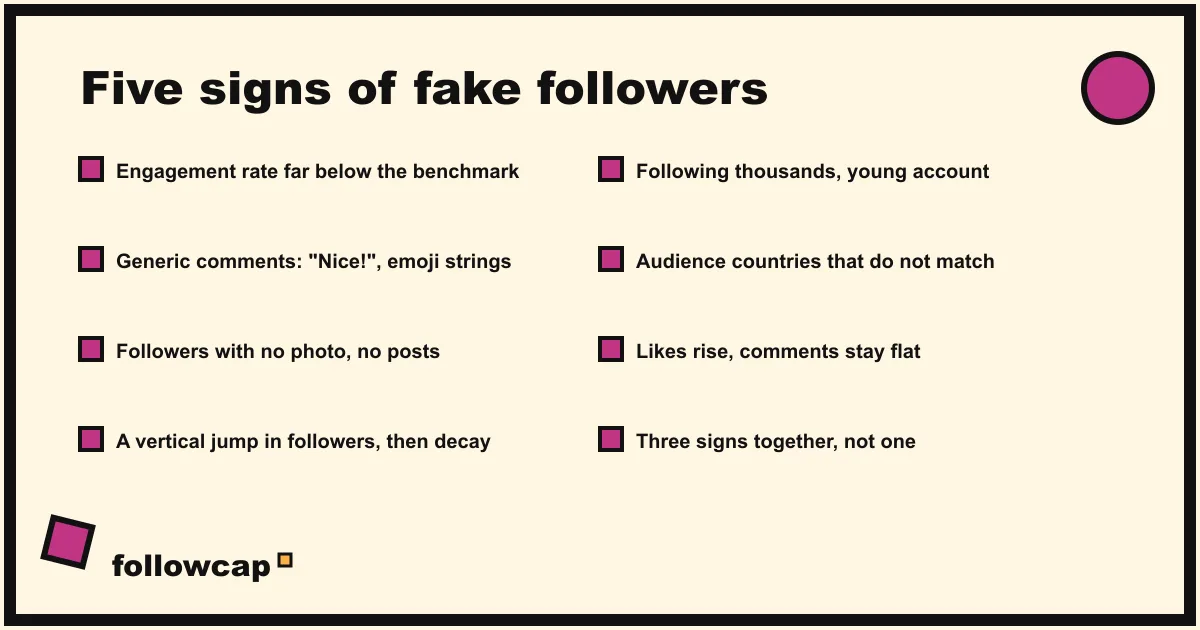
Most guides on how to spot fake followers on Instagram list the signs and stop. The checks below add the arithmetic and the benchmarks, and everything works from the public profile on instagram.com or in the app, with no tool and no access to the account’s Insights. Budget 15 minutes per account.
1. Engagement rate against follower count
Take the last 10 to 12 feed posts, skipping anything posted in the last 24 hours. Add likes and comments for each, average them, divide by the follower count, and multiply by 100. Instagram engagement rate walks through the arithmetic.
Then compare with a benchmark for the size. Socialinsider’s 2026 Instagram benchmarks, built on 67.5 million organic posts from 579,000 brand accounts with 1K to 1M followers, put the average engagement rate by followers at 0.48 percent in 2025, with reels at 0.52 percent, carousels at 0.55 percent and images at 0.37 percent. Creators and small accounts usually run well above brand averages, so use Instagram engagement rate benchmarks for the right comparison. The signal is the gap, not the exact number: an account with 80,000 followers averaging 150 likes sits at 0.19 percent, below a brand average built on far duller content, and that gap needs an explanation.
Two caveats: likes can be hidden by the poster, in which case use the comment rate, and a low rate alone can mean a dormant audience rather than a bought one.
2. Comment quality
Open the comments on the five most recent posts and read them, not count them. Real comments reference the post: a question about the recipe, a joke about the caption, a tag of a friend with a reason. Bought comments are generic (“Amazing!”, “Love this”, three fire emoji), repeat across posts, arrive within minutes of publishing from accounts that comment the same way everywhere, and get no reply. If a post has 2,000 likes and four comments, all generic, the likes deserve a second look too. Comment pods (the same 20 real accounts on every post) are not fake followers, but they inflate the rate from check 1, so discount them.
3. The follower list
Open Followers on the profile (you need to be logged in, and the account must be public). Scroll a few screens and tap into 20 accounts at random. Fake followers share a look: no profile photo or a stock one, a username made of a name plus a string of digits, zero or a handful of posts, few followers and thousands of following, an empty bio or a single link. One or two per screen is normal. Half the screen is not.
Also look at where they are from: a creator posting in Italian from Milan whose sample is mostly empty accounts with names in a script that does not match has bought something. Modash’s free checker shows audience countries, which turns this into one number.
4. Growth spikes
Followers bought in bulk arrive together. A real account grows in a curve with small bumps when a post travels; a bought one shows a vertical step of thousands in a day or two, then a slow bleed as Instagram removes the emptiest accounts. The app shows no history for other accounts, so HypeAuditor’s free report shows followers gained or lost over the past four weeks; a sheet with one row per week shows it for as long as you keep it. Instagram follower count history covers the ways to reconstruct a curve.
For your own account, Insights show the chart directly: the About Instagram Insights help page lists Total followers with the number of followers gained or lost, available once you have at least 100 followers, within a 90-day window.
5. Follower-to-following ratio and account age
A ratio alone proves little, but two patterns are telling. An account following 7,000 people with 7,500 followers has probably grown by follow-unfollow automation, which Instagram’s 2018 announcement targets as inauthentic. And an account with 200,000 followers, 40 posts and a join date (under About this account on the profile, where Instagram provides it) a few months old has grown faster than content explains. Why am I losing followers on Instagram reads the same ratio from the other side.
Free fake follower checkers that still exist
Two official tool sites offer free checks in late 2026, and both exist to sell the paid vetting platform behind them.
| Checker | What the free check shows | Needs | Limits | Paid plan |
|---|---|---|---|---|
| HypeAuditor Instagram fake follower check | Audience Quality Score (1 to 100), follower count, engagement rate; “Get Report” adds category, ranks, average likes and comments, and followers gained or lost over four weeks | A username; a sign-up prompt appears, the page does not say whether it is required | Accounts with at least 1,000 followers; no demographics, posting frequency or sponsored history | Priced on request |
| Modash fake follower checker | Fake follower percentage, engagement rate, average likes and comments, audience type, top five audience countries | A username, no sign-up | A limited version of the vetting tool; gender and full audience data need a trial | 14-day trial, no card; from $199 a month |
HypeAuditor’s score needs reading: its audit page says 60 or more is good and below 40 suggests abnormal follower-growth activity. Modash gives a percentage with a benchmark for what is normal; a few percent of fake followers is the background level on any real account, since bots follow random accounts to look real.
Treat both as estimates: they sample followers and apply models, so two checkers rarely agree to the decimal, and a creator hit by a bot wave they never bought scores badly through no fault of their own. Use a checker to decide whether the manual checks are worth 15 minutes, not as a verdict.
Avoid the rest of the “free checker” results: sites that ask you to log in with your Instagram account, extensions that read your session, and apps that promise to remove fake followers for you. Instagram’s terms forbid handing your credentials to third parties, and the 2018 announcement asked affected accounts to change their password precisely because those apps hold it. Instagram profile analyzer lists which analyzers are safe to use.
How a brand vets a creator before a deal
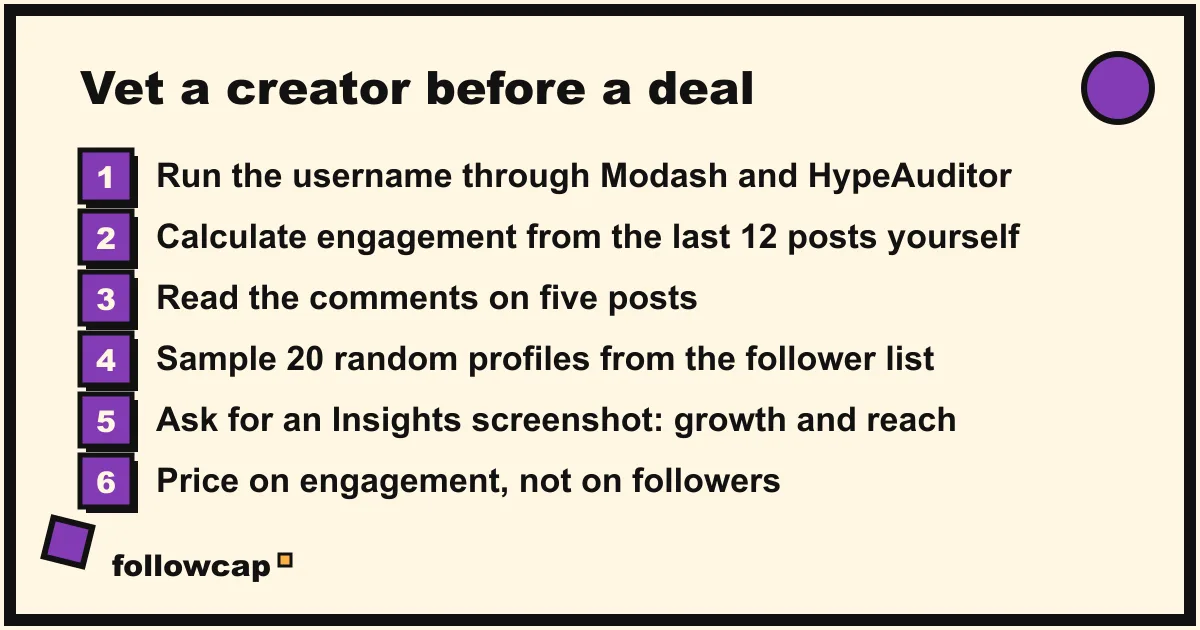
Put the checks in order so the cheap ones filter before the slow ones.
- Run the username through Modash and HypeAuditor. Two minutes. A fake follower rate at or below the benchmark Modash shows and an Audience Quality Score of 60 or more clears the first gate; anything worse goes to step 2 with suspicion, not rejection.
- Calculate the engagement rate from the last 12 posts yourself. Checkers sample; your count is exact.
- Read the comments on five posts. Specific, replied-to comments from accounts that look like customers are worth more than any score.
- Sample the follower list. Twenty random profiles, as in check 3.
- Ask the creator for a screenshot of their Insights. Total followers growth over 90 days, reach on the last few posts, audience countries. A clean audience is shared in a minute; hesitation is information.
- Price on engagement, not followers. Pay for average interactions per post, or on performance, and the fake share stops mattering. How to track influencers and creators for your brand covers the contract side. Keep the numbers from steps 1, 2 and 5 in the creator’s row of your sheet.
How weekly tracking exposes bought spikes
A checker is a photograph. A log is a film, and bought growth is easier to see in motion. Record, once a week, each account’s follower count, posts, likes and comments, and three things fall out within a month. First, the spike: a step of several thousand followers in one week, with no post that travelled. Second, the decay: the count drifts down as Instagram’s cleanups remove dormant accounts, which Meta’s Account Integrity policy flags as accounts that may be asked to verify themselves. Third, the flat line: followers rise, likes and comments do not, and the engagement rate falls in proportion. Real growth lifts all three. Instagram follower growth tracker explains the sheet, and Instagram follower growth rate gives the healthy range to compare against.
By hand, five accounts take 15 minutes a week. Followcap is our product, so read this as the maker’s description: you type the usernames of public Instagram creator or business accounts, with no Instagram login or password, and every Sunday you get one email with a 30-second summary, the three posts not to miss, a recap of the best posts from each account with their links, and what to apply this week. Three accounts are free with no card. Premium (€9 a month, 10 accounts) adds the weekly numbers per account, including follower growth and the best post, with a personal archive page, which is the log above kept for you; Business Pro (€29 a month, 50 accounts, 3 team users) adds a dashboard with alerts and CSV export. Its limits: weekly, not real time; public creator and business accounts only; it sees public posts, likes, comments and follower counts, so it cannot tell you which followers are fake, show reach, saves, views, Stories or audience countries, or replace a checker; paid after the 7-day trial, with a 30-day money-back. It shows the spike and the flat line; the checker explains them.
What no check can prove
- That a specific follower is a bot. Empty accounts belong to real people too. The signal is the proportion, never one profile.
- Who bought the followers. Rivals buy them for accounts they want to discredit. A spike is evidence of inauthentic followers, not of intent.
- Reach, saves and views of someone else’s posts. Only the owner sees them. Ask for a screenshot; distrust any tool that claims to know.
- An exact percentage. Every checker samples and models. Report ranges, and say which tool produced them.
FAQ
How can you tell if someone bought Instagram followers?
The short version of how to spot fake followers on Instagram is the combination: a follower count far above what likes and comments support, generic comments, a follower list full of empty profiles, and a vertical jump in growth followed by a slow decline. Confirm with a free checker. One sign can be innocent; three together rarely are.
What is a normal percentage of fake followers on Instagram?
A few percent on any real account, because bot networks follow accounts at random to look authentic. Modash’s checker shows a benchmark beside each result; HypeAuditor expresses it as a quality score, with 60 and above considered good. Treat anything well above the benchmark the checker shows as a problem worth raising with the creator.
Does Instagram remove fake followers?
Yes, periodically. Instagram said in 2018 it would remove inauthentic likes, follows and comments from accounts using third-party apps, and in May 2026 Meta answered press reports of follower drops across large accounts with a statement about routine removal of inactive accounts. Bought followers shrink over time; real ones do not.
Is there a free tool to check fake followers on Instagram?
Yes, two from official sites: HypeAuditor’s free Instagram fake follower check, for accounts with at least 1,000 followers, and Modash’s free checker, which needs no sign-up. Both are limited versions of paid platforms. Avoid any “checker” that asks for your Instagram login.
How do I check my own account for fake followers?
Run your username through both checkers, then open Insights and compare the Total followers growth chart with your posting history: a spike you cannot tie to a post is suspect. Sample your own follower list the same way you would a creator’s. You can remove followers one by one, and Instagram’s own cleanups take the dormant ones over time.
Related reading
- The Best Instagram Analytics Tools in 2026 (Yours and Others’)
- Best Time to Post on Instagram in 2026 (and How to Find Yours)
- Free Social Media Monitoring Tools That Actually Work in 2026
The bottom line
Knowing how to spot fake followers on Instagram comes down to five checks you can run on any public profile in 15 minutes: engagement rate against size, comment quality, a sample of the follower list, growth spikes, and the follow ratio with account age. HypeAuditor and Modash still offer free checks that turn two of those into a number, and both are estimates. For brands, vet before the deal and price on engagement. For anyone watching a set of accounts, a weekly log of followers, likes and comments, kept by hand or by a tool such as Followcap, shows the spike and the flat line that a bought audience cannot hide.