Influencer Tracking Tools: What They Cost and What They Show (2026)
Influencer tracking tools compared: Modash, Upfluence, HypeAuditor, CreatorIQ, GRIN, Later Influence and a weekly recap. Real prices, what each shows, who needs consent.
 Andrea Marino12 min read
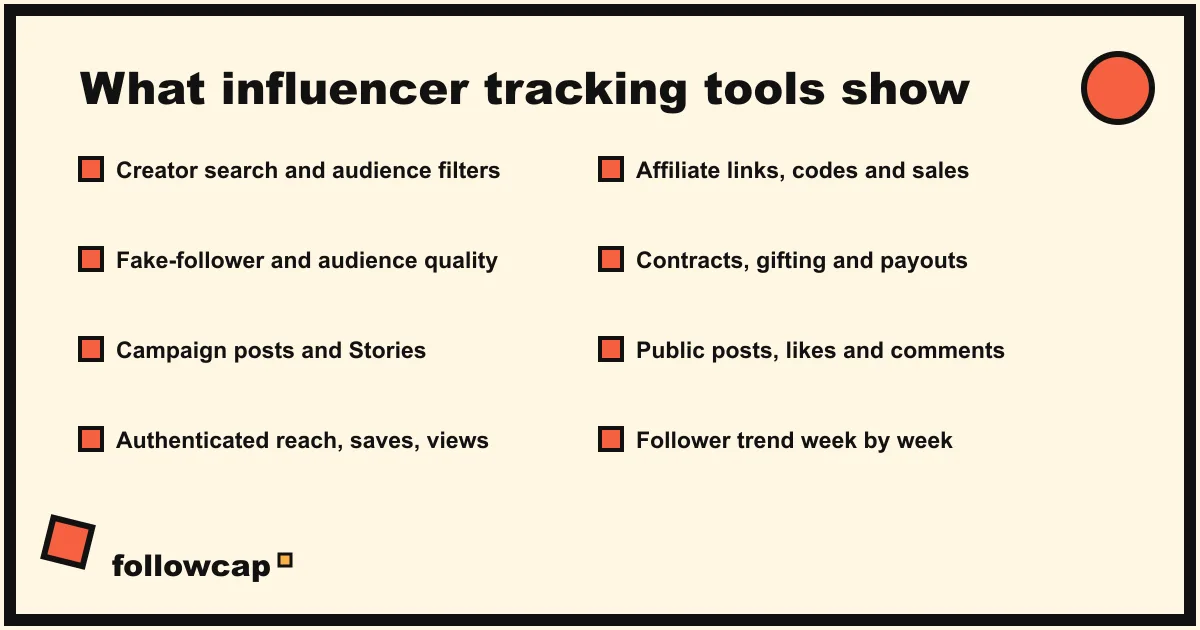
Influencer tracking tools do three different jobs, and the price depends on which one you need: finding and vetting creators (databases with audience and fraud checks), reporting on paid campaigns (which needs the creator to connect their account), and watching specific creators week after week (public posts, likes, comments, follower trend). Enterprise suites do all three for a quote; two tools publish a price.
Quick answer: Modash (from $199 a month billed annually) and GRIN (free tier, then $200 a month plus a fee on payouts) are the two with public prices. Upfluence, HypeAuditor, CreatorIQ and Later Influence quote per customer. All of them need the creator to connect their account before you see reach, saves, Story results or audience data. If you only want what a list of creators posted and how it did on public numbers, a weekly recap under €10 a month does that, and nothing more.
What an influencer tracking tool actually tracks
The phrase covers three products that happen to share a name, and most buyers only need one.
1. Discovery and vetting. A searchable database of creator profiles (Modash cites 380 million, HypeAuditor 226.8 million) with filters for niche, location, size, engagement rate and audience demographics, plus a fake-follower or “audience quality” score. Public data and estimates; the creator does nothing.
2. Campaign reporting. Once you have hired creators, the tool collects the posts and Stories they publish for you, pulls the real numbers behind them, tracks affiliate links, promo codes and sales, and handles contracts and payments. The real numbers (reach, impressions, saves, Story taps, audience breakdown) only exist if the creator authenticates their account. Without that step, the tool is back to public likes and comments, like everyone else.
3. Ongoing monitoring. Watching a fixed list of creators, hired or not, including competitors’ creators: what they post, which formats work, how likes and comments move, whether followers grow. This is a creator tracking routine, and it needs public data only.
The enterprise platforms sell all three in one contract; the question is whether you are paying for jobs 1 and 2 to get job 3.
7 influencer tracking tools compared
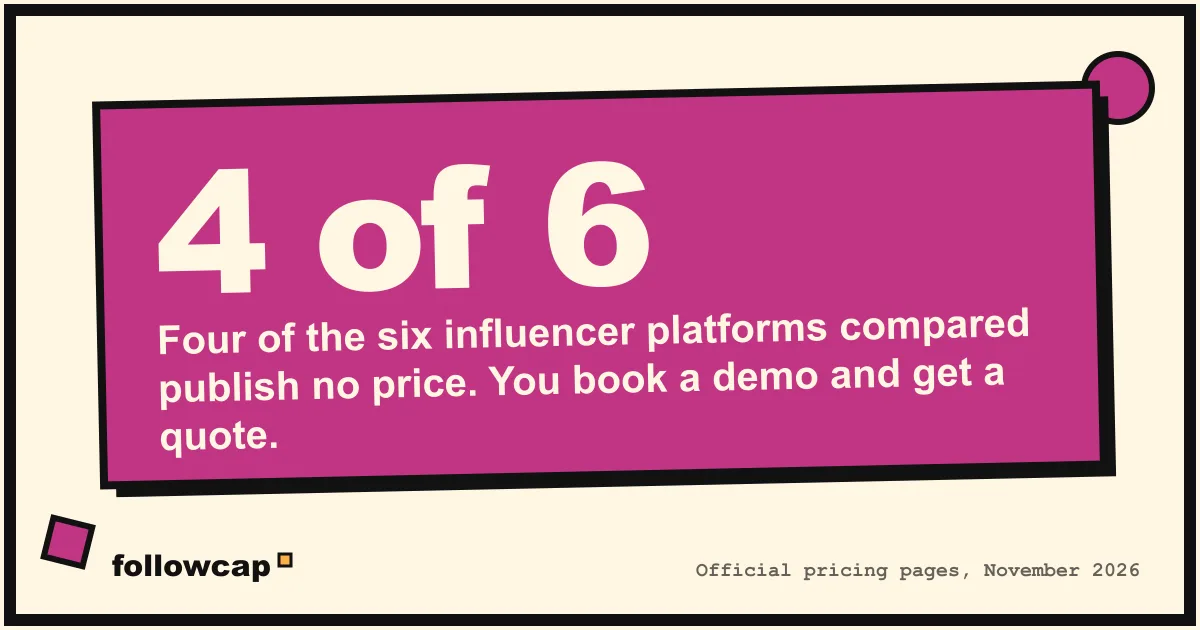
Prices were read on each tool’s official pricing page on November 4, 2026. “Needs creator consent” means the creator must connect their account before the tool shows anything beyond public counts.
| Tool | What it tracks | Needs creator consent? | From | Best for |
|---|---|---|---|---|
| Modash | Discovery, audience and fraud reports, campaign content tracking, Shopify sales | No for discovery and content tracking; yes for authenticated metrics | $199/month billed annually (Essentials), $499 Performance, Enterprise from $14,700/year; 14-day trial, no card | Mid-size brands running paid campaigns on a self-serve plan |
| Upfluence | Creator search, outreach, affiliate and discount tracking, e-commerce integrations, payments | Yes for program and sales tracking | Custom quote, three tiers, 12-month minimum on annual plans | E-commerce brands running affiliate-style creator programs |
| HypeAuditor | Discovery, audience quality and fraud analytics, campaign tracking, media plans | No for audience reports; yes for authenticated campaign data | Not published; the pricing page is a demo request form. Free media plans and demo features | Vetting creators for fake followers before you pay them |
| CreatorIQ | Enterprise creator CRM, authenticated campaign reporting, payments, compliance | Yes: reach, saves, Story metrics and demographics require authentication | Request pricing (no published tiers) | Large brands and agencies with hundreds of creators and procurement |
| GRIN | Creator CRM, gifting, campaigns, affiliate and sales tracking, payments | Creators link accounts and authorise what GRIN pulls | Free ($0 + 20% fee on payouts), Starter $200/month + 10%, Growth $500 + 7%, Scale $1,500 + 5%; Enterprise by quote | DTC brands paying creators through the platform |
| Later Influence | Discovery and vetting, campaign management, performance tracking, social listening, managed services | Yes for campaign performance | Request pricing, three plans (Platform, Platform + Services, Services); no free trial | Brands that want a platform plus a team to run campaigns |
| Followcap (ours) | Public posts, likes, comments, best post and follower trend of chosen public creator and business accounts, as one Sunday email; CSV on Business Pro | No: public accounts only, no login or connection | Free for 3 accounts, no card; Premium €9/month (10 accounts); Business Pro €29/month (50 accounts, 3 users); 7-day trial, 30-day money-back | Watching what a list of creators posts each week. Weekly, not real time; no reach, saves, views, Stories, mentions or audience data |
The tools one by one
Modash
Modash is the clearest self-serve option among the campaign platforms. The Modash pricing page lists Essentials at $199 a month on annual billing ($2,388 a year; Modash’s blog gives $299 on monthly billing), with 2 team members, 300 opened profiles a month and 100 tracked creators’ content; Performance at $499 with 5 members, 800 profiles and 250 tracked creators; and Enterprise from $14,700 a year above 250 creators. The 14-day trial needs no card but caps you at 20 profile views and 10 tracked creators. Two lines on that page matter for consent: “Creators get discovered without signing up or doing anything,” and “All tracking happens automatically in the background.” True for public content tracking; authenticated metrics still need the creator.
Upfluence
Upfluence sells three tiers, Find Creators, Scale Creator Programs and Run Programs on Autopilot, and its pricing page prints no numbers for any of them: each is a fixed platform fee quoted after a call, with a 12-month minimum on annual plans and a free trial “set up after an initial call with the sales team.” The pitch is e-commerce: Amazon, Shopify, WooCommerce, Magento and BigCommerce integrations, affiliate and discount-code tracking with no commission on tracked sales, and bulk payouts on the top tier. If your creator program is measured in orders rather than likes, this is the category; if not, you are paying for a sales stack you will not use.
HypeAuditor
HypeAuditor built its name on audience quality scores, the fake-follower check brands run before signing a creator. Its site advertises a 226.8 million profile database with 35 filters, audience, performance and fraud insights, and end-to-end campaign tracking. As of November 2026 the HypeAuditor pricing page is a “Book your free demo” form with no plan names or prices; the free entry point is “free media plans, campaign management, and demo versions of other features.” Roundups still quote $299 a month for an entry plan, but that figure is not on HypeAuditor’s own page, so treat it as a rumour until a sales call confirms it.
CreatorIQ
CreatorIQ is the enterprise end: a creator CRM, campaign reporting, payments and compliance for brands that run hundreds of creators and have a procurement department. Pricing is by request only, through a form that promises “more information on our pricing and packages.” The useful public document is on the creator side. CreatorIQ’s page on the benefits of authenticating social accounts lists the Instagram metrics “only available to your partnering brand or agency through authentication”: views, reach, video views, replies, shares, taps forward and back, saves and audience demographics. When a creator merely adds a handle without authenticating, “no data will be passed along to CreatorIQ or your partnering brand or agency.” That sentence applies to every tool in this list, whether or not they say it as plainly.
GRIN
GRIN is the one platform with a free tier, and the catch is in the fee column. On the GRIN pricing page, Free costs $0 a month with a 20 percent management fee on wallet deposits, Starter is $200 a month with a 10 percent fee, Growth $500 with 7 percent, Scale $1,500 with 5 percent, and Enterprise is set with the sales team. Starter has a 30-day trial that converts to $200 a month unless you downgrade, with a card or bank account on file at sign-up. Creators link their own social accounts and authorise what GRIN pulls, which makes its reporting reliable and makes it a hiring tool rather than a watching tool: you cannot report on a creator who has not joined your program.
Later Influence
Later Influence, the influencer platform inside Later, lists three plans on its pricing page: Platform, Platform + Services and Services, each with “Request Pricing” where a number would be, “unlimited users, campaigns, and creator partnerships,” and a plain note that “we don’t currently offer a free trial for Later Influence.” The services plans add Later’s own team to recruit, negotiate and run campaigns, which suits a brand that wants the campaigns done more than it wants a dashboard.
The weekly recap (ours)
The last row of the table is our own tool, so read its line as the maker’s description. It is not a campaign platform: no discovery database, no contracts, no payments, no authenticated metrics. You type the usernames of public creator or business accounts, with no Instagram login, and every Sunday one email arrives with a 30-second summary, the three posts not to miss, a two to three line recap of the best posts from each account with their links, and “what you can apply this week.” Paid plans add weekly numbers per account (posts, likes, comments, best post, follower growth), an archive page, and on Business Pro a dashboard with alerts, CSV export and a “you vs your niche” view. The limits are in the table: weekly, not real time; public accounts only; public posts, likes, comments and follower counts and nothing else; paid after the 7-day trial.
Consent and connection: why the good numbers need the creator
Every “reach” column in a campaign report comes from one of two places: the creator authenticated their Instagram account through the platform, or someone screenshotted the Insights screen and typed the number in. There is no third source. Instagram shows reach, impressions, saves, Story views and audience demographics to nobody but the account’s owner, which is why the public tools and the analytics tools for other accounts stop at likes, comments, follower counts and posting rhythm.
Three consequences:
- Before a creator is hired, every tool works from public data and estimates. The audience-quality scores in HypeAuditor and Modash are models built on public followers, not Instagram’s numbers. Good models, but models.
- A creator who will not connect cannot be fully reported on. Write authentication into the contract, or accept screenshots.
- Competitors’ creators and creators you have not hired are public-data-only, forever. No platform at any price gets their reach. What you can get is what they posted, how often, in which formats, the likes and comments each post drew, and whether their follower count moved, which answers “who is worth approaching” and “what is working in our niche.”
When you need an enterprise platform, and when a weekly recap is enough
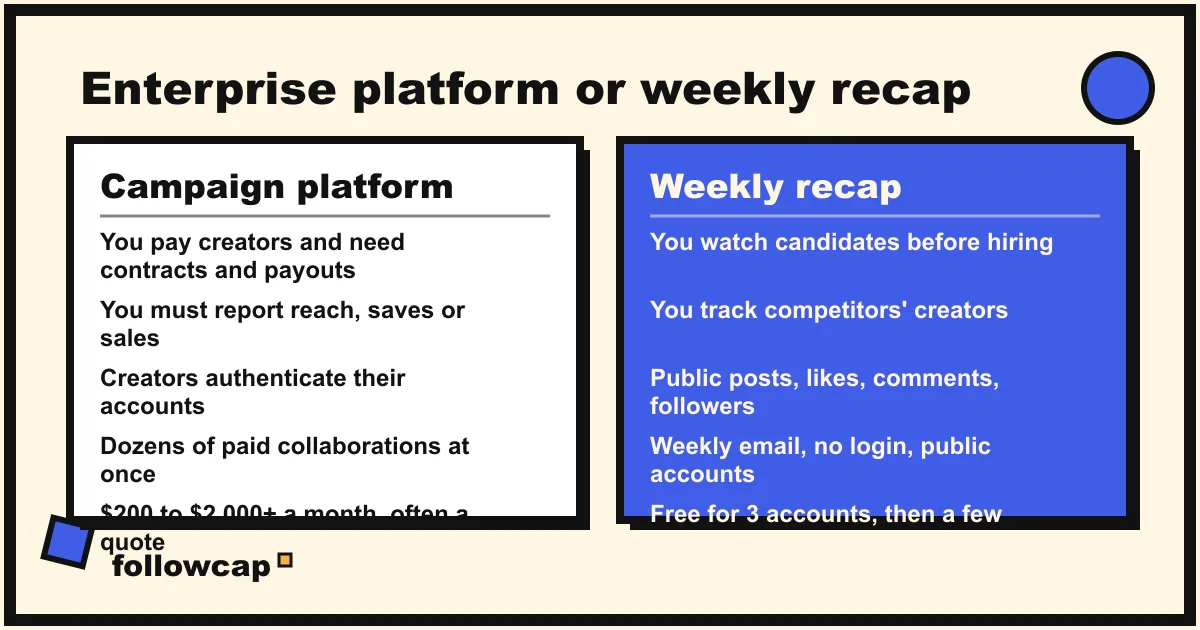
You need a campaign platform when:
- You pay creators and need contracts, briefs, product seeding and payouts in one place.
- You must report reach, saves, Story performance or sales to a client or finance, so you need authenticated data.
- You run more than a dozen paid collaborations at once and the spreadsheet has broken.
- You need affiliate links, promo codes and attribution to orders.
A weekly recap of public accounts is enough when:
- You are deciding whom to approach and want to watch 10 to 50 candidates for a month first.
- You are tracking competitors’ creator partnerships, which no platform can authenticate anyway.
- You run a handful of collaborations and the creators send their own Insights screenshots.
- You are a solo marketer, a small agency or a creator studying peers, and $200 a month is the whole budget.
Many teams do both: a recap for the long list, a platform for the contracted few. The expensive mistake is paying enterprise rates to watch creators you will never hire.
What no influencer tracking tool can show you
- Reach, impressions, saves and audience data for an account that has not authenticated. Not public, not available at any price. Reach vs views vs impressions explains what each would have told you.
- Stories after they expire, unless the tool captured them within 24 hours through the creator’s connection.
- Brand-deal rates and private negotiations. Rate “benchmarks” are survey averages, not that creator’s price.
- Why a post worked. Tools give numbers; reading the hook, format and timing is still a person’s job.
How to choose in five steps
- Name the job. Discovery, campaign reporting or ongoing monitoring. If it is the third, cross out the enterprise tier.
- Count the creators you will track monthly and check the caps (Modash Essentials tracks 100 creators’ content; recap plans count accounts).
- Decide whether you need authenticated data. If yes, you need a platform the creators will join, and a contract clause that says so.
- Check the price on the official page, not a roundup. Four of the six platforms above publish none; budget a sales cycle.
- Run the free entry point for a month: Modash’s trial, GRIN’s free tier, HypeAuditor’s free media plans, or three free accounts on a recap. Compare what you actually opened.
FAQ
What is the best influencer tracking tool?
There is no single best. For paid campaigns with authenticated reporting on a self-serve budget, Modash is the clearest priced option; for e-commerce programs with payouts, GRIN or Upfluence; for enterprise scale, CreatorIQ; for vetting fake followers, HypeAuditor. For watching what chosen creators post each week on public numbers, a weekly recap does it for a fraction of the cost.
How much do influencer tracking tools cost?
Published prices run from free (GRIN, with a 20 percent fee on payouts) through $199 to $499 a month (Modash) to $14,700 a year and up (Modash Enterprise). Upfluence, HypeAuditor, CreatorIQ and Later Influence quote per customer. A public-data weekly recap is free for 3 accounts and €9 to €29 a month beyond that.
Can I track an influencer without them knowing?
You can watch any public account’s posts, likes, comments and follower count; that is public by Instagram’s design. You cannot get their reach, saves, Story views or audience data without their authentication, and tools that claim to are estimating. For hired creators, tell them what you track; it is in the contract anyway.
Do influencer tracking tools work for TikTok and YouTube?
The campaign platforms cover Instagram, TikTok and YouTube at least; CreatorIQ’s authentication page also lists Facebook, Snapchat and blogs. The weekly recap here is Instagram only.
Is a free influencer tracking tool good enough?
For discovery, the free tiers are enough to shortlist. For campaign reporting, you quickly hit profile and tracking caps. For monitoring a few creators’ public posts, free is often enough: three accounts on a recap, or post notifications in the app itself.
Related reading
- Free Social Media Monitoring Tools That Actually Work in 2026
- Social Media Competitor Analysis Tools: 8 Options Compared (2026)
- Social Media Monitoring Tools: 9 Options Compared (2026)
The bottom line
Influencer tracking tools are three products under one name: discovery databases, campaign reporting platforms and ongoing monitoring of chosen creators. Modash and GRIN publish prices (from $199 a month billed annually, and free plus a payout fee); Upfluence, HypeAuditor, CreatorIQ and Later Influence quote per customer, and every one of them needs the creator to authenticate before it can show reach, saves or audience data. Buy a platform when you pay creators and must report authenticated numbers; for watching what a list of public creators posts each week, with likes, comments and follower trend, a weekly recap such as Followcap, which we make, costs a few euros and tells you exactly what is public and nothing else.