Social Media Competitor Analysis Tools: 8 Options Compared (2026)
Social media competitor analysis tools compared: Socialinsider, Rival IQ, Sprout, Hootsuite, Metricool, Brandwatch, Meta Ad Library and a weekly recap, with prices.
 Andrea Marino12 min read
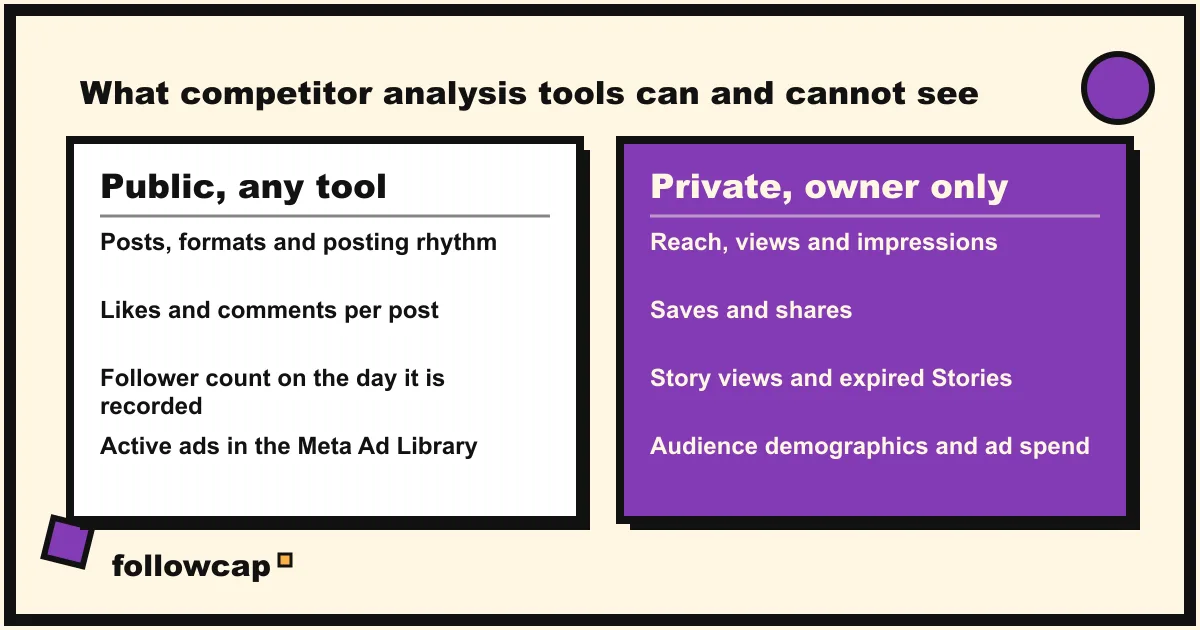
Social media competitor analysis tools record the public activity of accounts you do not own, usually posts, likes, comments, follower counts and ads, and set it against your own numbers. Eight are worth your time in 2026, from a free ad search to suites costing several hundred dollars a month, and not one of them can see a rival’s reach, saves or Stories.
Quick answer: for a free start, use Metricool’s free plan (5 competitor profiles) and the Meta Ad Library (every active ad, no account needed). For benchmarking across six networks with history, Socialinsider from $82 a month or Rival IQ from $239. If you already pay for Sprout Social or Hootsuite, competitor reports are included on the right plan. For a weekly email about a chosen list of public Instagram accounts, a recap service, free for three accounts. Brandwatch is the enterprise option.
What these tools compare, and what the price buys
Every tool on this list works from the same raw material, because it is the only material available: what a public profile shows to anyone. Posts and their formats, likes and comments, the follower count on the day it was recorded, and for ads, the creative and the start date. The expensive tools do not see more of a competitor than the cheap ones. They see it for more accounts, on more networks, with longer history, and they turn it into charts and exports.
So the question to ask of any social media competitor analysis tool is not “how deep is the data” but four plainer ones. How many competitor accounts can I add? Which networks? How far back does the history go, and does it start the day I add the account? And can I get the numbers out, as a CSV or a scheduled report? The prices below are the published entry prices on each tool’s own site as of early November 2026.
If you want the manual version first, how to monitor competitors on social media sets up the routine these tools automate, and the social media competitor analysis template is the spreadsheet that holds it.
The 8 tools compared
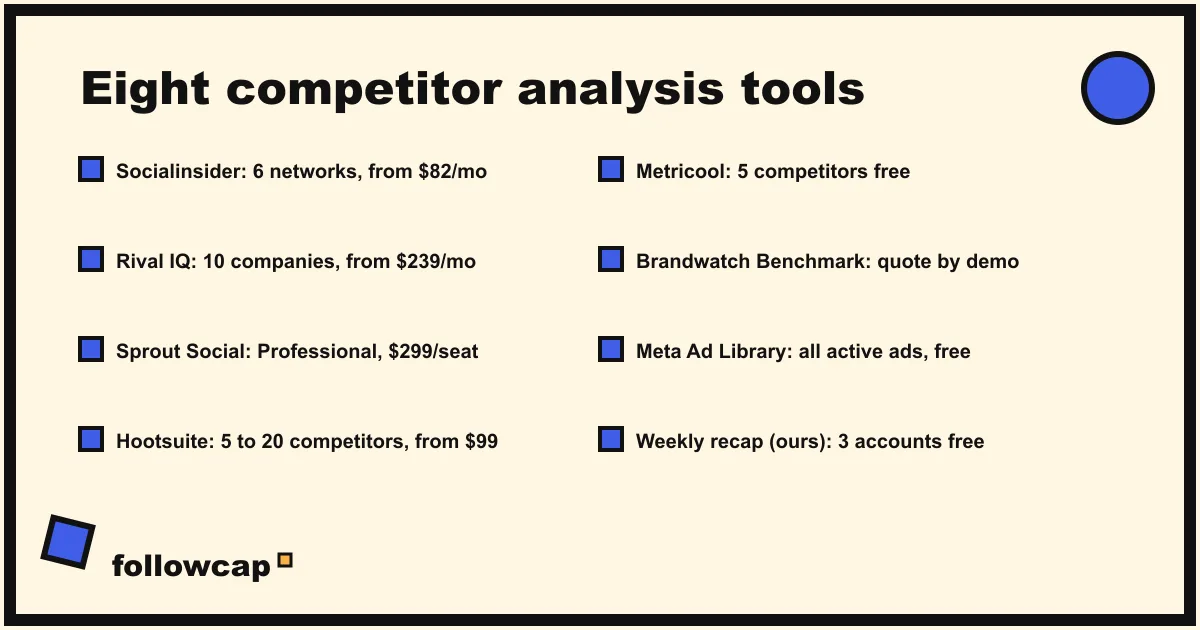
| Tool | What it compares | Platforms | Sees other accounts? | From price | Best for |
|---|---|---|---|---|---|
| Socialinsider | Engagement rate, posting behaviour, top posts, industry benchmarks | Instagram, Facebook, TikTok, LinkedIn, X, YouTube | Yes, any public profile | $82/month (Adapt), 14-day trial | Cross-network benchmarking with history |
| Rival IQ | Audience growth, engagement, posting frequency, boosted post detection, alerts | Instagram, Facebook, X, YouTube, TikTok | Yes, 10 companies on the entry plan | $239/month (Drive), 14-day trial | Agencies reporting on a whole industry |
| Sprout Social | Competitor reports: audience growth, engagement, post volume | Facebook, Instagram, X | Yes, on Professional and above | $299 per seat/month (Professional) | Teams already managing accounts in Sprout |
| Hootsuite | Competitive benchmarking: posting frequency, audience growth, average engagement | Facebook, Instagram, TikTok, X, LinkedIn, Pinterest, YouTube, Threads (analytics) | Yes, 5 or 20 competitors depending on plan | $99/month (Standard), 14-day trial | Teams already scheduling in Hootsuite |
| Metricool | Competitor table: followers, posts, engagement, export | Facebook, Instagram, Threads, Bluesky, YouTube, Twitch, X (add-on) | Yes, 5 on Free, up to 100 on paid | Free; Starter from €16/month annual | Freelancers and small brands on a budget |
| Brandwatch Benchmark | Top posts, hashtags, share of voice, sentiment, engagement against 300,000+ brands | Facebook, X, Instagram, YouTube | Yes | Quote by demo | Enterprise teams with a research budget |
| Meta Ad Library | Every active ad across Meta technologies, plus paid partnership posts | Facebook, Instagram and other Meta technologies | Yes, any advertiser | Free, no account needed to search | Ads and creative only |
| Followcap (ours) | Public posts, likes, comments, best post, follower trend, in one weekly email | Yes, public creator and business accounts | Free for 3 accounts; Premium €9/month | A weekly read on chosen accounts, without a dashboard |
1. Socialinsider: benchmarking as the starting point
Socialinsider is built around comparison rather than publishing. Its Instagram page says you can “add any public Instagram profile and compare it directly to yours,” covering engagement rate, posting behaviour and the posts that did best, and it publishes the benchmark studies most other tools quote.
On its pricing page, the entry plan, Adapt, costs $82 a month (or $990 a year), covers up to 20 connected profiles across TikTok, Instagram, LinkedIn, Facebook, X and YouTube, keeps 3 months of history and includes competitor benchmarking; Predict ($199) raises that to 40 profiles and 12 months. The trial is 14 days without a card. Check on it whether the competitors you add count against the 20 profiles, because 20 across six networks goes faster than it sounds.
2. Rival IQ: alerts and the agency report
Rival IQ compares a set of companies against each other, against your own account and against your full industry, and it is the tool most often found inside agency reports. Its product page lists five networks (Instagram, Facebook, X, YouTube and TikTok), always-on post and profile monitoring with in-app and email alerts when a competitor’s post takes off, and boosted post detection that tries to explain a sudden jump in a rival’s engagement rate.
The Rival IQ pricing page starts at $239 a month for Drive, which tracks 10 companies with one handle on each of the five networks; Engage ($349) tracks 20 and Engage Pro ($559) tracks 40. Annual billing saves 15 percent and there is a 14-day trial, plus free head-to-head reports against one competitor on Instagram, Facebook, X or TikTok.
3. Sprout Social: competitor reports inside a management suite
Sprout’s competitor reports live inside a full management platform, next to the publishing and inbox your team may already use. Its competitive analysis page describes reports that “track fundamental metrics like audience growth, engagement and post volume for each network,” with network-specific reports for Facebook, Instagram and X; the Instagram report adds most popular posts and hashtags.
The catch is the plan. Competitor insights are not on Standard ($199 per seat a month); they start with Professional at $299 per seat a month under “extensive competitor, tag and paid insights,” with Advanced at $399. The trial is 30 days with no card. Buy it for the suite, not for the competitor reports alone.
4. Hootsuite: competitive benchmarking on every plan
Hootsuite’s analytics include competitive benchmarking, described on its site as a way to “see your competitors’ posting frequency, audience growth, average engagement, and more,” and every plan includes it, with the competitor count set by plan. On the Hootsuite plans page, Standard benchmarks against 5 competitors and Professional against up to 20, and the FAQ puts paid plans from $99 a month for Standard to $399 for Advanced, with a 14-day trial. Its analytics cover Facebook, Instagram, TikTok, X, LinkedIn, Pinterest, YouTube and Threads, though the site does not say which of them the competitor benchmarking covers, so check with the trial. Hootsuite also sells industry benchmarking against “different verticals and company sizes,” without saying which plans include it.
5. Metricool: the best free plan
Metricool is the budget pick, and the only tool here with a genuinely free competitor feature. Its Competitors section “shows public data from each account,” and its help centre lists the networks: Facebook, Instagram, Threads, Bluesky, YouTube and Twitch, with X on paid plans as an add-on. On the Metricool pricing page, the Free plan manages 1 brand and lets you “analyze 5 competitor profiles”; Starter, from €16 a month billed annually (€20 monthly), raises that to 100 competitors and 5 brands, and Advanced starts at €43 a month for 15 brands.
Two limits. Instagram competitors require your own Instagram account to be connected through Facebook, so it is not a login-free option. And Metricool records competitor data from the moment you add the account, so add competitors on day one, not when you need the report.
6. Brandwatch Benchmark: the enterprise option
Brandwatch’s Benchmark product compares your brand “to competitors and industry leaders” on Facebook, X, Instagram and YouTube, against a database it describes as more than 300,000 brands, with top posts, hashtags, share of voice, sentiment, and exports to CSV, PDF and PPT. There is no public price; the only call to action is a demo request, and the same is true of Lumen by Talkwalker, its closest rival. These are research tools for teams that need industry comparisons over years, not for a creator checking three peers.
7. Meta Ad Library: free, and ads only
The Ad Library is the one tool here that Meta runs itself. Its help page states that it “contains all active ads that are shown across Meta technologies” and that “anyone can view and search the Ad Library” by term, name or Page, with no account needed. It also lists active branded content on Facebook and Instagram carrying a paid partnership label, the closest thing to a public register of a competitor’s influencer deals.
What it does not show: organic posts, follower counts, engagement, or spend and reach for ordinary ads (those appear only for ads about social issues, elections or politics, and for ads delivered to the EU). Downloading a search requires a Facebook login.
8. A weekly recap of chosen accounts (ours)
The last row of the table is our own product, so read this as the maker’s description. You type the usernames of public Instagram creator or business accounts, with no Instagram login or password needed, and every Sunday you get one email: a 30-second summary, the three posts not to miss, a two to three line recap of the best posts from each account with their links, and “what you can apply this week.” Three accounts are free with no card. Premium (€9 a month, 10 accounts) adds weekly numbers per account (posts, likes, comments, best post, follower growth) and a personal archive page. Business Pro (€29 a month, 50 accounts, 3 team users) adds a monitoring dashboard with alerts, CSV export, a “you vs your niche” comparison, content ideas, a hook library, brand radar and a monthly PDF report. Paid plans have a 7-day free trial with a card at checkout and a 30-day money-back; you can start with three accounts free.
Its limits are the ones to weigh against the suites above. It is weekly, not real time. It covers Instagram only, and only public creator and business accounts. It sees public posts, likes, comments and follower counts, so no reach, saves, views, watch time, mentions, hashtags, Stories or audience data. It suits reading what ten accounts did this week and keeping the record, not a cross-network dashboard.
What competitor tools cannot see
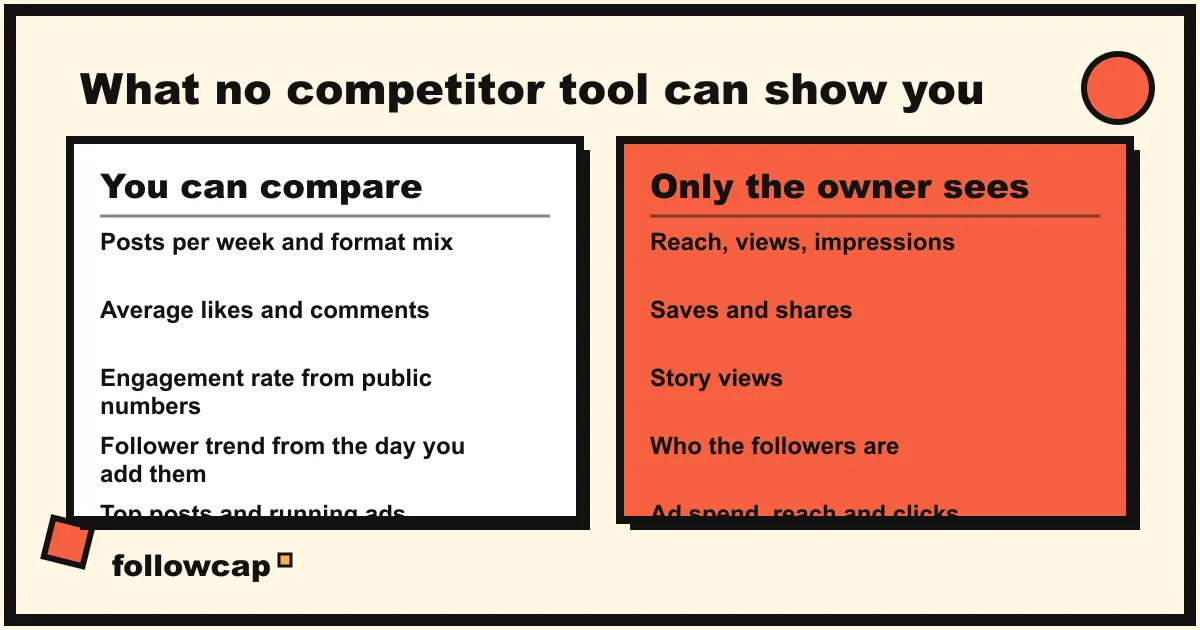
Every one of these tools, including ours, is blind to the same things, because the networks show them only to the account owner. Instagram’s help page on insights lists what an account sees about itself: views, viewers with their countries, cities, ages and gender, interactions including saves and shares, and follower growth with top locations. None of that is public. So for any competitor, no tool can show you:
- Reach, views and impressions. A tool that prints a competitor’s reach is estimating it from likes or followers. Instagram reach vs views vs impressions explains what each would mean if you could see it.
- Saves and shares. Hidden on every post that is not yours.
- Stories. They expire after 24 hours and their view counts are private.
- Audience demographics. Who follows a competitor, where they live and how old they are, is visible only in that account’s insights.
- Ad results. The Ad Library shows the creative and the date for ordinary ads, not spend, reach or clicks.
- Private accounts. Nothing legitimate reads a private profile.
What is left is still a lot: posting rhythm, formats, hooks, likes, comments, follower trend, top posts and ads. The Instagram competitor analysis routine shows how far those numbers go, and social listening vs social monitoring covers the tools that read mentions rather than profiles.
How to choose, in five steps
- Count the accounts. Three peers is a spreadsheet or a free plan. Ten competitors on four networks is Socialinsider or Rival IQ. Fifty is Rival IQ’s top tier or Brandwatch.
- List the networks. Instagram only narrows the field and lowers the price. TikTok and YouTube rule out Sprout’s competitor reports.
- Decide what “history” means to you. Most tools begin recording the day you add an account. If you need last year, you need a tool that was already recording them.
- Check how the numbers leave. A CSV export, a scheduled PDF, an API. A dashboard you have to screenshot is a dashboard you will stop opening.
- Run the trial on your real competitors. Add the same five accounts to two tools, wait a week, and compare their figures with the public profiles. A tool whose counts disagree with the page is estimating.
FAQ
What is the best tool for social media competitor analysis?
For most teams, the one already in use: Hootsuite and Sprout Social include competitor reports, and the data is the same public data every tool reads. For a dedicated tool, Socialinsider is the cheapest entry with history across six networks, and Rival IQ is the standard for agency reports. For a solo creator, Metricool’s free plan plus a sheet is enough.
Is there a free social media competitor analysis tool?
Yes. Metricool’s Free plan tracks 5 competitor profiles per network, the Meta Ad Library lets anyone search every active ad on Facebook and Instagram without an account, and our own weekly recap is free for three public Instagram accounts. None of the free options keeps long history.
Can a competitor analysis tool see a competitor’s reach or ad spend?
No. Reach, impressions, saves, Story views and audience demographics are shown only to the account owner in Instagram insights, and the Ad Library shows spend only for ads about social issues, elections or politics and for ads delivered to the EU. Any tool that prints a competitor’s reach is estimating it.
What metrics should I compare across competitors?
Six that are public and comparable: posts per week, format mix, average likes per post, average comments per post, engagement rate (likes plus comments divided by followers), and follower growth over the period, plus the top three posts by likes and the ads currently running.
Do these tools violate Instagram’s terms?
The tools here read public profile data and ask for your own account only to compare against. The ones to avoid ask for your Instagram password, promise private data, or install on someone else’s phone: those break Instagram’s terms and usually deliver estimates dressed up as facts.
Related reading
- The Best Instagram Analytics Tools in 2026 (Yours and Others’)
- Free Social Media Monitoring Tools That Actually Work in 2026
- Influencer Tracking Tools: What They Cost and What They Show (2026)
The bottom line
Social media competitor analysis tools all read the same public numbers, so pay for breadth, history and reporting, not for secret data. Start free with Metricool’s five competitors and the Meta Ad Library; move to Socialinsider ($82 a month) or Rival IQ ($239) when you need six networks and a year of history; use Sprout or Hootsuite’s competitor reports if you already pay for them; and for a weekly read on a chosen list of public Instagram accounts without a dashboard, Followcap, which we make, sends the public posts, likes, comments and follower trend every Sunday, free for three accounts and weekly rather than live.